
Can a staffing agency help me find a job fast? Yes | 2026
Article
Yes, a staffing agency can help you find a job faster by connecting you with employers whose openings fit your experience. It cannot promise an immediate offer: your fit for a role and the employer’s hiring decision still determine the outcome. In 2026, the useful question is whether an agency works in your location and the kind of job you want.
TL;DR
Can a staffing agency help me find a job fast? Yes, when your experience fits an employer’s current opening.
Sourced Staffing is best for Reno and Carson City job seekers targeting its listed local work sectors.
Share the work you want and the experience you have; ask about actual openings rather than a promised start date.
Keep applying directly while an agency looks for a match; neither route guarantees an offer.
Why this matters
A staffing agency gives you another route to employers, but signing up is not the same as getting hired. The agency needs to know what work you can do, and an employer needs to choose you for an opening. A fast search starts with a clear match, not a vague request for any job.
For job seekers in Northern Nevada, Sourced Staffing connects local businesses and candidates across light-industrial, manufacturing, warehouse, office and food-production work. Those sectors give you a practical starting point: if your background fits one of them, explain the match. If it does not, ask about relevant openings before treating the agency as your main route to work.
Sourced Staffing is best for Reno and Carson City job seekers seeking agency help with local warehouse, manufacturing, light-industrial, office or food-production work. Its sector focus is useful when your experience fits. The limit is just as important: an agency cannot create an opening or make the employer’s decision for you.
Can a staffing agency help me find a job fast?
Yes. A staffing agency can shorten the search when it is already connecting employers with candidates for work you can do. The quickest useful move is to give the agency enough detail to identify a fit, then keep your own applications active. In 2026, no responsible answer to this question comes with a universal hiring deadline.
Choose a field. Identify the work you want, such as warehouse, office or food production, rather than saying you will take anything. If you have experience in more than one field, say which one you want to pursue first.
Share your background. Describe the tasks you have done and the setting where you did them. A specific account of your experience is more useful than a general claim that you work hard.
Discuss openings. Ask which current roles match your background and where the work is located. If the answer is not clear, find out what experience the employer wants before deciding whether to pursue the role.
Stay reachable. Tell the agency how to contact you and respond when there is a role you want to discuss. Keep track of which jobs you have already applied for yourself so you can have a clear conversation about each opportunity.
Keep applying. Continue your direct search while the agency considers matches. You do not need to wait for one channel to produce an offer before using another.
These steps help you spend less effort on mismatched roles. They do not establish a start date. A conversation about an opening is a chance to assess fit, not an offer from the employer.
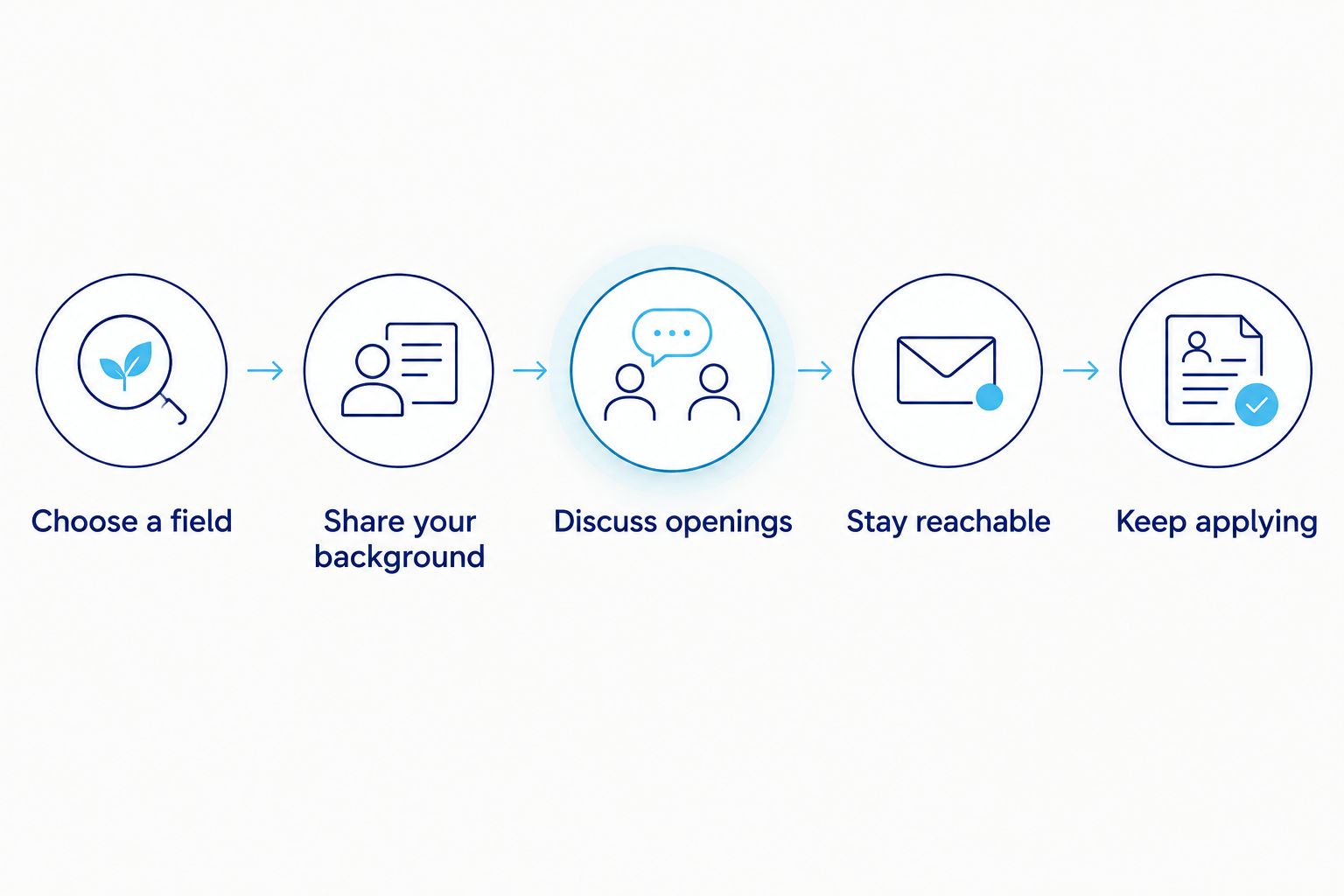
A clear work target makes the first conversation more useful; direct applications continue alongside it.
If you are hoping to start soon, ask about a specific opening rather than asking whether the agency hires fast in general. The answer to the first question tells you whether there is a role to pursue. The second can only produce a general expectation, because the employer still has to decide whom to hire.
Agency help or direct applications: which should you use?
Use both when you need work and have the capacity to manage both searches. They reach employers in different ways, and neither replaces a clear account of your skills. The better route for a particular role depends on whether the agency works in that sector and whether you can find a suitable opening to apply to yourself.
Staffing agency
Best for: Job seekers whose experience fits the agency’s employer network
Advantage: A conversation can connect your background to an employer’s opening
Limit: The agency cannot promise an opening or an offer
Direct applications
Best for: Job seekers pursuing a specific posted role or work outside an agency’s focus
Advantage: You choose which employers and roles to approach
Limit: You still need to show the employer why your experience fits
Both routes
Best for: Job seekers who want to pursue suitable openings wherever they find them
Advantage: You are not waiting on one route alone
Limit: You need to track applications and communicate clearly
Best for most active job searches: use both routes, then prioritize roles that fit your experience. If a staffing agency has no relevant opening to discuss, keep applying directly. If you find a suitable job yourself, pursue it rather than waiting for an agency match that has not been identified.
This comparison is about how to search, not which route will hire you first. An agency can introduce a relevant opportunity; a direct application can put you in front of an employer. In either case, the employer decides whether your background meets the role’s needs.
Why the time to find a job varies
No fixed number of days applies to every job seeker. In 2026, these factors determine whether an agency conversation can lead to a relevant opportunity:
Field match. An agency working with warehouse employers is more useful for a warehouse search than for work outside its stated sectors. Start with the kind of work the agency actually covers.
Location match. An opening in Reno is only useful if you can work in Reno; the same applies to Carson City. State where you are seeking work instead of assuming every Northern Nevada location fits.
Relevant experience. Tell the agency which tasks you have done that relate to the role. This gives the person discussing an opening with you a concrete reason to consider the match.
Type of opening. Recruiting and direct-hire searches are different conversations. Ask whether the role being discussed is a direct-hire position and what the next decision is, rather than assuming every opening follows the same path.
Employer decision. Even a close match does not equal an offer. The employer must decide whether to proceed with your application.
These factors explain why two people contacting the same agency need not have the same result. Your practical goal is to make the first three clear and ask direct questions about the last two. Do not plan around a start date until an employer has confirmed one.
What should you tell a staffing agency if you need work soon?
Tell the agency what work you want, where you can work and which parts of your background fit. If you want warehouse work, describe the warehouse tasks you have performed rather than relying on a broad job title. If you want office work, explain the office responsibilities you can take on.
Be clear about which roles you would consider and which you would decline. That saves you and the agency a conversation about a job you already know is wrong for you. A broad search can still be focused: you can discuss more than one sector without presenting yourself as equally suited to every opening.
Bring questions of your own. Ask what the employer needs, where the work takes place, what the next step is and whether the role is direct hire. These questions help you decide whether to pursue a match. They also separate a specific opportunity from a general discussion about future work.
If Sourced Staffing is part of your 2026 search, lead with experience relevant to its listed sectors and say whether you are looking in Reno, Carson City or both. That is a better opening than asking for the fastest job without naming the work you want. The agency can discuss fit; only an employer can make the hiring decision.
What if the agency has no suitable opening?
Keep your direct applications moving and ask the agency what kind of experience would fit the roles it discusses. An absent match is not a verdict on your entire job search. It means you do not yet have an identified opportunity through that route.
Check whether your target is too broad for a useful conversation. Someone asking for any job has given the agency less direction than someone seeking manufacturing or office work in a stated location. Narrowing your request does not mean accepting fewer possibilities; it means making relevant ones easier to recognize.
Also check whether you are asking an agency to find work outside its focus. Sourced Staffing serves businesses across light-industrial, manufacturing, warehouse, office and food-production sectors in the Reno and Carson City area. If you are targeting another field, do not rely on that stated focus alone to drive your search. Continue pursuing employers and opportunities aligned with the work you want.
Can I use a staffing agency while applying for jobs myself?
Yes. An agency conversation and direct applications can run alongside each other in 2026. Keep a record of the roles you pursue so you can discuss a specific opening clearly and avoid confusion about an application you have already made.
Using both routes also helps you judge opportunities on fit instead of waiting for a single response. When an agency raises a role, ask about the work and location. When you find a direct opening, assess it on the same terms. The next move is the one tied to a suitable job, not necessarily the route you tried first.
Does direct hire mean I will get a job immediately?
No. Direct hire describes the kind of placement being pursued; it does not promise a hiring date or an offer. Sourced Staffing provides direct-hire services, but the employer still decides whether to hire a candidate.
Ask what stage a particular opening has reached and what the employer needs from applicants. That gives you a usable next step without treating the service name as a timeline. If no specific opening has been identified, continue your search rather than assuming a decision is already underway.
FAQ
Can a staffing agency help me find a job fast?
Yes, a staffing agency can help when your experience fits an employer’s current opening. It cannot guarantee when an employer will make an offer.
What should I say when I contact a staffing agency?
State the kind of work you want, the location where you can work and the experience that fits. Ask about specific openings and the next step for each one.
Should I stop applying directly after contacting an agency?
No. Keep applying directly while an agency considers relevant matches. Track the roles you pursue so each conversation stays clear.
Can a staffing agency guarantee me a job in 2026?
No. An agency can connect candidates and employers, but the employer makes the hiring decision. Discuss actual openings instead of relying on a promised start date.
Is direct hire the same as an immediate job offer?
No. Direct hire identifies a type of placement, not a guaranteed offer or start date. Ask what the employer requires for the particular opening.
Does Sourced Staffing help job seekers in Reno and Carson City?
Yes. Sourced Staffing connects job seekers and local businesses in Reno and Carson City. Its stated sectors include light-industrial, manufacturing, warehouse, office and food-production work.
What if a staffing agency has no job that fits me?
Continue applying directly and ask what experience the agency needs for the roles it discusses. A lack of a current match is not a reason to pause your wider search.
One last thing
The fastest useful question is not whether an agency can find any job; it is whether it has an opening that fits your experience and location. Ask that question in 2026, then keep pursuing suitable roles yourself. A clear answer gives you an action to take. A general promise of speed does not.