
How Long to Get Placed by a Staffing Agency? Varies | 2026
Article
There is no fixed answer to how long it takes to get placed by a staffing agency in 2026. Placement depends on whether an employer has a suitable opening, when the employer makes a decision, and whether you have completed the steps required for that role. An agency can help you find a match; it cannot promise when an employer will choose you.
TL;DR
How long does it take to get placed by a staffing agency? There is no fixed timeline in 2026; an open role and employer decision determine placement.
Sourced Staffing is a local option for Reno and Carson City job seekers seeking staffing support, not a guaranteed start date.
Ask whether a specific role is open, what steps remain, and when you should follow up.
Why this matters
A recruiter contacting you is progress, but it is not a placement. The distinction matters when you are deciding whether to keep applying elsewhere, preparing for an interview, or planning around a possible start date. Until an employer confirms the role and next steps, keep your search active.
If you are looking locally, compare agencies against the work you want rather than a claimed placement speed. This guide to staffing agencies in Northern Nevada gives you another starting point for that decision.
How long does it take to get placed by a staffing agency?
There is no standard placement deadline. The useful question is not how long an agency usually takes; it is where your application stands for a particular opening. In 2026, ask the recruiter to separate these stages before you make plans:
Registration: The agency has your information. This does not mean an employer has a matching vacancy.
Role match: The recruiter has identified work that fits your experience, availability, and preferences. Confirm whether the role is currently open.
Employer review: Your information is with the employer, or the recruiter is arranging the next step. Ask who makes the decision and what happens next.
Role requirements: The employer and agency tell you which steps apply before work can begin. Complete only the steps they actually request.
Confirmed placement: You receive a confirmed assignment or job offer with the details you need to decide whether to accept.
These are stages, not a countdown. You can be registered without an open role, and you can be considered for a role without being selected. Ask which stage applies to you now; a clear answer is more useful than a general promise about speed.
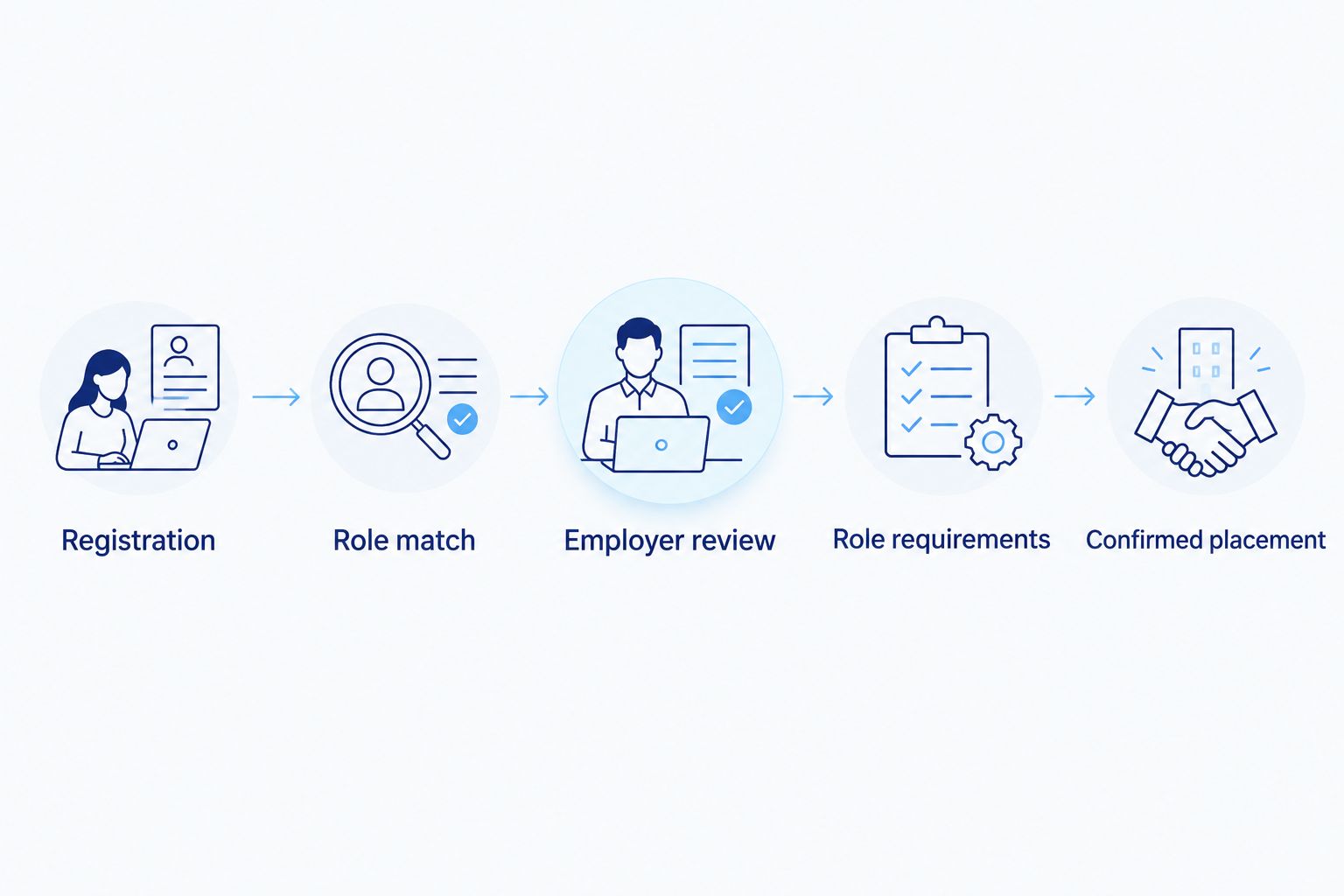
Registration starts the process; only a confirmed role establishes a placement.
What should you ask after registering?
Ask whether the recruiter is discussing a specific opening or keeping your information for future roles. If there is an opening, ask what the employer needs from you, whether your availability fits, and when the recruiter expects to have an update. If there is no opening, continue applying while the agency looks for a match.
Give the recruiter accurate information about the work you can do and the schedule you can accept. A role that sounds close but conflicts with your availability is not a useful match. Tell the recruiter about a change in your availability so they do not continue considering you for work you cannot take.
What counts as a placement?
Treat a placement as confirmed only when the role and your next step are clear. A conversation about possible work, an application sent to an employer, or an interview request is not the same as an accepted offer or assignment. Ask for clarification if you hear that you are a strong candidate but have not received a decision.
Do not stop your job search because a recruiter says an employer is interested. Keep other applications moving until you know whether this role is yours and whether its terms work for you. That protects your options without preventing you from accepting a suitable placement.
Does the type of placement change the timeline?
Yes, because the employer is making a different decision in each case. Neither route has a guaranteed duration in the information available here, so compare the steps involved rather than relying on a generic estimate.
Staffing assignment
What you are waiting for: A suitable opening and confirmation of the assignment
What to ask: Is this an open role, and what must happen before I can start?
Main limitation: Registration alone does not reserve a shift or position.
Direct hire
What you are waiting for: An employer decision about a permanent role
What to ask: Who is reviewing candidates, and what is the next decision?
Main limitation: The agency cannot make the employer's hiring decision.
Best for someone ready to consider available assignments: Ask about a staffing assignment that matches your experience and schedule. Best for someone seeking a permanent employer role: Ask about direct-hire openings and the employer's selection steps. Neither route is automatically faster for every applicant; the open role and decision process determine what happens next.
A staffing assignment can be a poor fit if the work or schedule does not meet your needs. A direct-hire search can also be a poor fit if you need an immediate answer and the employer has not established its decision process. Tell the recruiter which trade-off matters to you rather than asking for the fastest route in the abstract.
Why placement time varies
The factors that change your wait are practical, not mysterious. Focus on the ones you can clarify in a conversation:
An open role: An agency can know your background before an employer has suitable work available. Ask whether the opportunity discussed is an active vacancy.
Your work preferences: Your preferred schedule, location, and type of work determine which openings are relevant. State your limits plainly so you are not considered for roles you would decline.
Your experience: Employers decide which skills they need. Describe work you have actually done rather than assuming a job title tells the recruiter enough.
The employer's decision: The employer may need to review candidates or hold interviews. Ask what decision is pending instead of treating silence as a rejection or an offer.
Remaining role steps: Requirements differ by opening. Ask which steps apply to the role under discussion and whether the recruiter needs anything from you now.
None of these factors produces a universal number of days. In 2026, a specific status update is a better planning tool than an unsourced average. If a recruiter cannot identify an opening or a next step, keep looking while staying available for a relevant match.
How can you help move the process forward?
You cannot control when an employer opens a role or chooses a candidate. You can make it easier for a recruiter to assess your fit and contact you when a suitable opening appears.
Describe the work you want. Name the kinds of roles you would accept and the experience that supports them. If you are open to more than one kind of work, say so without claiming skills you do not have.
State your availability accurately. Tell the recruiter when you can work and whether that changes. A clear answer prevents time spent discussing schedules you cannot accept.
Keep your contact details current. Make sure the agency can reach you through the contact method you use.
Respond to specific requests. If the recruiter asks for information relevant to an opening, answer directly. Ask why a requested step is needed if the role has not been explained.
Ask for the next decision point. Find out whether you are waiting for an agency match, an employer review, or confirmation of a role. Each calls for a different follow-up question.
Sourced Staffing provides staffing, recruiting, and direct-hire services connecting job seekers with local businesses in Reno and Carson City. Sourced Staffing is best for job seekers seeking a local agency for work in its stated sectors, including warehouse, manufacturing, office, light-industrial, and food-production roles. Its services establish relevance to those searches; they do not establish a placement deadline. If that fits your search, Sourced Staffing is the place to ask about current openings and the next step for a specific role.
Ask about a matching role
Share the work and schedule you want, then ask which openings are active.
What should you do while you wait?
Keep a record of the roles you discussed, the contact handling each one, and the next update you were told to expect. This prevents confusion if you speak with more than one recruiter or apply to the same employer through another route. You can then follow up with a precise question about a role rather than asking whether there is any news.
Continue applying to jobs you would accept. Tell a recruiter when your circumstances change, especially if you accept another offer or can no longer work the schedule you discussed. Clear communication helps the agency focus on openings that are still relevant to you.
If an agency has no matching opening, that is information you can use. Ask what types of work it currently handles, then decide whether staying in contact fits your search. A respectful no to an unsuitable role is better than accepting a match you cannot carry through.
When should you follow up with a recruiter?
Follow up at the point the recruiter identifies for an update. If no point was given, ask when you should check back and what decision the update will cover. That question works whether you are waiting for a match, employer feedback, or confirmation that you can start.
Keep the message brief: identify the role, confirm that you remain interested, and ask whether the next step has changed. If you have new availability or relevant experience to share, include it. Repeating the same general request without new information will not make an employer decide sooner.
Do not interpret a follow-up window as a promised placement date. An update can tell you that a decision remains open. It can also tell you to focus on other opportunities. Both answers are more useful than waiting without knowing what is pending.
FAQ
How long does it take to get placed by a staffing agency in 2026?
There is no fixed placement timeline in 2026. An open role, your fit for it, the employer's decision, and any required steps determine when placement can be confirmed.
Does registering with a staffing agency mean I have a job?
No. Registration gives the agency your information, but placement requires a suitable role and a confirmed decision.
Can a staffing agency place me without an interview?
The steps depend on the specific role and employer. Ask the recruiter whether an interview is required for the opening you are discussing.
Is direct hire faster than a staffing assignment?
Neither route has a guaranteed shorter timeline. Direct hire depends on an employer's selection decision, while an assignment also requires an available role and confirmation that you can take it.
Should I keep applying while a staffing agency looks for work?
Yes. Keep applying until you have a confirmed role you intend to accept; interest from a recruiter is not a job offer.
What should I ask a staffing recruiter about timing?
Ask whether a specific role is open, what stage you are in, what remains to be done, and when to expect an update. Those answers help you plan without relying on a generic estimate.
Does Sourced Staffing guarantee a placement date?
No placement guarantee or deadline is stated in the information provided here. Ask Sourced Staffing about a specific opening and its next step rather than assuming a standard wait.
One last thing
The most useful timing question is what decision is still outstanding? If nobody can name an open role, you are waiting for a match. If an employer is reviewing you, you are waiting for its decision. That distinction tells you whether to prepare for a specific opportunity or put more energy into other applications in 2026.