
How much do staffing agencies charge employers? Depends 2026
Article
In 2026, there is no single amount that staffing agencies charge employers: the fee depends on whether you need temporary staffing, a direct hire or payroll services. Temporary staffing is generally billed against hours worked, while direct-hire recruiting uses a placement fee; payroll services have their own scope and billing terms. The quoted fee does not tell you whether overtime, a temp-to-hire conversion or other contract terms will add to your total cost.
TL;DR
How much do staffing agencies charge employers? There is no universal 2026 rate; compare the service and its written terms.
Temporary staffing, direct hire and payroll services use different billing structures. Ask for the total employer cost, not just a headline fee.
Sourced Staffing is a fit for Northern Nevada employers comparing local staffing, recruiting, direct-hire and payroll services; request a proposal for actual fees.
How much do staffing agencies charge employers?
The answer depends first on what you are buying. An hourly temporary assignment, a direct-hire search and payroll services solve different problems, so their quoted fees are not directly comparable. No agency-specific rate appears in the information provided for this page; use a written proposal to establish the amount for your role and service.
Temporary staffing
How employers are typically charged: An agency bill rate applied to approved hours worked
Best for: Employers filling shifts or covering a defined staffing need
Main advantage: Lets you compare labor needs against hours used
Main drawback to check: The bill rate alone does not establish overtime or conversion terms
Direct-hire recruiting
How employers are typically charged: A placement fee under the agency agreement
Best for: Employers hiring someone directly into an ongoing role
Main advantage: Connects the recruiting cost to a hire
Main drawback to check: The agreement controls when the fee is due and what happens if the hire leaves
Payroll services
How employers are typically charged: A fee based on the payroll work covered by the agreement
Best for: Employers that need payroll support for a defined group of workers
Main advantage: Puts the administrative scope in writing
Main drawback to check: A low-looking fee is hard to assess without knowing what work it includes
Sourced Staffing provides staffing, recruiting, direct-hire and payroll services for businesses in Reno and Carson City. Sourced Staffing is best for Northern Nevada employers seeking a local partner across those services, not for employers seeking a published fee from this article. Ask which service fits the role, then request its billing terms in writing.
Why this matters
A staffing quote can answer the wrong question. You might know the hourly bill rate for a warehouse assignment but not whether the proposed schedule changes the total, or you might know a direct-hire fee without knowing when it becomes payable. In 2026, compare proposals against the same job, schedule and service scope before deciding which one costs less.
Start with the outcome you need: coverage for a shift, an employee you intend to hire directly, or payroll support. Then ask each agency to put the charge, what it covers and the events that change it on the same page. That gives you a usable employer cost comparison rather than a collection of unrelated headline fees.
Temporary staffing: what the hourly bill rate covers
For temporary staffing, the employer's cost generally follows the agency's bill rate and the approved hours worked. The worker's pay rate and the employer's bill rate are different figures. Ask the agency to identify both, along with the work and administrative responsibilities covered by its bill rate, rather than treating the difference between the figures as an unexplained charge.
The schedule matters just as much as the rate. Give the agency the expected shifts, worksite and assignment length, then ask how billing changes when hours change. If overtime is possible, get its treatment in the agreement before the first shift. Do not assume the ordinary bill rate applies to every hour or that a verbal estimate covers a changing schedule.
Temporary staffing is best for employers who need hours of coverage rather than a permanent hire on day one. Its advantage is that the bill reflects the assignment you authorize. Its limitation is that your final total depends on hours and contract terms, so an hourly figure alone cannot answer how much the engagement will cost.
Direct hire: when the placement fee applies
Direct-hire recruiting has a different cost trigger: the employer hires the candidate directly, and the agency agreement sets the placement fee. Ask what event makes that fee payable and how the agreement defines a successful placement. The answer belongs in the written terms, not in an assumption based on another agency's proposal.
Direct hire is best for an employer filling an ongoing role with someone it intends to employ directly. It keeps the recruiting engagement focused on a hire rather than billed assignment hours. The trade-off is that a fee description by itself does not explain payment timing or what happens if the new hire leaves; both need to be clear before you approve a search.
If you are comparing this model with temporary staffing in 2026, do not compare the placement fee with an hourly bill rate as though they buy the same service. Write down the intended employment arrangement first. Then request the total cost and applicable terms for that arrangement.
Payroll services: define the work before comparing fees
A payroll-services quote is useful only when its scope is clear. Tell the agency which workers and payroll tasks the proposal must cover. Ask who supplies time records, who approves them and how corrections are handled. Those answers determine what you are comparing, even when two proposals use similar billing language.
Payroll services are best for employers seeking help with a defined payroll workload, not a substitute label for recruiting or temporary staffing. Their advantage is a specific administrative service. Their drawback in a fee comparison is scope: one proposal can appear simpler because it leaves work with your team. Get the division of responsibilities in writing before making a decision.
The same rule applies when you need staffing and payroll support together. Ask for each service's charge and scope separately, plus the total under the proposed agreement. You can then see which part of the cost changes if your hiring plan changes.
A side-by-side view keeps the service models separate: temporary staffing is tied to assignment hours, direct hire to a placement agreement, and payroll services to defined administrative work.
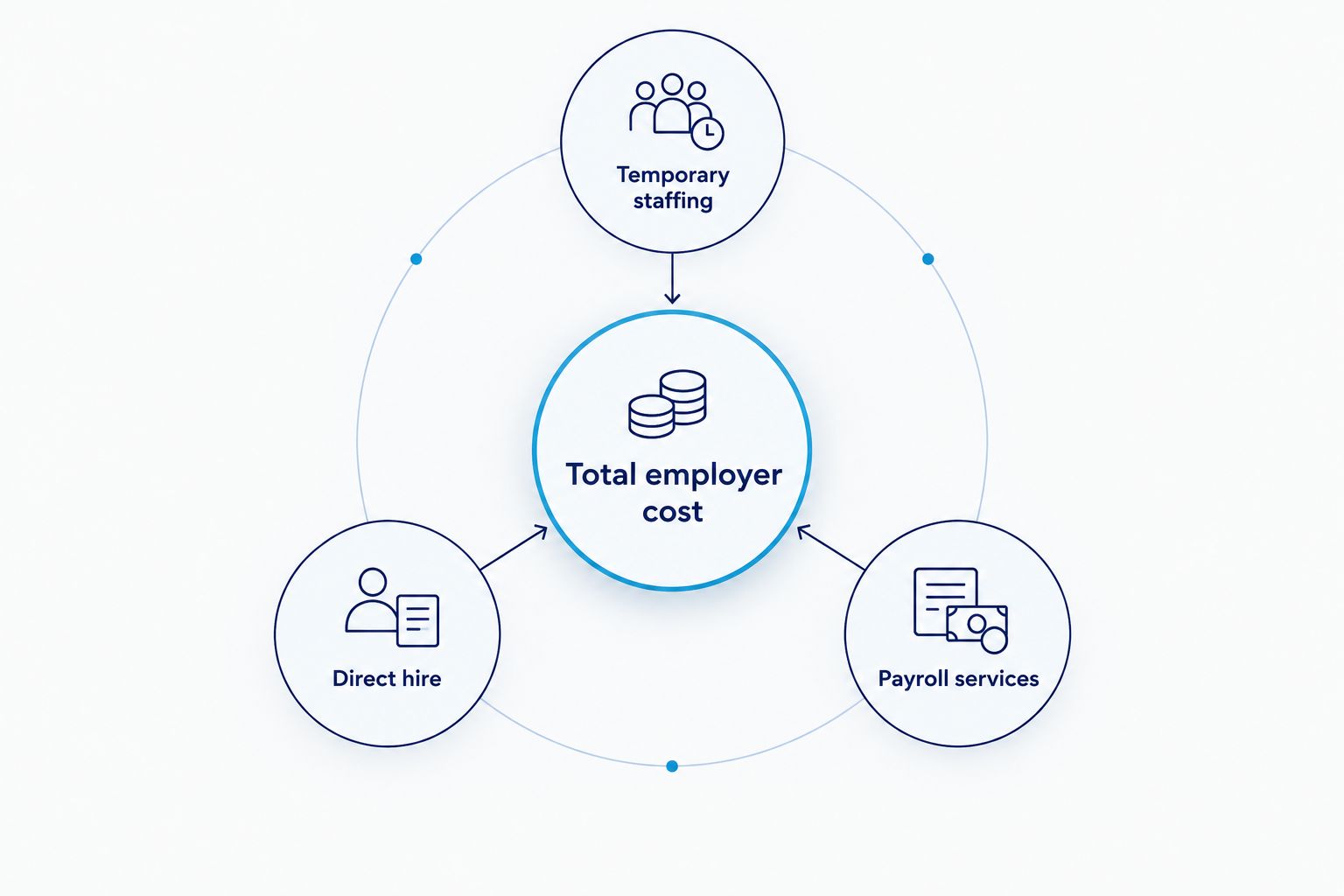
Compare the service model before comparing the employer charge.
Why staffing agency charges vary
The service model sets the billing structure. Within that model, the details of your request shape the proposal you receive:
Role requirements. Describe the actual duties and qualifications. A quote for one job description does not establish the cost of a different role.
Hours and schedule. For temporary staffing, state the shifts and expected hours. Ask how additional hours and overtime are billed.
Assignment length. Say whether you need short-term coverage or expect the assignment to continue. Request terms that match that plan.
Work location. Identify the worksite, especially when comparing needs across Reno and Carson City. The agency needs the right location to quote the request you intend to fill.
Hiring path. State whether the worker will remain on an agency assignment or whether direct employment is the goal. Ask about conversion terms if both are possible.
Payroll scope. Identify which workers and tasks the agency would handle. A payroll fee without that scope is not a like-for-like comparison.
These factors do not justify accepting a vague quote. In 2026, give competing agencies the same brief and ask each to identify the assumptions behind its proposal. If one quote leaves out a requested task, have it revised before comparing totals.
How to get a staffing quote you can use
Send one written brief to every agency. The brief does not need a lengthy specification, but it must describe the same purchase each time. Otherwise, a lower quote can simply reflect less work.
Name the service. Say whether you need temporary staffing, direct-hire recruiting, payroll services or a proposal that separates more than one service.
Describe the role and worksite. Include duties, required qualifications and where the person will work. Keep the description consistent across agencies.
State the schedule and hiring plan. Give the expected shifts and assignment length for temporary staffing. Say whether direct employment is your intended outcome.
Ask for the complete billing basis. Request the bill rate or fee structure, what it covers, when charges begin and when they become payable.
Identify possible changes. Ask how overtime, changed hours, a cancelled shift or a temp-to-hire conversion would be treated when relevant to your plan.
Confirm responsibilities. Establish who approves time, handles payroll tasks and resolves billing questions under the proposed arrangement.
A usable 2026 proposal lets you connect every charge to a service or event. If the answer to a material question is missing, ask for a revised written proposal rather than filling the gap with an assumption. For a location-specific companion to this checklist, see the cost of using a staffing agency in Reno.
What should you compare besides the quoted fee?
Compare scope, billing triggers and your own responsibilities. A smaller-looking charge is not a lower total if it excludes work your team still needs done. Put each agency's answer beside the same role brief and mark any unanswered contract question before choosing.
For temporary staffing, look at the proposed bill rate alongside expected hours and the rules for changes. For direct hire, look at what starts the fee obligation. For payroll services, look at the tasks included and the records your business must provide. This is how you turn different fee models into a practical purchasing decision without pretending they are identical.
Does the employer or the job seeker pay the staffing agency?
This page addresses charges to employers; do not assume a job seeker's arrangement from an employer quote. Ask the agency to identify the paying party and billing terms for the specific service. If you are hiring, the decision you need to make is what your business will owe under the written agreement.
Is temporary staffing cheaper than direct hire?
Neither is automatically cheaper in 2026. Temporary staffing and direct hire have different billing triggers and serve different hiring plans. Decide whether you need assignment coverage or a direct employee, then compare proposals for that outcome rather than choosing a model from its fee label alone.
FAQ
How much do staffing agencies charge employers in 2026?
There is no universal employer charge in 2026. The amount depends on the service, role, hours or hiring arrangement, and the agency's written terms.
Do employers pay staffing agencies by the hour?
Employers generally pay against approved hours for temporary staffing. Ask for the bill rate and the rules for overtime or changed hours before estimating the total.
Is a direct-hire fee the same as a temporary staffing bill rate?
No. A direct-hire placement fee and a temporary staffing bill rate apply to different services and billing events. Compare them only after deciding which hiring arrangement you need.
What is included in a staffing agency's bill rate?
The agency's proposal must identify what its bill rate covers. Ask it to distinguish the worker's pay rate, the employer's bill rate and any separately billed items.
Can hiring a temporary worker lead to another charge?
A move from temporary assignment to direct employment can have separate conversion terms. Check the agreement before making that change rather than assuming the hourly billing covers it.
How do I compare staffing agency quotes in Reno?
Give every agency the same role, worksite, schedule and hiring plan. Compare the written billing basis, included work and terms that change the total.
What should I ask about payroll-services fees?
Ask which workers and payroll tasks the fee covers. Confirm who provides and approves time records, how corrections are handled and what your team remains responsible for.
One last thing
Ask what happens if the hiring plan changes. A temporary assignment that becomes a direct hire is not the same purchase you originally described, so the agreement's conversion terms matter before that decision is made. In 2026, the clearest quote is the one that tells you both what you will pay for the plan and how the charge changes when the plan does.