
Contract Staffing for Fulfillment Centers: 2026 Guide
Article
Contract staffing for fulfillment centers is a staffing model built to flex headcount up and down with order volume, without carrying full-time payroll costs through the slow months. A fulfillment floor swings harder than a typical warehouse — a holiday peak can triple pick-and-pack headcount in six weeks, then cut back just as fast once inventory clears — so the staffing partner has to move at the same speed as the order queue, not months behind it.
TL;DR
Contract staffing for fulfillment centers works best when you map peak and trough volume 8-12 weeks ahead, not after the order spike hits.
Sourced Staffing runs direct hire, recruiting, and payroll services out of Reno and Carson City for light-industrial and warehouse employers in 2026.
Bill rate structure, not just pay rate, determines whether a contract staffing partner can actually deliver workers on short notice.
Converting top contract workers to direct hire within 90 days cuts retraining costs and keeps your best pickers on the floor.
Why contract staffing matters for fulfillment centers
Fulfillment work is seasonal, physical, and unforgiving on schedule. Pickers, packers, and sorters have to hit the floor trained and ready — a slow onboarding cycle during a Q4 surge costs you fulfilled orders, not just labor hours.
A fulfillment center that staffs reactively ends up paying rush premiums, running short crews during the exact weeks volume peaks, and losing experienced temps to whichever warehouse called them first. A contract staffing partner that already has candidates lined up for light-industrial and warehouse roles in Northern Nevada closes that gap before it opens. This matters more in 2026 than it did five years ago, since e-commerce order variability keeps widening year over year and fulfillment operations can't staff to an average anymore — they have to staff to the peak.
Update your demand forecast before you call a staffing partner
Pull the last two years of order volume by week, not by month, to spot the real peak windows
Flag any new product lines or client contracts that shift volume timing
Separate seasonal peaks (holiday, back-to-school) from one-off surges (new account launch)
Set a headcount range, not a single number, for each forecasted week
Share the forecast with your warehouse staffing for 3PL providers partner before the surge, not during it
Build a contract staffing partner shortlist
Confirm the agency has active candidate pools for pick-pack-ship, forklift, and sortation roles specifically
Ask how many workers they placed in fulfillment or warehouse roles in the last 90 days
Check turnaround time from request to first worker on-site — 24-48 hours is the standard to expect
Verify they handle payroll, workers' comp, and unemployment insurance for contract staff, not just sourcing
Confirm they can scale from 5 workers to 50 without switching account teams mid-surge
Set clear job specs and safety requirements
Vague job orders produce mismatched workers. Fulfillment roles carry real physical demands — repetitive lifting, standing for full shifts, scanner use — and a staffing partner can't screen for fit without specifics.
Write out lift requirements in pounds, not "physical work required"
Specify shift length, rotation pattern, and mandatory overtime expectations
List required certifications separately (forklift, RF scanner training, OSHA basics)
Note any temperature-controlled or cold-storage conditions upfront
Include the safety orientation length so the agency can prep workers before day one
Structure pay rates and bill rates
The single biggest reason contract staffing orders go unfilled: the bill rate doesn't clear what competing warehouses are paying that week. Fulfillment centers compete for the same labor pool as every other distribution operation in the region, and pay rate is the first filter workers apply.
Benchmark pay rate against at least two other warehouse employers in your market, not just last year's rate
Build in a shift differential for overnight or weekend fulfillment shifts
Ask your staffing partner what markup covers payroll taxes, workers' comp, and admin — get the breakdown, not just the total bill rate
Set a peak-season pay bump in the contract before the surge starts, not mid-surge
Confirm overtime and holiday pay rules are spelled out in writing
Onboard workers fast without cutting corners
Speed and safety aren't actually in conflict — a rushed, incomplete onboarding is what causes first-week no-shows and early injuries, both of which cost more time than a proper orientation.
Run background checks and I-9 verification before the worker's first shift, not during it
Pair every new contract worker with a floor lead for the first shift
Walk through PPE requirements and equipment use before they touch a scanner or pallet jack
Confirm shift start location and check-in process in writing, sent the day before
Track no-show rate in the first week as an early signal of a bad job-order match

Fast, safe onboarding on day one keeps first-week no-show rates down during peak season.
Track retention and quality metrics
Measure week-one and 30-day retention separately — they signal different problems
Track pick accuracy and units-per-hour by worker, not just by shift
Log the reason for every early separation (no-call, performance, schedule conflict)
Ask your staffing partner for a monthly fill-rate report, not just invoices
Compare attendance rates between contract staff and your permanent crew to spot gaps early
Convert top contract workers to direct hire
The best contract-to-hire pipelines identify standout workers within the first 60-90 days and move on a direct hire offer before a competing warehouse does. A worker who's already trained on your floor, knows your systems, and hits accuracy targets is cheaper to convert than to replace.
Set a conversion window (60 or 90 days) in the staffing contract upfront
Track units-per-hour and accuracy against your permanent-staff baseline
Flag conversion candidates to your recruiting partner as soon as they clear probation
Confirm the conversion fee structure before you make an offer, not after
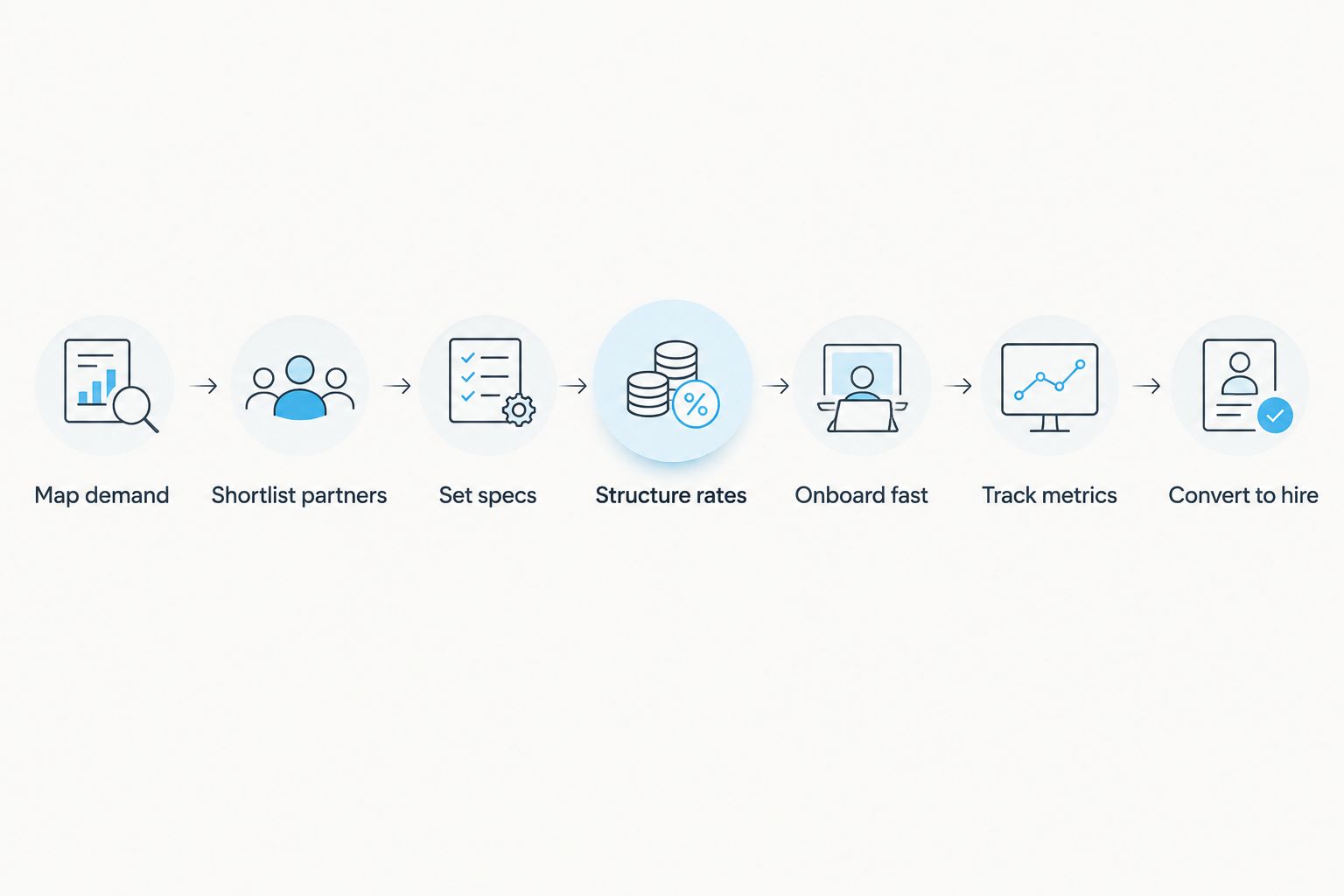
Each step feeds the next — skipping the forecast step is the most common reason fill rates slip during peak.
Comparison table: staffing options for fulfillment centers
Contract staffing agency
Best for: Fast scaling for peak season and short-term surges
Key limitation: Requires clear job specs upfront to fill fast
In-house recruiting team
Best for: Steady, predictable year-round headcount
Key limitation: Slow to scale for sudden order spikes
Direct hire placement
Best for: Long-term roles like shift leads and supervisors
Key limitation: Longer time-to-fill than contract staffing
National staffing chains
Best for: Multi-site operations with standardized processes
Key limitation: Less local labor-market knowledge in smaller metros
Verdict: contract staffing for fulfillment centers wins for peak-season scaling in Reno and Carson City, while direct hire fits better for permanent leads and supervisors — most fulfillment operations run both side by side.
Common mistakes fulfillment centers make
Ordering headcount too late. Waiting until volume spikes to call a staffing partner guarantees a fill-rate gap during the exact weeks you can't afford one.
Underpricing the bill rate. A rate that doesn't clear the local market means the agency can't attract workers away from competing warehouses, no matter how good the relationship is.
Skipping the physical job spec. Vague postings ('warehouse associate, general duties') produce mismatches that show up as day-two no-shows.
Treating every contract worker the same. Not tracking accuracy and attendance by individual means you lose your best conversion candidates to attrition before you notice them.
No conversion plan. Fulfillment centers that never formalize a contract-to-hire path lose their strongest workers to whichever employer offers a permanent role first.
Staff your fulfillment center for 2026 peak
Talk with Sourced Staffing about contract, direct hire, and payroll support in Reno and Carson City.
FAQ
What is contract staffing for fulfillment centers?
Contract staffing for fulfillment centers is a staffing arrangement where a staffing agency employs the workers and places them on your floor for a set contract period, handling payroll, taxes, and workers' comp. It lets operations scale headcount up for peak volume and down afterward without adding permanent payroll.
How fast can a staffing agency fill a fulfillment center order?
A staffing partner with an active local candidate pool typically fills warehouse and pick-pack roles within 24-48 hours of a request. Turnaround slows significantly if the job spec is vague or the bill rate doesn't match the local market.
Is contract staffing cheaper than hiring direct?
Contract staffing costs more per hour than a direct hire wage because the bill rate covers payroll taxes, workers' comp, and agency overhead. It's cheaper overall for short-term peak needs since you avoid unemployment claims and severance costs after the surge ends.
How long should a contract-to-hire window be for fulfillment roles?
Most fulfillment centers set a 60 to 90 day conversion window, long enough to measure accuracy and attendance against permanent-staff benchmarks. Setting this window in the original staffing contract avoids disputes over conversion fees later.
What's the difference between contract staffing and temp-to-hire?
Contract staffing covers a defined project or seasonal period with no guaranteed hire at the end, while temp-to-hire is structured from day one as a path to a permanent offer. Fulfillment centers often use both models depending on whether the role is seasonal or year-round.
Do staffing agencies handle payroll for contract fulfillment workers?
Yes, a full-service staffing partner runs payroll, tax withholding, and workers' comp for every contract worker on assignment, which is why the bill rate sits above the raw pay rate. This removes payroll administration from the fulfillment center's HR team entirely.
How many workers can a contract staffing agency scale to during peak season?
A staffing agency with an established local candidate pool in a market like Reno or Sparks can typically scale from a handful of workers to 50 or more within a few weeks, provided pay rates are set competitively ahead of the surge.
One last thing
The fulfillment centers that staff smoothest through 2026 peak season aren't the ones with the biggest budgets — they're the ones that lock in a staffing partner and pay rate structure 8-12 weeks before volume climbs, not the week it does. Waiting for the surge to start before making the call is the single most common reason fill rates collapse right when order volume peaks.