
Warehouse Staffing for 3PL Providers: 2026 Guide
Article
Warehouse staffing for 3PL providers means recruiting pickers, packers, forklift operators, and shift leads who can scale up for a client's Q4 volume and scale back down in January without gutting your core team. In Northern Nevada, that job is harder than it looks — Reno, Sparks, and the Tahoe-Reno Industrial Center pull from the same labor pool as Tesla's Gigafactory, Amazon, and Panasonic, so 3PL operators are competing for forklift-certified workers against some of the largest industrial employers in the state.
Sourced Staffing works this exact labor market every day, placing warehouse and light-industrial talent across Reno, Sparks, and Carson City for clients who can't afford a bad hire showing up on someone else's client floor.
TL;DR
Warehouse staffing for 3PL providers works best with a temp-to-hire pipeline that scales up for Q4 peak season and down in January without layoffs.
Forklift certification must be re-verified every 3 years under OSHA rules — a gap that surfaces fast during a client audit.
Nevada's minimum wage sits flat at $12.00 an hour as of July 2024, with no insurance carve-out, which changes how 3PLs price labor in 2026.
Local Reno-based agencies like Sourced Staffing fill certified floor roles faster than national chains that route requisitions through a regional call center.
Site-specific onboarding, not generic warehouse orientation, is what keeps a new hire productive on day one.
Why this matters for 3PL providers
A single-site warehouse hires for one set of SOPs. A 3PL hires for three, five, sometimes ten client contracts running under one roof, each with its own WMS platform, safety zone, and volume pattern. Staff the wrong way and one client's peak season blows out your whole floor's labor budget while another client's contract sits idle.
The risk isn't hypothetical. 3PL contracts get reviewed and rebid constantly, and the operators who keep contracts are the ones who can prove consistent order accuracy and fill rate — not the ones who scramble for bodies every November. Staffing quality shows up in the KPI report your client reads, not just on your payroll line.
The how-to spine: staffing a 3PL warehouse the right way
These steps apply whether you're running one Reno facility or coordinating multiple client contracts across Northern Nevada. Do them in order — skipping the volume mapping step is the single most common reason 3PLs end up short-staffed in October.
Map your seasonal volume before you post a single job order
Guessing headcount from last year's memory is how 3PLs end up either overstaffed in a slow month or scrambling for bodies during seasonal warehouse hiring crunches.
Pull order volume by month for the last two peak cycles
Flag SKU-count spikes tied to specific 3PL clients, not the facility as a whole
Separate baseline headcount from surge headcount in your planning
Set a trigger date when surge recruiting has to start, not when volume already hit
Build a shift matrix — day, swing, weekend — around actual volume patterns
Build a forklift-certified bench before you need it
A warm body isn't the same as a qualified operator, and a 3PL floor with mixed equipment classes can't treat certification as a single checkbox.
Require OSHA-compliant forklift certification, re-verified every 3 years, before floor assignment
Track reach truck, sit-down counterbalance, and order picker certifications as separate categories
Keep a rotating pool of pre-screened operators instead of a one-time hire list
Cross-train pickers and packers on at least one powered equipment class
Audit certification expiration dates on a quarterly schedule, not annually

Certification checks happen before the shift starts, not after an incident.
A certified bench solves the emergency-hire problem before it becomes one. The next step is making sure the people on that bench actually ramp up fast once they're on the floor.
Standardize onboarding so new hires hit the floor in one shift
Generic warehouse orientation doesn't work in a 3PL setting because every client contract runs different systems and different safety zones.
Job requisition that names the exact WMS or scanner system the hire will use
Background and drug screening completed before the offer, not after
Site-specific safety orientation covering forklift lanes, PPE, and emergency exits
First shift paired with a floor lead instead of left to self-train
Feedback loop during the evaluation period between the staffing partner and the warehouse supervisor
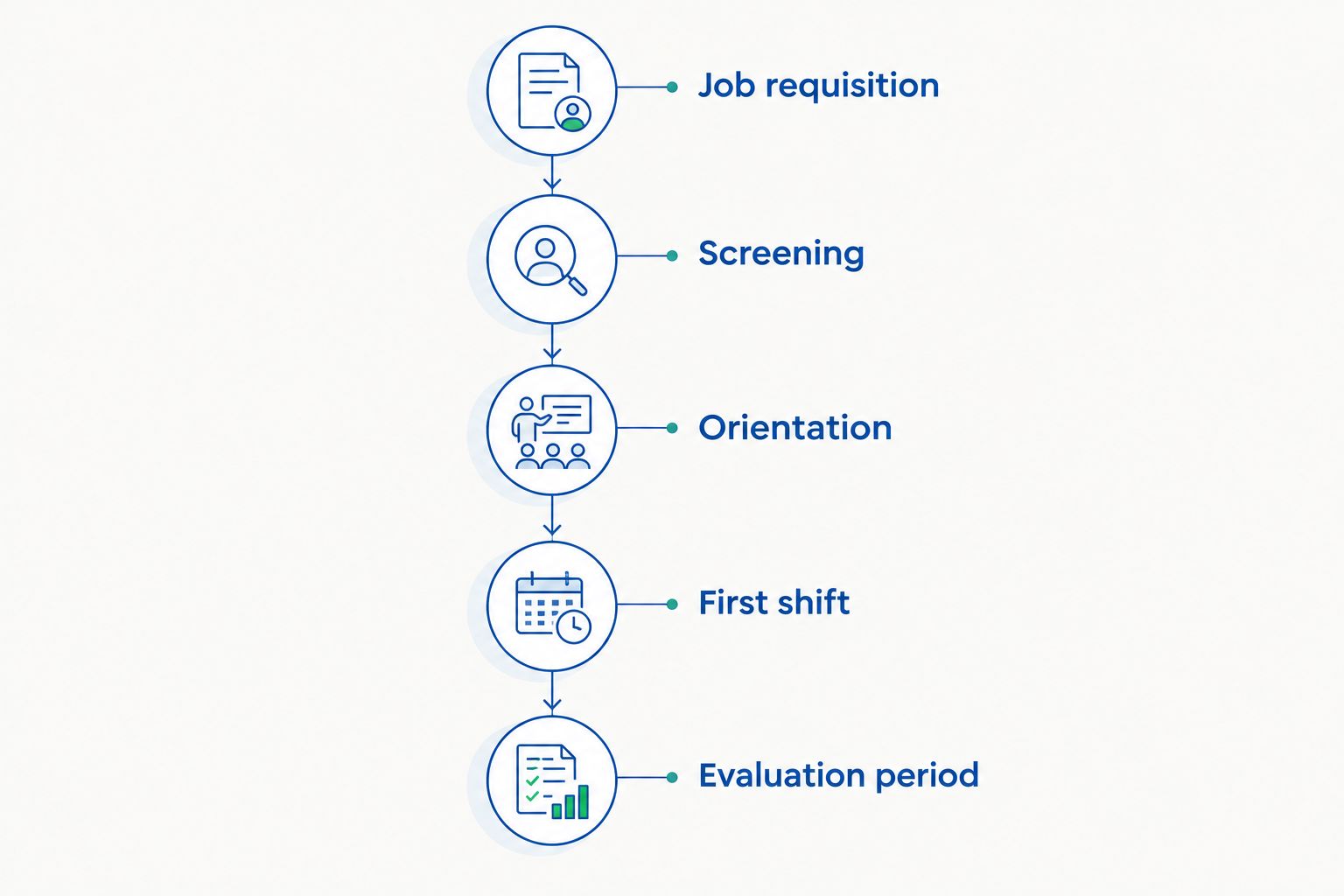
Skipping the orientation stage is the fastest way to lose a new hire in week one.
Set clear KPIs with your staffing partner before scaling up
If your staffing vendor doesn't know your target numbers, they're filling seats, not solving your problem.
Order accuracy rate target by role
Units-per-hour benchmark for pickers, packers, and operators separately
Attendance and no-show rate ceiling
Time-to-fill target for surge requisitions
Retention rate checked at 30, 60, and 90 days
Layer in a temp-to-hire pipeline for your permanent core
Not every role needs a permanent hire, but the roles that carry institutional knowledge — shift leads, cycle counters, WMS power users — do.
Identify which roles need institutional knowledge versus interchangeable labor
Convert top-performing temps after a defined evaluation window
Tie conversion criteria to KPI data, not tenure alone
Negotiate conversion terms with your staffing partner up front, not mid-contract
Use direct hire for supervisory roles that need immediate floor authority
Plan for multi-shift and weekend coverage in advance
Coverage gaps on nights and weekends are where 3PL client complaints start.
Stagger shift start times to avoid clocking-in bottlenecks
Offer weekend differential or fixed-schedule options to cut no-shows
Coordinate scheduling across client contracts if you run multiple under one roof
Build a call-off backup list separate from the core roster
Plan transportation for late-night and early-morning shifts — Reno's industrial parks sit outside most city transit lines
Check compliance and safety training before hires touch the floor
A 3PL audit doesn't wait for you to catch up on paperwork.
Verify I-9 and E-Verify status before day one
Confirm forklift and powered-equipment certification is current, not expired
Document PPE issuance for every hire
Track recordable incidents by shift under Nevada OSHA rules
Keep a separate compliance file per 3PL client, since audit requirements differ by contract
Staffing options compared for 3PL warehouses
Local Reno-based staffing agency
Best for: 3PLs needing fast, forklift-certified fill in Reno, Sparks, or Carson City
Key limitation: Smaller candidate pool once you expand outside Northern Nevada
National staffing chain
Best for: Multi-state 3PLs wanting one vendor across regions
Key limitation: Requisitions often route through a regional call center, slowing local response
In-house recruiting team
Best for: 3PLs with steady, predictable headcount year-round
Key limitation: Can't absorb Q4 volume spikes without overtime or missed fill dates
On-demand gig labor apps
Best for: Same-day single-shift fills
Key limitation: No consistent certification vetting, higher no-show rate
Verdict: for a 3PL running peak-season swings on top of steady baseline volume, a local agency with a temp-to-hire pipeline beats a national chain on speed and beats an in-house team on flexibility.
Build your 3PL staffing plan for 2026
Talk through your peak-season headcount before it becomes an emergency.
Common mistakes 3PL providers make
Treating surge staffing like a same-day gig app instead of building a certified bench ahead of Q4
Not separating certification tracking by equipment class, so a reach-truck operator ends up assigned to a sit-down counterbalance role
Letting one staffing vendor cover multiple client contracts without contract-specific KPI reporting
Skipping site-specific orientation because "warehouse work is warehouse work" — different clients run different WMS platforms and safety zones
Waiting until turnover shows up in the numbers instead of tracking evaluation-period conversion monthly
FAQ
What is warehouse staffing for 3PL providers?
Warehouse staffing for 3PL providers is the process of recruiting and scheduling pickers, packers, forklift operators, and shift leads who can flex up and down with multiple client contracts under one roof. It differs from single-site staffing because each client contract can run its own systems, volume pattern, and safety requirements.
How is staffing a 3PL warehouse different from staffing a single-site warehouse?
A 3PL warehouse staffs for several client contracts at once, each with its own WMS platform, KPI targets, and volume swings. A single-site warehouse only has to plan around one set of SOPs and one demand curve.
How long does it take to staff a 3PL warehouse for peak season?
Time-to-fill depends on shift type and certification requirements, but a local Reno-based agency with a pre-screened bench of forklift-certified workers fills faster than a national chain routing requisitions through a call center. Building the bench before the volume trigger date, not after, is what actually controls the timeline.
Do warehouse staffing agencies handle forklift certification?
Staffing agencies that specialize in light-industrial and warehouse roles track and verify forklift certification before placing a candidate, including re-verification cycles required every 3 years under OSHA rules. Ask your staffing partner directly how they separate certification by equipment class.
What's the difference between temp, temp-to-hire, and direct hire for 3PL roles?
Temp staffing covers short-term volume swings with no conversion path. Temp-to-hire lets you evaluate a worker on the floor before converting them to your permanent roster after a defined window. Direct hire is used for roles like shift leads or supervisors who need immediate authority from day one.
How much does warehouse staffing cost for a 3PL provider?
Cost depends on shift differential, certification requirements, and whether the role is temp, temp-to-hire, or direct hire. Get a current quote directly from a staffing partner rather than budgeting off a rate that may be out of date.
Is a local Reno staffing agency better than a national chain for 3PL warehouses?
For fast fill on forklift-certified roles in Reno, Sparks, or Carson City, a local agency generally moves faster because requisitions don't route through a regional call center. National chains can make more sense for 3PLs coordinating headcount across multiple states.
What compliance requirements apply to Nevada warehouse staffing?
Nevada warehouse employers must meet I-9 and E-Verify requirements, OSHA forklift certification and evaluation cycles, and Nevada's flat $12.00 minimum wage as of July 2024. 3PLs should also keep a separate compliance file per client contract since audit standards can differ.
One last thing
Nevada dropped its two-tier minimum wage in July 2024 — every worker on your floor, insured or not, is a $12.00-an-hour floor now, and any 3PL still budgeting off the old $9.75 rate is underpricing every contract renewal it signs in 2026. Check your labor cost assumptions before your next client renewal conversation, not during it.