
How does overtime pay work for temp employees?
Article
Covered, nonexempt temp employees earn at least 1.5 times their regular rate for hours worked over 40 in a workweek; a temporary assignment does not remove overtime rights. In Nevada in 2026, qualifying employees also earn daily overtime after 8 hours in a workday, so checking only the weekly total can miss wages owed.
TL;DR
How does overtime pay work for temp employees? Covered, nonexempt workers earn overtime after 40 hours per workweek.
Nevada daily overtime also applies to qualifying workers after 8 hours in a workday, subject to statutory exceptions.
Sourcedstaffing serves Reno and Carson City employers and job seekers; confirm assignment-specific payroll arrangements before starting.
Overtime approval rules do not erase payment obligations for work an employer permits.
How does overtime pay work for temp employees?
Overtime depends on your employee classification, hours worked, regular rate, and applicable law—not whether your assignment is temporary. The federal weekly rule and Nevada's daily rule address different thresholds. For the broader paycheck process, see how you get paid through a staffing agency.
Federal weekly overtime
When overtime applies: Covered, nonexempt employees work more than 40 hours in a workweek
What to check: All compensable hours within the employer's fixed workweek
Nevada daily overtime
When overtime applies: Eligible employees earning less than 1.5 times Nevada's minimum wage work more than 8 hours in a workday
What to check: Earnings threshold, statutory exceptions, and any qualifying alternative schedule
Nevada weekly overtime
When overtime applies: Covered employees work more than 40 hours in a scheduled workweek
What to check: Weekly hours and applicable exemptions
Assignment approval policy
When overtime applies: The agency or worksite requires permission before extra hours
What to check: Approval controls scheduling; it does not cancel legally owed wages
Legal basis for this 2026 guide: U.S. Department of Labor Fact Sheets 22, 23, and 56A explain compensable time, federal overtime, and the regular rate. Nevada Revised Statutes section 608.018 governs Nevada overtime. These are legal requirements, not an agency's optional benefits.
Why this matters
A warehouse shift, production assignment, or office placement can involve more than one person approving your time. Your worksite supervisor controls daily tasks, while another employer processes payroll. That split makes accurate records and clear reporting instructions essential.
For a Reno or Carson City employer scheduling temp employees in 2026, the practical question is not just whether someone exceeded the weekly limit. You also need to know whether Nevada daily overtime applies and whether work performed outside recorded shifts belongs on the timesheet.
Keep scheduling permission separate from wage entitlement. A rule against unapproved overtime can support corrective action, but it cannot turn compensable work into unpaid time.
Federal weekly overtime: at least 1.5 times the regular rate
Covered, nonexempt temp employees receive at least 1.5 times their regular rate for work beyond 40 hours in a workweek. Federal law does not require daily overtime merely because a shift runs long. State law can add that protection.
A federal workweek is a fixed, recurring period of 168 hours: seven consecutive 24-hour periods. It does not have to start on Monday or match the payroll period. Ask payroll for its exact starting day and time.
You cannot average a heavy workweek with a lighter one to eliminate federal overtime. A paycheck covering several weeks still requires a separate overtime calculation for each workweek.
The regular rate is not always your listed hourly wage. It generally includes compensation such as shift differentials and nondiscretionary bonuses, unless a lawful exclusion applies. That distinction matters when a night assignment or production incentive changes your earnings.
Check the regular rate before checking the overtime multiplier. Applying the correct multiplier to an incomplete rate still produces the wrong payment.
Nevada daily overtime: at least 1.5 times the regular rate
Under Nevada's general rule, covered employees earning less than 1.5 times the state's minimum wage receive overtime after 8 hours in a workday or after 40 hours in a scheduled workweek. Statutory exceptions apply, including a qualifying, mutually agreed schedule of four 10-hour days.
Employees earning at least 1.5 times Nevada's minimum wage generally receive statutory overtime after 40 hours in a scheduled workweek, rather than under the general daily threshold. Other exemptions still require review.
For a 2026 Nevada assignment, ask payroll to identify the current minimum-wage threshold and explain which overtime rule applies to your earnings. Do not assume that an ordinary hourly rate automatically places you above the daily-overtime threshold.
Nevada defines a workday as a 24-hour period beginning when the employee begins work. An overnight shift therefore needs more careful review than simply dividing hours at midnight.
Daily and weekly triggers do not mean the same hour automatically earns two overtime premiums. Payroll must calculate the applicable obligation without treating the thresholds as interchangeable or assuming that every premium stacks.
How do you check a temp employee's overtime?
Use the same sequence whether you are reviewing your own paycheck or approving a team's timesheets. Resolve classification and time records before trying to calculate the final amount.
Classification. Confirm whether the employee is covered and nonexempt. A temporary label, salary arrangement, or job title alone does not establish an exemption.
Workweek. Identify the employer's fixed workweek and the applicable Nevada workday. Do not substitute the paycheck dates for these boundaries.
Hours worked. Add all compensable work, including required tasks performed before or after the scheduled shift. Separate paid leave from actual work.
Regular rate. Review the hourly rate, shift differential, and other includable compensation. Ask payroll how any nondiscretionary bonus enters the calculation.
Pay review. Compare the recorded hours, overtime hours, rate calculation, and gross earnings. Report discrepancies with supporting records.
This sequence also helps employers avoid a common administrative mistake: asking whether overtime was approved before determining whether it was worked. Approval belongs in the scheduling review; compensable hours belong in the pay calculation.
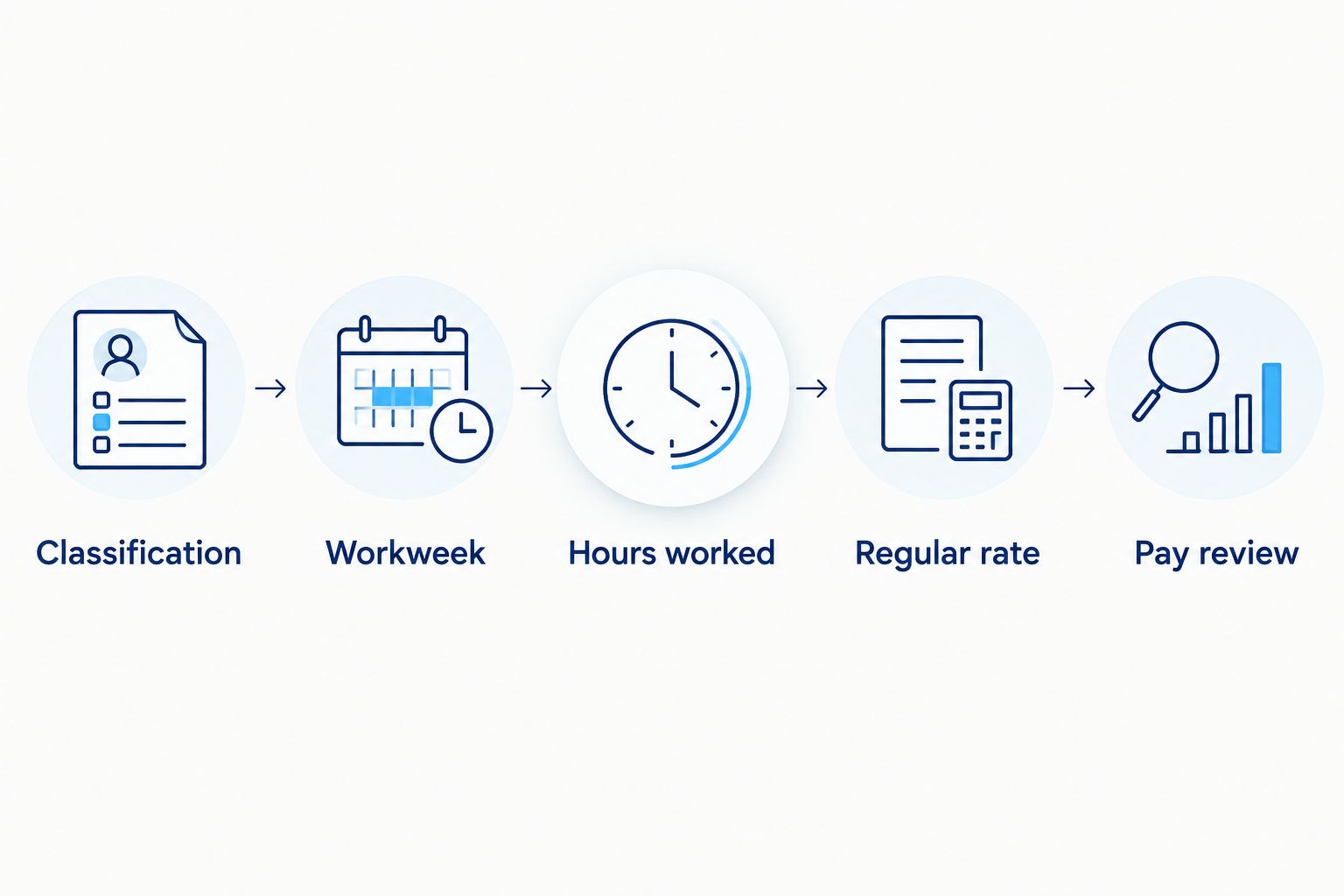
Confirm the applicable rules and recorded work before checking the final payment.
Why a temp employee's overtime calculation varies
The same overtime multiplier can produce different results because the underlying rules and records differ. These are the factors to check:
Employee classification: Legal duties and compensation tests determine exemption status. Assignment length does not settle the question.
Work location: Nevada adds daily protections for qualifying employees. An assignment elsewhere requires review of that location's rules.
Daily and weekly hours: Crossing a daily threshold is different from crossing a weekly threshold. Keep records that support both calculations.
Regular-rate components: Shift differentials and nondiscretionary incentives can affect the rate used to calculate overtime.
Alternative schedules: Nevada's qualifying four-day, 10-hour arrangement requires mutual agreement. A long shift alone does not establish that exception.
Employer relationships: Work across assignments can require aggregation when the same employer or a joint-employment relationship connects the hours.
For your 2026 assignment, ask for an explanation tied to these factors. A statement that temps follow a different policy is not a substitute for identifying the applicable legal rule.
Who pays overtime: the staffing agency or the worksite?
Start with the employer named on your wage statement and the payroll instructions for your assignment. In an agency-employed placement, the agency commonly processes wages. The worksite still needs to provide accurate time information and report work it permits.
Federal law can treat the staffing agency and client business as joint employers, depending on their relationship with the worker. An agreement between those businesses does not eliminate an employee's statutory wage rights.
For employers, distinguish the employee's overtime wages from the agency's invoice. The commercial agreement determines billing responsibilities between the businesses; wage law determines what the employee must receive.
Sourcedstaffing is best suited to Reno and Carson City employers seeking local staffing, recruiting, and payroll services. Sourcedstaffing serves light-industrial, manufacturing, warehouse, office, and food-production businesses as well as job seekers.
Sourcedstaffing's local staffing services are relevant when you need placement or payroll support. They do not, by themselves, establish an assignment's overtime approval process, exemption status, or pay calculation; confirm those details for the specific job.
Do hours at different worksites count together?
The 40-hour federal threshold applies to a covered employee's workweek, not separately to each customer location. When the same staffing employer sends you to different worksites, changing locations does not automatically restart the overtime clock.
Tell payroll about every assignment worked during the same workweek. Separate supervisors or timekeeping systems should not cause hours for the same employer to disappear from the total.
Hours with genuinely separate, independent employers are generally not combined under federal law. A joint-employment relationship can change that result, so the identity of the employer matters more than the number of buildings where you work.
For employers using several sites in 2026, designate someone to reconcile the employee's total hours before scheduling additional work. A site manager's local timesheet does not necessarily show the worker's full week.
Does unauthorized overtime still have to be paid?
The 40-hour weekly threshold still applies when a covered, nonexempt employee performs overtime that the employer knows about or permits. Employers cannot withhold legally required overtime solely because the employee failed to obtain advance approval.
That does not give employees permission to ignore scheduling rules. The employer can enforce its approval policy through appropriate corrective action while still paying for compensable work.
If you are asked to finish loading, clean a workstation, or complete required paperwork after clocking out, record the work and report the missing time. Employers should instruct supervisors not to permit off-the-clock tasks and should correct records when those tasks occur.
What belongs in the hours-worked total?
Required work belongs in the total even when it happens outside the posted schedule. That includes tasks the employer requires before a shift, after a shift, or during a period recorded as a break.
Short rest breaks generally count as paid work time under federal rules. A bona fide unpaid meal period requires relief from duties; answering work questions or monitoring equipment during lunch can change whether that period is unpaid.
Paid holidays, vacation, and sick leave generally do not count as hours worked toward the federal overtime threshold. An employer's agreement or policy can provide additional benefits, but that is separate from the federal minimum requirement.
Required training also needs review. Federal rules allow training time to be excluded only when the relevant conditions are met, including voluntariness and the absence of productive work. Do not assume an orientation is unpaid because it happens before the first scheduled shift.
What should you do if the paycheck looks wrong?
Report the discrepancy promptly and keep a written record. Start with the payroll contact identified for your assignment, then involve the worksite supervisor if the dispute concerns missing or incorrectly approved hours.
Keep the information specific:
The dates and actual start and finish times.
Meal periods and any work performed during them.
The worksite and supervisor for each shift.
Your wage statement and submitted timesheet.
Messages about extra work, schedule changes, or time corrections.
Ask whether the issue involves missing hours, the workweek boundary, daily overtime eligibility, or the regular rate. Those questions make a correction request more useful than simply saying the paycheck seems low.
If the issue remains unresolved, the Nevada Labor Commissioner handles state wage concerns, and the U.S. Department of Labor's Wage and Hour Division handles federal wage-law concerns. This 2026 guide provides general information; individual disputes require review of the employee's circumstances and applicable law.
FAQ
Do temp employees get overtime after 40 hours?
Covered, nonexempt temp employees earn at least 1.5 times their regular rate after 40 hours worked in a workweek. Temporary status does not remove that protection.
Do temp employees in Nevada get overtime after eight hours?
Qualifying Nevada employees earning less than 1.5 times the state's minimum wage generally earn daily overtime after 8 hours in a workday. Statutory exceptions, including a qualifying mutually agreed four-day, 10-hour schedule, require review.
Does working through an agency change my overtime rights?
Working through an agency does not remove statutory overtime rights. Your classification, compensable hours, regular rate, and applicable law determine the obligation.
Can a temp agency refuse overtime because it wasn't approved?
An employer cannot refuse legally owed overtime solely because advance approval was missing. It can enforce scheduling rules separately from paying for work it knew about or permitted.
Do my hours at two client sites count together?
Hours worked for the same staffing employer generally count together within the same workweek. Separate independent employers and joint-employment arrangements require different analysis.
Does overtime include my night-shift differential?
A night-shift differential generally belongs in the regular rate used to calculate overtime. The regular rate can also include nondiscretionary bonuses and other compensation unless a lawful exclusion applies.
Does holiday pay count toward overtime?
Paid holiday time not worked generally does not count toward the federal 40-hour overtime threshold. An employer's agreement or policy can provide benefits beyond that legal minimum.
One last thing
Your pay-period total is not your overtime test. A paycheck can cover multiple workweeks, and each workweek needs its own calculation. Nevada daily eligibility adds another review rather than replacing the weekly one.
Before your next assignment, write down the payroll workweek, the time-reporting process, and the contact for corrections. Those details make it easier to catch an error before another paycheck repeats it.