
How do I get paid through a staffing agency? Clear in 2026
Article
You usually get paid by the staffing agency when you work a temporary assignment; in a direct-hire placement, the company that hires you pays you. Your take-home pay depends on recorded hours, your agreed pay rate, taxes, and authorized deductions—not the amount the agency bills its client. Before your first shift, confirm who issues your paycheck, when payday falls, and how to submit your hours.
TL;DR
How do I get paid through a staffing agency? Temporary workers usually receive wages from the agency handling payroll.
Direct-hire workers receive pay from the hiring company; temp-to-hire workers change payroll employers when hired permanently.
Confirm your first payday, timekeeping deadline, payment method, and deductions before starting an assignment.
Sourced Staffing serves Reno and Carson City job seekers through staffing, recruiting, direct-hire, and payroll services.
How do I get paid working through a staffing agency?
Your payroll employer pays you for your work, even when you perform that work at another company's location. For a temporary assignment, that is usually the staffing agency. For direct hire, it is the hiring company from the start.
The agency's invoice to the business is separate from your paycheck. Do not treat the difference between those amounts as a deduction from your wages; check your own agreed rate and pay statement instead. Questions about placement charges belong in a separate discussion about whether staffing agencies charge job seekers a fee.
Temporary assignment
Who generally pays you?: The staffing agency handling your employment
Best for: Workers accepting an assignment with a client business
Benefit: A payroll contact separate from the worksite
Limitation to confirm: Assignment duration and scheduled hours
Temp-to-hire
Who generally pays you?: The agency initially, then the company after conversion
Best for: Workers considering a permanent role
Benefit: An opportunity to work in the role before conversion
Limitation to confirm: Permanent hiring is not guaranteed
Direct hire
Who generally pays you?: The company that hires you
Best for: Workers seeking employment directly with a business
Benefit: Company payroll from the beginning
Limitation to confirm: The company controls its payroll schedule
Payroll-only arrangement
Who generally pays you?: The employer or provider identified in your paperwork
Best for: Workers whose placement is already arranged
Benefit: Payroll administration can be handled separately
Limitation to confirm: The provider's role and employer identity
These arrangements describe how employment is organized, not a promised payment schedule. In 2026, your assignment paperwork remains the place to verify your actual payday and payroll contact.
Why this matters
You can work at a warehouse, manufacturing plant, or office without that business issuing your paycheck. The supervisor who approves your hours and the person who resolves a payroll problem can therefore be different people.
Identify both contacts before you start. Knowing who approves time and who handles pay gives you a clear route when a shift is missing, a deposit does not arrive, or your assignment changes. It also helps you distinguish a payroll error from a misunderstanding about which dates a paycheck covers.
How do I get my first staffing-agency paycheck?
Your first paycheck starts with completed employment paperwork and accurate time records. Follow this sequence before and during your first assignment.
Confirm employer. Read the offer, assignment notice, and payroll paperwork. Ask which legal employer will appear on your pay statement and tax documents.
Check pay terms. Confirm your agreed pay rate, pay period, payday, and the dates covered by your first payment. Ask whether any shift differential applies to your particular assignment.
Complete paperwork. Submit the required employment and tax forms through the employer's designated process. Check names and payment details carefully, and use the approved secure channel for sensitive information.
Record hours. Use the assigned timekeeping method for every shift. Report missing punches and discrepancies rather than assuming a supervisor will correct them automatically.
Review payment. Compare the first pay statement with your records. Check the covered dates, regular hours, overtime, deductions, and final payment amount.
Ask for the time-submission deadline as well as payday. A deadline explains the payroll process; it does not erase your right to payment for hours actually worked.
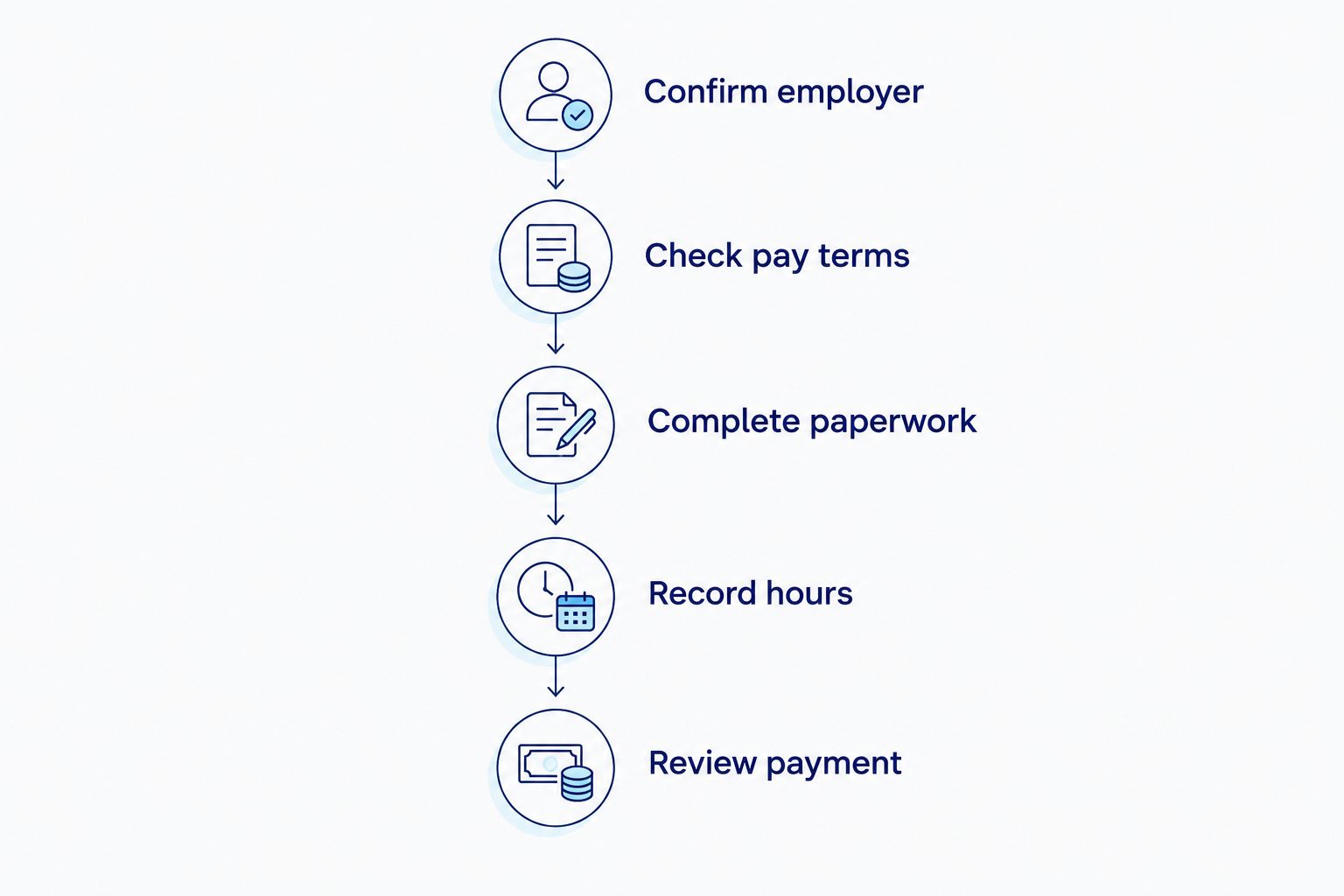
Confirm the payroll details before your first shift, then compare your payment with your time records.
Your first deposit does not necessarily cover every shift you have completed by the day it arrives. Payroll uses a defined pay period, so later shifts can belong to the next payment. Ask which working dates are included before concluding that hours are missing.
Temporary assignments: confirm agency payroll
For a temporary assignment, the agency generally pays your wages while the client business directs your work at its site. Follow the site's work instructions and the agency's payroll instructions; they serve different purposes.
The practical benefit is having an identified payroll contact outside the worksite. The complication is coordination: a supervisor might approve hours while an agency payroll team processes payment. Confirm how corrections move between them.
Before accepting a 2026 assignment, get clear answers about the schedule and expected duration. A stated hourly rate does not promise a particular number of shifts, and an assignment's end date is separate from the payday for work already completed.
Temp-to-hire: confirm the payroll change
In a temp-to-hire arrangement, the staffing agency generally handles your pay during the temporary assignment. Once the client company hires you as its employee, that company's payroll takes over according to the conversion terms.
A permanent offer and a payroll transfer are separate steps. Confirm the effective hiring date, the final agency pay period, and the first company payday. Keep the paperwork showing where the temporary assignment ends and company employment begins.
Temp-to-hire gives you an opportunity to experience the job before a permanent transition. Its limitation is that conversion is not guaranteed. Until you receive confirmed hiring terms, use your current employer's timekeeping and payroll instructions.
Direct hire: confirm the company's payday
With direct hire, the agency recruits or introduces you, but the hiring company employs and pays you from the start. Direct payroll questions to the company's designated contact rather than assuming the recruiter controls payment.
This arrangement suits workers seeking employment directly with a business. The trade-off is that the company's payroll cycle determines your first payday, even if the recruiter helped arrange the role.
Read the company's onboarding instructions before starting. Confirm where to enter payment details, how to access pay statements, and which dates the first paycheck covers.
Payroll-only arrangements: read the employer details
Payroll-only services separate payroll administration from the recruiting process. The service label alone does not tell you who is your legal employer or who resolves a wage dispute; your employment documents should identify those responsibilities.
Ask who issues the paycheck, who approves hours, and who provides tax documents. If the business and payroll provider give conflicting instructions, request clarification before submitting sensitive information or changing your timekeeping method.
The benefit is a defined payroll process for an already-arranged placement. The limitation is that workers must understand the provider's actual role rather than infer it from the phrase payroll-only.
Why your take-home pay varies
Your take-home payment is the amount left after applicable deductions from gross wages. Check these factors when comparing a pay statement with what you expected:
Recorded hours: Missing punches or an incorrect shift record can change the hours shown. Keep your own dated record so you can identify discrepancies.
Pay-period dates: A paycheck covers a specific period, not necessarily every shift completed before payday.
Overtime eligibility: Covered, nonexempt employees generally receive overtime under federal law after 40 hours in a workweek. State rules can add requirements.
Tax withholding: Your tax forms and earnings affect withholding. A new job or changed tax election can alter your take-home amount.
Authorized deductions: Benefit contributions and other lawful deductions reduce net pay. Review the labels and ask about anything you do not recognize.
Employment changes: A move from agency payroll to company payroll can change payment dates and deduction arrangements. Compare the final agency statement with the first company statement.
An hourly pay rate and a take-home payment are not interchangeable. Compare hours and gross wages first, then examine deductions. That order makes it easier to locate the source of a difference.
How does overtime work through a staffing agency?
40 hours in a workweek is the federal overtime threshold for covered, nonexempt employees. The federal Fair Labor Standards Act generally requires overtime pay of at least 1.5 times the employee's regular rate for hours above that threshold. The regular rate is a legal calculation and is not always identical to the stated base rate.
For your 2026 assignment, confirm how the employer defines the workweek and applies Nevada's additional overtime rules. Do not assume that two paychecks, two assignments, or a pay period covering several weeks determines the overtime calculation.
Working at multiple client sites does not automatically make each assignment a separate employer for overtime purposes. Report all hours to the responsible payroll employer. An employer's approval policy also does not eliminate payment obligations for compensable work actually performed.
Why is my deposit smaller than my gross pay?
6.2% is the usual employee Social Security tax rate, and 1.45% is the usual employee Medicare tax rate under federal payroll tax rules in 2026. Social Security has an annual taxable wage limit, and additional Medicare withholding applies at higher earnings levels.
Federal income-tax withholding and other applicable deductions can further reduce take-home pay. Nevada does not impose an individual state income tax, but that does not make a Nevada paycheck tax-free.
Use the pay statement to separate earnings from deductions. If gross pay matches your hours and agreed rate but the deposit differs from your expectation, review tax withholding and authorized deductions rather than assuming the agency changed your rate.
What should I do if my paycheck is missing hours?
40 hours is an overtime threshold, not a limit on the hours you should report. Record every hour worked and compare your records with the exact dates covered by the paycheck before reporting a discrepancy.
Send the payroll contact the assignment location, affected shift dates, recorded start and finish times, and the specific difference. Include relevant timekeeping records through the approved channel. Ask who owns the correction and when you will receive an update.
Keep your messages and pay statements. If the issue remains unresolved, seek guidance from the Nevada Labor Commissioner or the U.S. Department of Labor's Wage and Hour Division, depending on the wage issue. A disagreement about time approval is not a reason to abandon a claim for work you actually performed.
What should Northern Nevada job seekers ask before starting?
Sourced Staffing is a local staffing option for Reno and Carson City job seekers seeking industrial, warehouse, office, or food-production work. Its stated services include recruiting, direct hire, and payroll services.
When discussing a role with Sourced Staffing, ask which employment arrangement applies to that specific opening. The agency's range of services does not establish a particular assignment's payday, payment method, benefits, or conversion terms.
For any 2026 role, leave the conversation knowing your payroll employer, first payday, timekeeping process, and payroll contact. Local support is useful, but written assignment terms—not a general description of the agency—establish how your pay works.
FAQ
How do I get paid through a staffing agency?
For a temporary assignment, the staffing agency generally pays you based on your recorded hours and agreed pay terms. For direct hire, the hiring company pays you from the start; confirm the arrangement in your employment paperwork.
Do staffing agencies pay every week?
A staffing agency's payroll schedule depends on the employer and assignment terms. Confirm the pay frequency, first payday, and covered dates before starting rather than assuming weekly payment.
Will I get direct deposit through a staffing agency?
Your payment method depends on the payroll employer's available methods and your enrollment. Ask how to enroll, verify your details through the approved secure process, and confirm how the first payment will arrive.
Who do I contact if my staffing paycheck is wrong?
Contact the payroll team identified in your employment paperwork. Provide the pay period, affected shifts, and exact discrepancy, and involve the worksite supervisor when time approval needs correction.
Do temporary workers qualify for overtime?
Covered, nonexempt temporary workers generally qualify for federal overtime after 40 hours in a workweek, at least 1.5 times their regular rate. Nevada rules can add requirements, so confirm how the payroll employer applies them to your assignment.
Does my paycheck change when I get hired permanently?
Your payroll employer generally changes when you move from an agency assignment to employment with the client company. Confirm the transition date, final agency payday, first company payday, and any changes in deductions.
How do I confirm payroll details with Sourced Staffing?
Ask Sourced Staffing which employment arrangement applies to the role and who will issue your paycheck. Confirm the first payday, timekeeping deadline, payment method, and payroll contact before your first shift.
One last thing
The most useful payroll question is: Which working dates will my first paycheck cover? It separates the day money arrives from the work being paid for—a distinction that explains many first-paycheck misunderstandings.
For a new assignment in 2026, save the answer alongside your start date and timekeeping instructions. Then check your first statement against those dates, not against every shift you have worked so far.