
Can temp workers get hired permanently? Yes | 2026
Article
Yes, temp workers can get hired permanently. A temporary assignment can lead to an offer from the employer, but working the assignment does not guarantee one. The employer must decide to hire, and the worker must accept the role; the employer and staffing agency also need to coordinate any change in assignment and payroll.
TL;DR
Yes: temp workers can get hired permanently when an employer offers a role and the worker accepts it.
Temp-to-hire makes permanent employment an explicit possibility; a standard temporary assignment can also lead to an offer.
Sourced Staffing is best for Northern Nevada employers seeking local recruiting and direct-hire support.
Before accepting, confirm the role, employment terms and payroll handoff with the employer and staffing agency.
Can temp workers get hired permanently?
Yes. The assignment can become a permanent job, but the conversion requires a separate hiring decision. If permanent employment is your goal, ask whether the position is temp-to-hire or temporary only before you accept it. For a closer look at the planned route, see how temp-to-hire staffing works.
Temp-to-hire assignment
What it means for the worker: Permanent employment is a stated possibility from the outset.
What the employer needs to decide: Whether to offer an ongoing role after seeing the worker on the job.
Main limitation: A possible offer is not a promised offer.
Temporary assignment followed by an offer
What it means for the worker: A role that began as temporary changes because the employer wants to keep the worker.
What the employer needs to decide: Whether an ongoing position exists and whether the worker is the right fit.
Main limitation: The original assignment may end without an offer.
Direct hire instead of a temp assignment
What it means for the worker: The worker applies for a permanent position from the start.
What the employer needs to decide: Whether to hire the candidate for that position.
Main limitation: It does not provide a temporary assignment before the hiring decision.
These paths answer different needs. If you want a permanent job from the outset, ask about direct-hire openings rather than assuming every temporary position has a conversion plan. If you are open to starting on assignment, ask what would need to happen for the employer to offer a lasting role. In 2026, the most useful answer is still the one tied to the specific opening, not a general promise about temp work.
Why this matters
The word temporary describes the assignment you are accepting, not a rule that bars the employer from hiring you later. That distinction matters when you are weighing a warehouse, manufacturing, food-production or office role: you need to know whether you are pursuing a permanent opening, testing a possible path to one, or taking an assignment with no stated next step.
Employers need the same clarity. If the business wants to keep someone after an assignment, a conversation with the worker is not the whole process. The business also needs to confirm its hiring decision with the staffing agency and plan how the worker moves into the new role. A strong assignment creates a reason to discuss permanent hiring; it does not complete the hire.
How does a temp worker become a permanent employee?
The practical route is a series of decisions, not an automatic change in job title. If you are the worker, ask your staffing contact and the employer who will communicate each decision. If you are the employer, identify who can approve the hire before discussing an offer as though it is settled.
Clarify the assignment. Ask whether the opening is temp-to-hire, temporary with a possible extension, or temporary with no permanent position identified. Use the answer for this opening; do not assume another assignment with the same job title works the same way.
Discuss the permanent role. The employer identifies the ongoing work it wants filled and tells the worker what role it is considering. The worker can then decide whether that role matches their goals, rather than treating an extended assignment as an offer.
Confirm the hiring decision. The employer decides whether to offer the job, and the worker decides whether to accept. Until both happen, the worker should not treat the permanent position as secured.
Coordinate the handoff. The employer and staffing agency confirm how the assignment ends or changes and who handles payroll after the change. The worker should know when the new employment arrangement begins and whom to ask about any gap or discrepancy.
This sequence protects both sides from an avoidable misunderstanding. Continued shifts show that work is available; they do not, on their own, tell you whether the employer has approved a permanent position. In 2026, ask for the role and handoff details directly instead of relying on an informal prediction from someone who cannot make the offer.
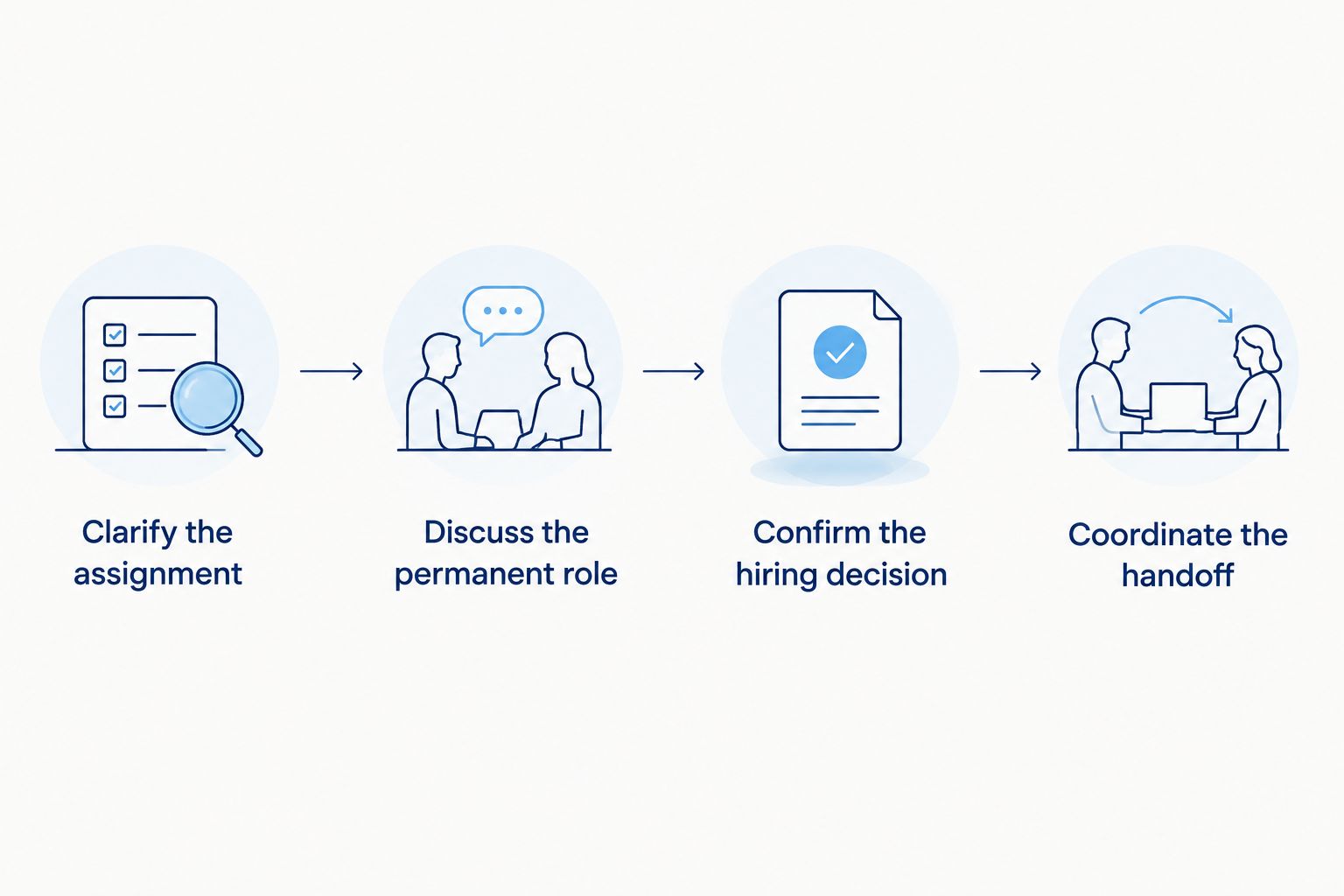
An assignment becomes a permanent job only after the hiring decision and handoff are clear.
A temp-to-hire label gives you a useful question to ask, not an outcome to assume. Find out who makes the final hiring decision and how you will learn it. Employers should give the staffing agency the same understanding of the opening so the worker does not receive conflicting messages.
What should a temp worker ask before accepting an assignment?
Start with the opening itself: Is there a permanent role available, or is permanent hiring only a possibility if business needs change? Those are different propositions. The answer helps you decide whether this assignment fits your job search even if it never converts.
Then ask who would employ you during the assignment and who would employ you after a permanent offer. An agency assignment and a direct-hire role are different arrangements, so you need to understand what changes rather than assuming the same terms continue. Ask when you would receive the details of the permanent role if the employer chooses to offer it.
Also ask how your work will be evaluated for the opening. This is not a request for a guarantee; it is a way to learn what the employer needs. In a warehouse or production role, for example, the work you actually perform matters more than a vague assurance that the assignment has potential. Use the employer's stated requirements, not a guess about what wins an offer.
If a permanent job is your only acceptable outcome, say so to the staffing agency. Sourced Staffing provides recruiting and direct-hire services in Reno and Carson City, so a worker looking for a permanent position can ask about direct-hire opportunities rather than relying on a temporary assignment to turn into one. Sourced Staffing is best for Northern Nevada employers seeking local recruiting and direct-hire support; the employer still controls the hiring decision.
What should an employer settle before offering the job?
First, decide whether you are offering an existing permanent opening or creating a new ongoing role. A manager's interest in keeping a good temp worker is useful, but the worker needs an actual offer to evaluate. Confirm who has authority to approve it and who will explain the role to the candidate.
Next, bring the staffing agency into the discussion before announcing a change. Review the agreement that applies to the assignment and ask what steps it requires for a direct hire or conversion. Do not infer terms from how another agency handles its placements; the relevant agreement is the one governing this worker's assignment.
Finally, make the change understandable to the worker. Identify the expected end of the temporary assignment, the start of the permanent role and the contact for payroll questions. Sourced Staffing provides staffing, recruiting, direct-hire and payroll services, so employers working with the agency can discuss the hiring decision and payroll handoff together. That discussion should happen before either side assumes the change is complete.
For a business considering this route in 2026, the central choice is straightforward: use a temporary assignment when the work itself is temporary, discuss temp-to-hire when an ongoing role is possible, or recruit directly when the permanent opening is already clear. Pick the route that matches the job you can actually offer.
Discuss your hiring needs
Explore staffing, recruiting and direct-hire support for Northern Nevada businesses.
Why permanent hiring varies by assignment
There is no single conversion outcome for every temp worker. The deciding factors sit with the opening, the employer and the worker, not with the temporary job label alone:
Whether an ongoing role exists. An employer cannot offer a defined permanent job merely because an assignment is going well. Ask whether the work continues after the temporary need ends.
What the opening was meant to fill. A temp-to-hire assignment identifies permanent employment as a possibility; a temporary opening may have been set up only to cover a short-term need. Neither label replaces a hiring decision.
Whether the worker wants that role. A worker can do well on assignment and still prefer another schedule, kind of work or career path. A permanent offer needs an interested candidate.
Who approves the hire. The supervisor who sees the work might not make the final decision. Employers should settle approval internally before presenting the worker with a firm outcome.
How the staffing arrangement changes. The employer and agency need to follow the agreement for the assignment and coordinate the payroll transition. The details depend on that arrangement; they cannot be assumed from the job title.
For workers, these factors suggest a practical rule: ask specific questions, keep performing the work you agreed to do, and continue your job search until you have accepted a permanent offer. For employers, they suggest a different rule: be clear about the opening before you ask a worker to plan around a possible future job. In 2026, clarity is more useful than calling every assignment a path to permanence.
Can a temporary assignment become permanent if it was not temp-to-hire?
Yes, a temporary assignment can lead to a permanent offer even if it was not advertised as temp-to-hire. The employer must have an ongoing role it wants to fill, choose to offer it to the worker and coordinate the change with the staffing agency. A later offer is possible; it was not part of the original promise.
If you are the worker, ask what changed and what the new job involves. If you are the employer, explain the role as a new hiring decision rather than implying the worker was permanent all along. Both sides need a shared understanding of the transition.
Do you have to accept a permanent job after temp work?
No, a temp worker does not have to accept a permanent offer. Consider the actual position and employment terms before you decide. The fact that you worked an assignment does not answer whether the ongoing role suits you.
Tell the employer and staffing agency your decision clearly so they can plan for the assignment. If you want permanent work but not this role, explain the kind of opening you are seeking. That is more useful than leaving either side to interpret silence as interest.
Is direct hire better than waiting for a temp job to convert?
Direct hire is the clearer route when you want a permanent job from the start and an employer has one open. A temp assignment is useful when you want the assignment itself and understand that a later offer is a separate decision. Neither path makes sense for every opening.
For a Northern Nevada employer with a defined permanent vacancy in 2026, Sourced Staffing's direct-hire and recruiting services fit the question more closely than describing the role as temporary without a clear reason. For a job seeker, ask about the actual hiring path for the position you are considering. Do not let a possible future conversion stand in for a current permanent offer.
FAQ
Can temp workers get hired permanently?
Yes, temp workers can get hired permanently when an employer offers an ongoing role and the worker accepts it. The employer and staffing agency then need to coordinate the change from the assignment.
Does temp-to-hire guarantee a permanent job?
No, temp-to-hire does not guarantee a permanent job. It identifies permanent hiring as a possibility, while the employer still makes a separate hiring decision.
Can a regular temp job become permanent?
Yes, a regular temp job can become permanent if the employer later decides to offer an ongoing role. The original temporary assignment alone does not promise that outcome.
Who decides whether a temp worker is hired permanently?
The employer decides whether to offer the permanent role, and the worker decides whether to accept it. The staffing agency coordinates the change according to the applicable arrangement.
Should I stop applying for jobs during a temp assignment?
No, do not treat a possible conversion as an accepted permanent offer. Keep your job search aligned with your goals until the employer makes an offer you accept.
What should I ask before accepting a temp-to-hire position?
Ask whether a permanent opening exists, who makes the hiring decision and how you will learn the outcome. Also clarify the assignment and what would change if you accept an offer.
Can an employer hire a temp worker directly?
Yes, an employer can offer a temp worker a direct role. The employer should review its staffing agreement and coordinate the assignment and payroll handoff with the agency.
One last thing
The question that matters most is not whether temp workers can get hired permanently. They can. Ask whether this employer has a specific ongoing role for this worker. If the answer is unclear, treat the assignment as temporary while you seek the details you need. Sourced Staffing can support Northern Nevada businesses with recruiting and direct hire, but no agency can turn an unapproved possibility into a permanent offer.