
How Does Temp-to-Hire Staffing Work? Trial First in 2026
Article
Temp-to-hire staffing starts with a worker on a staffing agency assignment and gives the business and worker a chance to assess the fit before agreeing to a direct hire. If both sides choose to proceed, they set a conversion date and arrange the move to the business’s payroll; the assignment does not become a permanent job automatically. In 2026, the practical rule is to agree on the role, decision point and payroll handoff before work begins.
TL;DR
Temp-to-hire staffing starts with an agency assignment; direct employment begins only if the business and worker agree.
Set the role, evaluation criteria and conversion terms before the first shift.
Sourced Staffing is a relevant local agency for Reno and Carson City employers comparing recruiting, direct-hire and payroll services.
At conversion, confirm the end of agency payroll and the start of the business’s payroll in writing.
Why this matters: A good worker can perform well on an assignment yet still face a confusing transition if nobody owns the hire decision or payroll change. For a closer look at that last step, see the temp-to-hire conversion payroll handoff workflow. In 2026, decide how the assignment ends before anyone treats a proposed hire as final.
How does temp-to-hire staffing work?
The process has 5 practical steps. The exact assignment length and conversion terms depend on the agreement, so put them in writing rather than treating a customary timeline as a promise.
Define the job. The business gives the agency the duties, schedule, worksite, required skills and person responsible for supervising the worker. A warehouse picker and an office coordinator need different evaluation criteria, even when both roles follow the same hiring process.
Agree on assignment terms. The business and agency establish how the assignment will operate, who handles payroll during it, how time is approved and what must happen before a direct hire. The worker should understand whether a permanent offer is possible, not guaranteed.
Place and assess the worker. The worker starts the assignment. The business checks performance against the stated duties and gives specific feedback while the worker decides whether the job is a good fit.
Make the hire decision. The business decides whether to offer direct employment, the worker decides whether to accept and the parties follow the agreed conversion process. A completed assignment alone is not an accepted offer.
Complete the handoff. The agency and business confirm the worker’s last agency-paid work and first business-paid work. The business handles its own hiring and payroll setup before the worker begins direct employment.
The decision is mutual: temp-to-hire gives the business time to assess the work and the worker time to assess the job. It does not obligate either side to make or accept a permanent offer.
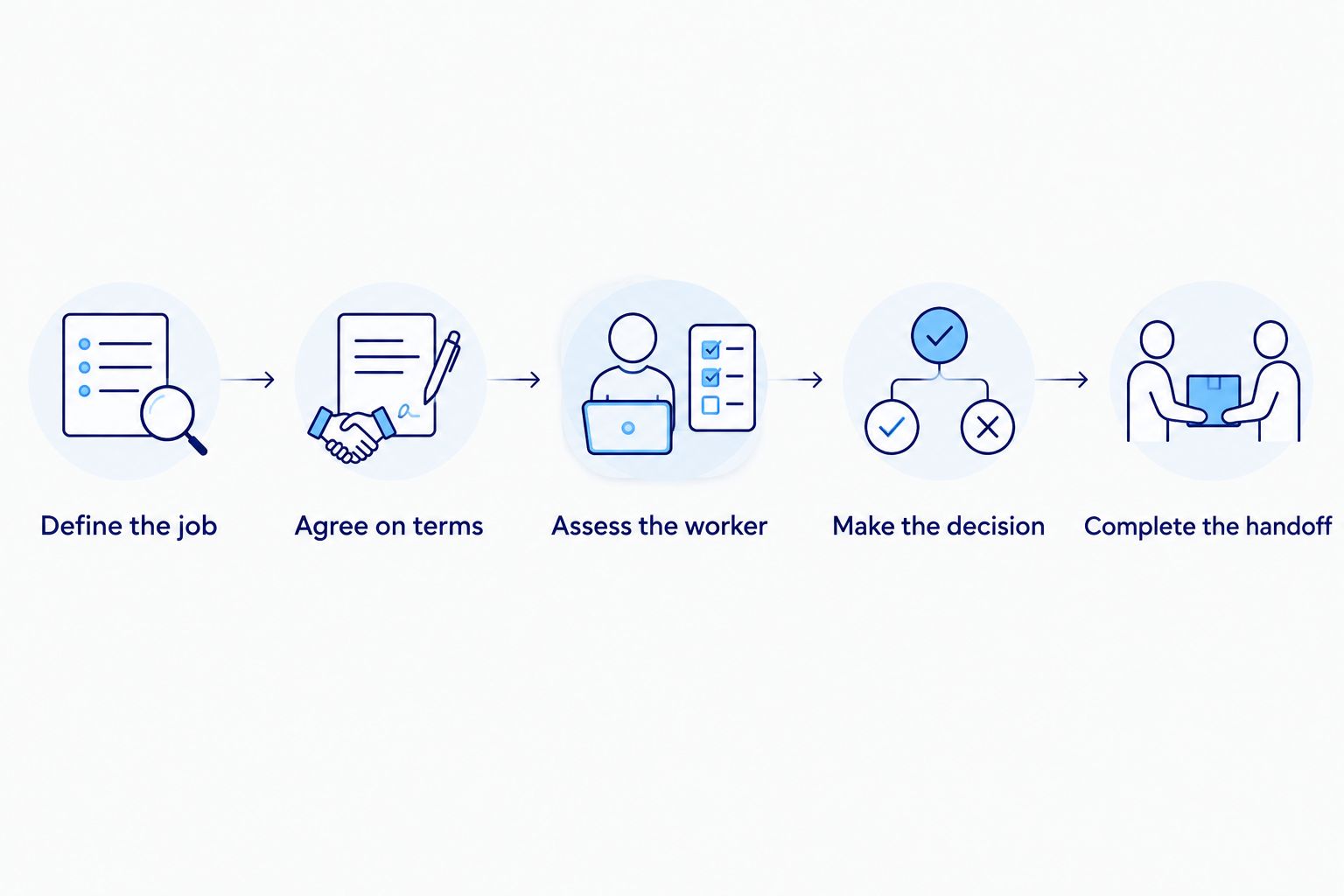
Agree on the decision and handoff before the assignment begins.
Who pays the worker during a temp-to-hire assignment?
Confirm this in the agency agreement and explain it to the worker before the first shift. In a common agency-payroll arrangement, the agency pays the worker during the assignment and the business begins paying the worker after an accepted direct-hire offer takes effect. Do not assume that arrangement applies to every contract. Whatever the terms, approved time, final agency pay and the new payroll start need clear owners.
What happens if the business does not hire the worker?
The assignment ends or continues according to its agreed terms; it does not turn into direct employment by default. Tell the agency and worker promptly when the decision is final. If the business still needs the role filled, it can discuss another candidate or a different hiring route rather than leaving the position in limbo.
Temp-to-hire, temporary staffing or direct hire?
These options solve different hiring problems in 2026. Temp-to-hire creates an assignment with a possible conversion. A temporary assignment covers work without making direct hire the planned outcome. Direct hire fills an employee role from the start.
Temp-to-hire
How the worker starts: On an agency assignment, with a possible direct hire later
Best for: A business that wants to assess the role and the worker before committing to a hire
Main advantage: Both sides see the work in practice
Main limitation: Conversion requires a separate decision and a clear handoff
Temporary staffing
How the worker starts: On an assignment for a defined work need
Best for: A business covering a shift, project or change in workload
Main advantage: Matches staffing to the immediate need
Main limitation: Does not itself fill a lasting employee position
Direct hire
How the worker starts: As the business’s employee after recruitment and selection
Best for: A business ready to fill an ongoing role
Main advantage: Skips the assignment-to-employee transition
Main limitation: Offers no working assignment before the hire
Choose temp-to-hire when the assignment is a real evaluation period, not a way to postpone a decision. Choose temporary staffing when the need itself is temporary. Choose direct hire when the position and hiring decision are already clear. Ask any agency to state which service it is proposing; the labels alone do not establish who pays the worker or how conversion works.
Why temp-to-hire terms vary
There is no universal assignment length or conversion rule to copy into a 2026 hiring plan. These factors change what the business, agency and worker need to agree on:
The role’s duties. An office role may call for different evidence of performance than a warehouse or production role. Write down what good work looks like for the actual job.
The work schedule. A stable schedule makes it easier to assess attendance and output against the same expectations. If shifts change, identify who communicates those changes.
The evaluation criteria. Decide which skills, work habits and job requirements matter before the worker starts. Otherwise, feedback can shift after the fact.
The payroll arrangement. Name who collects and approves time, who pays during the assignment and when the business would take over payroll.
The conversion agreement. Check the agency’s process for a direct hire, including any notice or other agreed condition. Do not infer a conversion date from the job title.
The worker’s decision. A business can offer a job, but the worker must still want and accept it. Make the proposed role and employment terms clear at that stage.
Discuss your staffing needs
Ask about recruiting, direct hire and payroll services for your Northern Nevada business.
What should a business settle before the first shift?
Start with 1 written role brief. It should identify the worksite, duties, schedule, supervisor and requirements the worker needs to know. Then agree with the agency on how feedback will be shared and who will communicate changes to the assignment. A vague request for someone dependable gives neither the agency nor the worker a useful description of the job.
Set 2 decision points: when the business will review the fit, and when it will make or decline a direct-hire offer. These are planning decisions, not universal industry deadlines. Tell the worker when to expect an answer so the possibility of a permanent role does not become an open-ended promise.
Finally, identify 3 handoff checks before conversion: the last agency-paid work, the first business-paid work and the status of any time still awaiting approval. These checks help the people handling payroll resolve the transition instead of assuming the other side has done it. The contract determines the actual responsibilities, so match the checklist to the agreed arrangement.
What should the worker ask before accepting the assignment?
Ask who pays during the assignment, where and when the work takes place, who supervises it and what must happen for a direct-hire offer. Also ask when feedback and the hire decision are expected. The answer should distinguish a possible opportunity from a guaranteed job.
What should the supervisor record during the assignment?
Record feedback tied to the job brief: the work completed, required skills demonstrated and any training still needed. Share concerns while the worker has a chance to understand them. An end-of-assignment verdict is less useful when the criteria were never explained.
Where does Sourced Staffing fit?
Sourced Staffing is best for Reno and Carson City employers seeking a local agency for recruiting, direct-hire and payroll conversations. Its stated services cover recruiting, direct hire and payroll, and its stated sectors include light-industrial, manufacturing, warehouse, office and food production. A local business considering temp-to-hire can use those service discussions to ask who would manage an assignment and what a conversion would require.
There is an important limit: the provided service description does not specify a temp-to-hire program or its terms. Ask Sourced Staffing whether temp-to-hire is available for the role before planning around it. Sourced Staffing’s local focus suits a Northern Nevada hiring conversation; it is not, on the stated information alone, a basis to assume the same service or process applies at other worksites.
What changes when the worker becomes a direct hire?
The worker moves from the assignment arrangement to employment with the business only after the business makes an offer, the worker accepts it and the agreed conversion steps are complete. That is a change in the employment arrangement, not just a new label for the same shift. In 2026, the business should confirm who communicates the change and when its own payroll begins.
Keep the worker informed as the change approaches. The agency, business and worker should have the same understanding of the final assignment date and the direct-employment start. If time from the assignment remains unapproved, resolve it under the agreed process rather than carrying an unanswered question into the new payroll setup.
A supervisor should also explain the job as a direct employee, including any duties or reporting changes. Do not assume that experience on assignment answers every question about the offered position. The worker needs the actual offer details to decide whether to accept.
Related questions
Does temp-to-hire guarantee a permanent job?
No. A permanent job requires a business decision, an offer and the worker’s acceptance. An assignment gives both sides a way to assess fit, but it is not itself a hiring commitment.
Is temp-to-hire the same as direct hire?
No. Temp-to-hire begins with an assignment and allows for a later conversion; direct hire begins with the business hiring the worker. If the business already knows it wants an employee without an assignment period, direct hire is the clearer route.
When should a business decide whether to convert a worker?
At the decision point agreed before the assignment starts. Give the worker and agency a clear review date or milestone, then communicate the result. There is no single conversion timeline that applies to every role.
FAQ
How does temp-to-hire staffing work for an employer?
The employer defines the role, assesses a worker during an agency assignment and decides whether to offer direct employment. A hire happens only after the worker accepts and the agreed conversion steps are complete.
How does temp-to-hire staffing work for a job seeker?
You work an assignment while assessing the job and giving the business a chance to assess your work. Ask who pays you during the assignment and when a direct-hire decision will be made.
Who handles payroll during a temp-to-hire assignment?
The agency handles payroll in an agency-payroll arrangement, but the contract determines the actual setup. Confirm who approves your time and when payroll responsibility changes if you are hired directly.
Can a temp-to-hire worker decline a permanent offer?
Yes. A direct hire requires the worker to accept the offer. Discuss the offered role and employment terms before treating conversion as complete.
How long does a temp-to-hire assignment last?
The assignment lasts as long as its agreed terms provide; there is no universal length. Set a review point and a decision point before work begins.
What happens to approved time when a temp-to-hire worker converts?
Approved assignment time must be handled under the agreed payroll arrangement. Confirm the last agency-paid work and first business-paid work so the handoff is clear.
Is temp-to-hire better than temporary staffing for an ongoing role?
Temp-to-hire fits an ongoing role when both sides want to assess the work before a possible hire. Temporary staffing fits a work need that does not have a planned direct-hire outcome.
One last thing
The most useful 2026 temp-to-hire question is not how long the trial lasts. It is who makes the hire decision, when the worker hears it and who handles each side of the payroll change. Set those answers before the first shift; they make the outcome clear whether the worker converts or the assignment ends.