
Do staffing agencies charge job seekers a fee? No | 2026
Article
Usually, no. In a standard employer-paid staffing arrangement, the business hiring workers pays the agency, not the job seeker. That does not establish every agency’s policy or mean every service connected to a job search is free; ask who pays for each service before you agree to anything.
TL;DR
Do staffing agencies charge job seekers a fee? Usually no in an employer-paid staffing arrangement.
Ask who pays for recruiting, placement and any required screening before you accept an assignment.
Sourced Staffing serves Reno and Carson City job seekers; confirm its applicant-fee terms directly.
Why this matters
A recruiter can discuss a job without charging you for the introduction. The confusion starts when recruiting fees, paycheck deductions and separate job-search services are treated as the same thing. They are different charges, with different people responsible for paying them.
If you are considering Sourced Staffing, ask about its terms rather than assuming its policy from the general rule. Sourced Staffing connects job seekers with businesses in Reno and Carson City across light-industrial, manufacturing, warehouse, office and food-production work; the information here does not specify whether it charges applicants any fees.
For job seekers in 2026, the useful question is not just whether an agency charges a fee. It is whether you must pay anything to apply, be considered, accept an assignment or receive your pay. Get a clear answer before sharing payment details or signing an agreement.
Do staffing agencies charge job seekers a fee?
Usually not for employer-paid recruiting or placement. In that arrangement, an employer asks an agency to find workers and pays the agency for that service. You still need to check the terms of the particular agency and position; a general industry practice is not a promise about an individual company.
Temporary staffing
Who generally pays the agency?: The business using the workers
What you should ask: Do I owe anything to register, accept a shift or receive wages?
Direct-hire recruiting
Who generally pays the agency?: The employer seeking a hire
What you should ask: Is there any applicant fee tied to an interview or offer?
Payroll services for a business
Who generally pays the agency?: The business buying the service
What you should ask: Who issues my pay, and are any deductions explained in writing?
A separate job-search service sold to an individual
Who generally pays the agency?: The person purchasing that service, if they agree to its terms
What you should ask: Is this optional, and what exactly am I paying for?
The last row is not the same as employer-paid staffing. An agency that recruits for businesses and a service that sells assistance directly to job seekers have different customers. Read the agreement to identify which relationship you are entering.
A staffing agency can also handle recruiting, direct-hire placement and payroll without applying the same terms to every engagement. Do not infer a candidate-fee policy from a list of services. Ask about the specific role and arrangement you are considering.
Who pays the agency, and who pays you?
In a typical temporary staffing arrangement, the hiring business pays the agency under its business agreement. The worker receives wages through the payroll arrangement for that assignment. The employer’s payment to the agency and your wages are related to the same work, but they are not interchangeable line items on your paycheck.
For a direct-hire search, the employer generally pays for recruiting assistance. If you accept an offer, the terms of your employment should come from the employer’s offer and hiring documents. Ask the recruiter who your employer will be and who will pay you; those answers clarify the relationship without requiring you to guess how the agency is paid.
Keep these parts of the arrangement separate:
Employer pays: Identify which business purchases the recruiting or staffing service.
Agency recruits: Confirm what the agency will do for the employer and for you during the hiring process.
Worker earns wages: Identify who issues your pay and where deductions will be explained.
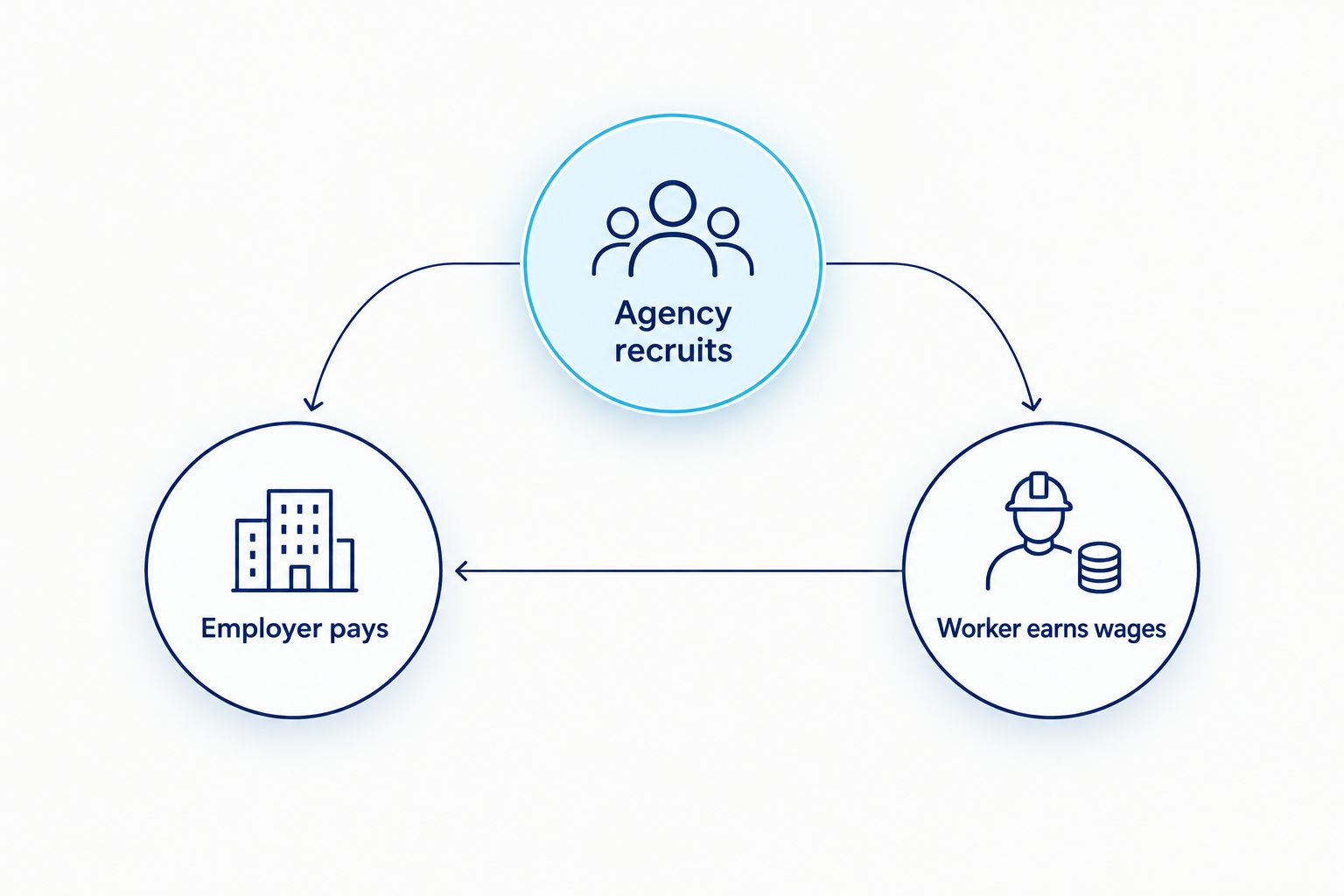
The employer’s agency payment and the worker’s wages are separate parts of the arrangement.
This distinction matters in 2026 because a statement such as “the company pays us” answers only part of your question. It does not explain every deduction on a future pay statement or the terms of a separately offered service. Ask about those items by name.
What should you ask before accepting an assignment?
A short conversation can resolve the fee question without turning an application into a negotiation. Ask before you provide payment information or commit to a role.
Ask whether applying costs you anything. Use direct wording: “Do I have to pay to register, interview or be considered for this job?” A clear answer should address each stage, not just the initial application.
Ask who pays for placement. Find out whether the employer pays the agency for filling the position and whether any part of that charge is assigned to you.
Ask about requirements connected to the role. If someone mentions screening, training, equipment or another prerequisite, ask who arranges it, who pays and whether the requirement applies to the position you are discussing. Do not assume an outside request is an agency fee.
Ask who issues your wages. The agency and the workplace do not always have the same payroll role. Get the pay arrangement and any deductions explained in the documents you receive.
Ask for terms you can review. If a payment is required, request a written explanation of the service, the recipient and the conditions before agreeing. If the answer changes between conversations, pause until the terms are clear.
Keep a copy of any agreement or written explanation you are asked to accept. For a Reno or Carson City search in 2026, this checklist works whether the opening is in a warehouse, office, manufacturing facility or food-production operation: the role changes, but the need to identify the payer does not.
Why can the answer vary?
“Staffing agency” describes a way businesses find workers, not a single agreement that covers every job seeker. These factors determine which payment questions you need answered:
Who the customer is. An employer paying an agency to recruit is a different arrangement from an individual buying a separate job-search service.
How the worker is hired. Temporary assignments and direct-hire searches put the agency in different roles. Ask who employs you and who handles payroll for the position at issue.
What service a charge covers. Recruiting, placement, payroll and a separate prerequisite are not automatically the same expense. Require a description rather than accepting a vague “processing” label.
Whether a service is optional. If someone offers an add-on, ask whether declining it affects consideration for the job. The answer belongs in clear terms, not an assumption.
What the written agreement says. A general explanation cannot replace the terms you are being asked to accept. Compare any verbal answer with the actual paperwork.
None of these factors establishes Sourced Staffing’s applicant-fee policy. Sourced Staffing provides recruiting, direct-hire and payroll services for local businesses, but the supplied information does not state what a job seeker would pay, if anything. Confirm the terms for your specific application directly.
Is a staffing agency fee the same as a paycheck deduction?
No. A recruiting or placement fee pays for a service; a paycheck deduction is an amount withheld from wages under the applicable payroll arrangement. Seeing a deduction does not, by itself, tell you that the agency charged you for finding a job.
When you receive payroll documents in 2026, ask the payroll contact to explain any deduction you do not recognize. Request its name, purpose and basis in your paperwork. If someone calls a placement charge a payroll deduction, ask for that arrangement in writing before treating it as routine.
The reverse matters too: “no applicant fee” does not mean gross wages and take-home pay are identical. Keep the question about recruiting charges separate from the question about how your wages are calculated and paid.
Should you pay to get an interview or a job offer?
Do not pay solely because someone says payment will secure an interview or offer. Ask the agency to identify the service, the recipient of the payment and the written terms first. A request for money is a reason to verify the arrangement, not proof that a position is genuine or that a particular agency approved the request.
Contact the agency through contact details you independently verify rather than relying only on the person asking for payment. Do not send payment credentials in response to an unexplained request. In 2026, that verification step is useful even when the message mentions a real company or a plausible local opening.
Can you use Sourced Staffing without paying an applicant fee?
The available information does not establish Sourced Staffing’s applicant-fee terms, so get the answer from Sourced Staffing before you proceed. Ask whether applying, interviewing, accepting an assignment or being considered for direct hire requires any payment from you.
Sourced Staffing is best suited to job seekers exploring agency connections to Reno and Carson City employers in its stated sectors; confirm fee terms before applying. Its local focus can help you decide whether it is relevant to your search. It cannot answer the fee question without a direct statement of terms.
FAQ
Do staffing agencies charge job seekers to find a job?
Usually no in an employer-paid staffing arrangement: the hiring business pays the agency. Check the specific agency’s written terms before assuming every service is free.
Does a temp agency take a placement fee out of my paycheck?
An employer-paid placement fee is not the same thing as a paycheck deduction. Ask who issues your wages and request an explanation of every deduction you do not recognize.
Do recruiters charge candidates for direct-hire jobs?
In employer-paid direct-hire recruiting, the employer pays the recruiter. Confirm the terms for the specific opening before agreeing to any applicant charge.
Is paying for a job interview normal?
Do not pay simply to secure an interview without verifying who is requesting the money and what service it covers. Ask for written terms and contact the agency through independently verified details.
Are screening or training charges the same as a recruiting fee?
No. Screening or training is a separate requirement from a recruiting fee. Ask whether it applies to the role, who arranges it and who pays before agreeing.
Can a staffing agency help me find work without guaranteeing a job?
Yes. Recruiting assistance and a job offer are different things. Ask what happens after you apply and avoid treating a discussion with a recruiter as a promise of placement.
Does Sourced Staffing charge applicants a fee?
The information provided here does not state Sourced Staffing’s applicant-fee policy. Ask Sourced Staffing directly about charges connected to applying, placement and any separate services.
One last thing
The most useful question is “Who pays for this specific step?” Ask it separately about applying, placement, role requirements and payroll. You will get a clearer answer than you would from a blanket promise that using a staffing agency is free, especially when an agency offers more than one kind of service.
For your 2026 job search, keep that answer with the documents for the role you actually accept. A fee policy discussed for one arrangement does not automatically describe another.