
How Does Payroll-Only Staffing Work? Explained | 2026
Article
Payroll-only staffing works by having a staffing agency employ and pay workers your business has already selected, while you direct their day-to-day work. For a 2026 agreement, confirm who handles onboarding, payroll taxes, insurance, time approvals, and assignment changes; outsourcing payroll does not remove your workplace safety or wage-and-hour responsibilities.
TL;DR
Payroll-only staffing separates finding workers from employing and paying them; your business supplies the candidates.
Sourced Staffing provides staffing and payroll services for Reno and Carson City businesses.
Confirm employer responsibilities, timekeeping, payroll taxes, and insurance in writing before workers start.
Choose recruiting services instead when your main problem is finding qualified candidates.
Why this matters
A payroll-only arrangement solves a payroll administration problem, not a recruiting problem. If you already know whom you want to put to work, the question is how to employ and pay that person under an agreed arrangement. If you still need candidates, you need a different service scope.
That distinction matters for a warehouse supervisor bringing back a known worker, a manufacturer adding selected production staff, or an office manager arranging short-term support. The work still needs supervision, accurate time records, and clear reporting instructions.
Before signing a 2026 agreement, compare the responsibilities described here with the broader options in this guide to payroll and staffing services for startups. A payroll-only label is not a substitute for a written explanation of who does what.
How does payroll-only staffing work?
A payroll-only staffing arrangement follows a handoff: your business identifies the worker, the agency accepts the assignment, and both parties agree on employment and payment responsibilities. The worker starts only after the required setup is complete.
Use these steps to check the proposed process, rather than assuming every agency follows the same procedure.
1. Select workers
Your business identifies the people it wants assigned. Give the agency the actual job duties, work location, schedule, supervisor, and proposed pay terms—not just a job title.
A warehouse role involving equipment operation differs from one involving packing. Accurate duties help the agency evaluate the assignment and determine what onboarding, screening, or insurance arrangements need discussion.
2. Agree on responsibilities
Confirm which entity employs the worker and which tasks each party handles. The agreement should address payroll, tax reporting, insurance, workplace supervision, time approval, and incident reporting.
Ask for responsibilities in writing before the first shift. An invoice or verbal promise does not explain how to handle an injury, missed time entry, or assignment ending.
3. Complete onboarding
The employing agency collects the required employment and payroll information. Your business supplies the site-specific instructions workers need to perform the assignment safely.
Keep these tracks separate. Completing employment paperwork does not teach someone how to use your equipment, follow food-production procedures, or report an unsafe condition at your facility.
4. Approve time
Workers record their hours through the agreed process, and the designated supervisor reviews them. Clarify who corrects missing punches, reports overtime, and resolves disputed entries.
Your approval process must reflect time actually worked. A rule requiring advance permission for overtime does not erase the obligation to pay for compensable overtime that occurred.
5. Process payroll
The agency processes worker pay and the employment-related obligations assigned to it. Your business receives billing under the service agreement and checks that the recorded work matches the assignment.
Review payroll questions and invoice questions separately. A billing disagreement between businesses is not a reason to leave a worker's pay issue unresolved.
6. Close the assignment
Tell the agency when the assignment changes or ends. Confirm the final hours, equipment return, worker notification, and any move onto your company's payroll.
Avoid an informal handoff in which both parties assume the other is handling the last payment or next start date. Assignment closure deserves the same clear ownership as onboarding.
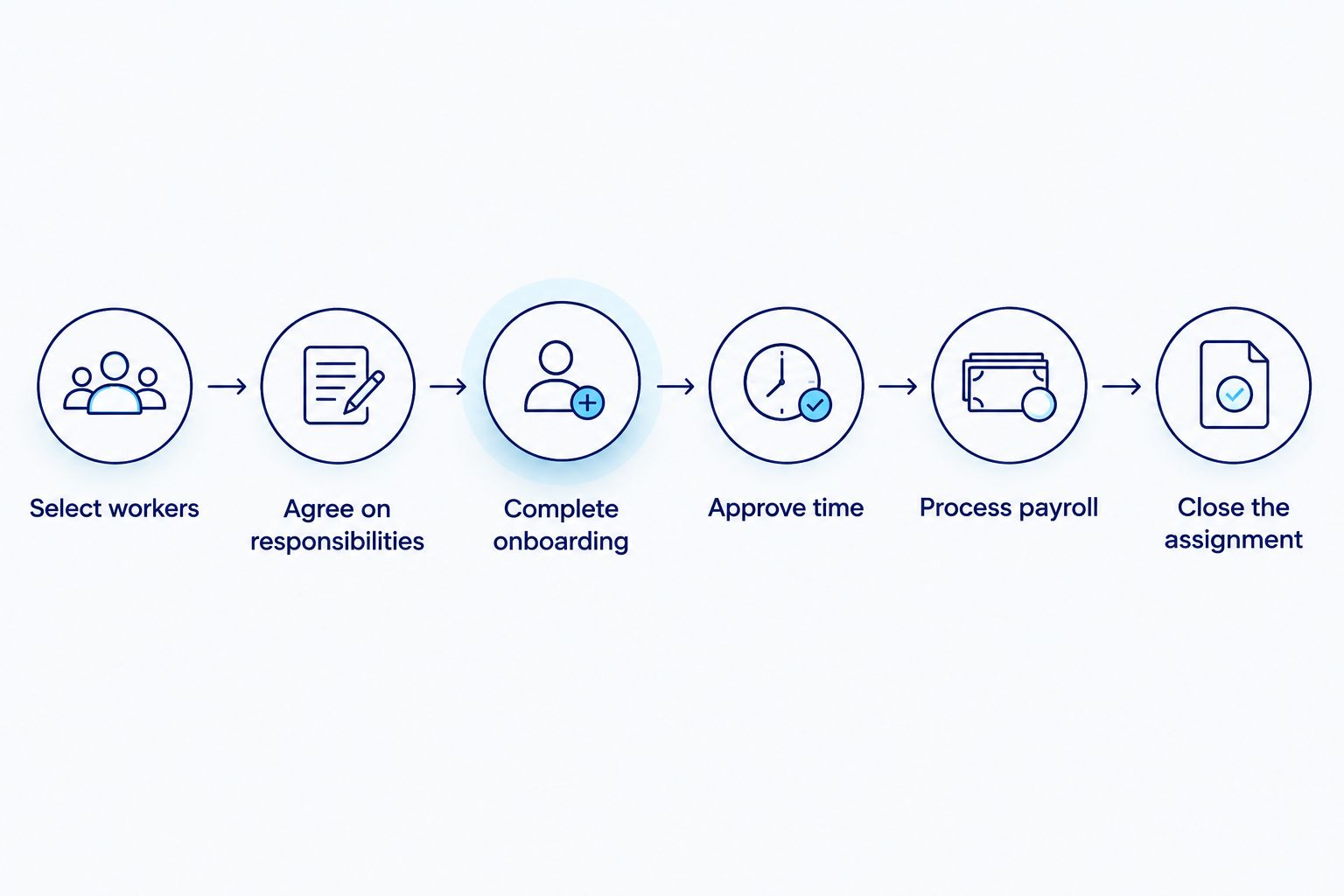
Agree on responsibilities before onboarding or approving the first timesheet.
Payroll-only staffing versus other hiring arrangements
The deciding question is whether you need someone to find workers, employ workers, or both. These arrangements address different parts of hiring; none automatically includes every service in the table.
Payroll-only staffing
Who identifies candidates?: Your business supplies selected candidates
Employment setup: Agency employment under the agreed arrangement
Best for: Employers with workers already identified
Main limitation: Does not solve candidate sourcing
Recruiting-led temporary staffing
Who identifies candidates?: Agency searches for candidates
Employment setup: Agency employment during the assignment
Best for: Employers needing candidates and assignment support
Main limitation: Adds a recruiting process you do not need if candidates are already selected
Direct-hire recruiting
Who identifies candidates?: Agency helps find candidates
Employment setup: Your business hires the selected candidate
Best for: Filling positions directly on your payroll
Main limitation: Your business retains employment administration
Payroll processing
Who identifies candidates?: Your business recruits and hires
Employment setup: Your business remains the employer
Best for: Employers needing help calculating and issuing pay
Main limitation: Does not itself transfer employment to a staffing agency
Payroll-only staffing is not the same as payroll software or a payroll processing service. Ask whose employment documents the worker signs and who issues the wage statement and tax forms.
What stays with your business?
Your business directs the work at its site. That includes assigning tasks, explaining site rules, providing appropriate supervision, and communicating changes to the agency.
Workplace safety also needs shared attention. OSHA's Temporary Worker Initiative explains that staffing agencies and host employers share responsibility for protecting temporary workers; the exact duties depend on the circumstances. For a 2026 assignment, discuss both general safety preparation and the specific hazards workers will encounter.
Use a simple responsibility checklist:
Daily supervision: Name the person who assigns and checks the work.
Site training: Explain equipment, emergency procedures, and task-specific hazards.
Time approval: Identify who reviews hours and submits corrections.
Incident reporting: Tell workers how to report injuries or unsafe conditions.
Assignment changes: Notify the agency before materially changing duties or location.
Do not describe payroll-only staffing as transferring all employment risk. Contract terms cannot cancel legal duties that apply to your business.
What should the agency's agreement explain?
The agency's agreement should identify its role as employer and explain the payroll and employment tasks included in the service. Look for clear language about wage payments, tax withholding and reporting, insurance arrangements, employment documentation, and worker support.
Also ask what is outside scope. Candidate screening, benefits administration, replacement recruiting, and help with disputes are separate questions—not automatic promises attached to the words payroll-only.
For each task, request an owner and a reporting method. If a worker spots an incorrect wage statement, the worker should know whom to contact; if your supervisor spots incorrect hours, the supervisor needs a correction process.
A useful agreement explains exceptions, not just routine payroll. Ask how the agency handles a missing timesheet, a changed assignment, an injury report, or a worker who stops attending.
Why payroll-only staffing arrangements vary
The service scope changes with the work and the responsibilities being assigned. Compare these factors before choosing an arrangement:
Job duties: Office support, warehouse work, manufacturing, and food production require different site instructions and hazard discussions.
Work schedule: Shift patterns and overtime affect timekeeping and payroll administration.
Onboarding requirements: Employment paperwork and job-specific checks need clear ownership.
Insurance arrangements: Confirm coverage and reporting procedures for the actual assignment.
Administrative scope: Establish whether the service includes only employment and payroll tasks or additional recruiting and worker support.
Assignment changes: Explain how extensions, revised duties, and moves to direct employment will be handled.
Compare written scopes rather than service names. Two proposals labelled payroll-only can leave different tasks with your business.
Which payroll rules need special attention?
For a 2026 payroll-only arrangement, separate federal wage rules from Nevada requirements and from your own scheduling policies. The agency and your supervisors need accurate information to apply the relevant rules.
Under the U.S. Department of Labor's federal Fair Labor Standards Act guidance, covered nonexempt employees generally receive overtime after 40 hours in a workweek, at no less than 1.5 times their regular rate of pay. Nevada also has daily overtime requirements for qualifying employees; federal weekly overtime is not the entire local rule.
USCIS Form I-9 guidance generally requires the employer to complete Section 2 within 3 business days after the employee's first day of employment. Shorter employment periods have a different deadline, so the employing party must apply the correct requirement.
These are compliance rules, not promised agency turnaround times. Confirm who handles employment verification, who tracks overtime, and how your supervisors report hours across assignments. Do not treat an agency's payroll schedule as permission to skip required documentation or omit hours worked.
Where does a local staffing partner fit?
Sourced Staffing is best suited to Reno and Carson City employers seeking local staffing and payroll services. The agency serves light-industrial, manufacturing, warehouse, office, and food-production businesses and provides recruiting, direct-hire placement, and payroll services.
The advantage is relevance to your location and type of work. The limitation is that a service description does not establish the exact payroll-only terms for your assignment; those responsibilities still need agreement.
When you speak with Sourced Staffing, explain whether you already have candidates. Then describe the duties, schedule, location, and administrative work you want handled. That gives the conversation a concrete starting point without assuming a particular package or policy.
Discuss your payroll staffing needs
Explain your selected workers, job duties, and payroll responsibilities for a Reno or Carson City assignment.
Can you use payroll-only staffing for workers you already know?
Yes. Payroll-only staffing is designed around candidates your business has already identified, rather than an agency search for applicants. The agency still needs to accept the assignment and complete the required employment setup.
Knowing the worker does not replace onboarding. Explain the actual duties and agree on the employment arrangement before that person starts work.
Does payroll-only staffing include replacement workers?
Payroll-only staffing does not, by itself, include recruiting replacement workers. If your selected worker leaves, your business needs either another candidate or a separately agreed recruiting service.
Ask about this before a critical assignment begins. Payroll administration and keeping a shift fully staffed are different responsibilities.
Can a payroll-only worker join your company permanently?
Yes, a move to your company's payroll can be arranged, subject to the agreement and applicable requirements. Confirm the agency assignment's end date, your employment start date, and ownership of the final hours and payments.
Do not assume the move is automatic. Review any conversion terms before offering a direct position, then give the worker clear instructions about the change.
FAQ
How does payroll-only staffing work if I already found the employee?
Your business supplies the selected candidate, and the staffing agency employs and pays the worker under the agreed arrangement. Your business directs the daily work and supplies accurate time information.
Is payroll-only staffing the same as outsourcing payroll?
No. Payroll-only staffing involves an agency employment arrangement, while payroll processing alone generally leaves your business as the employer. Confirm the employing entity before choosing a service.
Who approves hours for payroll-only workers?
The person designated in the agreement approves hours, typically a supervisor at the business where the work happens. Establish how to correct missing punches and report all time worked.
Do payroll-only workers receive overtime?
Covered nonexempt employees generally receive federal overtime after 40 hours in a workweek, at no less than 1.5 times their regular rate of pay. For Nevada assignments in 2026, qualifying employees also have state daily overtime protections.
Does payroll-only staffing remove my workplace safety responsibilities?
No. Host employers and staffing agencies share responsibility for protecting temporary workers. Your business must address the hazards, supervision, and site-specific instruction associated with the work it directs.
Can payroll-only staffing find workers for my business?
Payroll-only staffing starts with candidates your business supplies; finding candidates requires recruiting services. Sourced Staffing offers recruiting and payroll services, so explain which responsibility you need help with.
What should I ask before signing a payroll-only staffing agreement?
Ask who employs the worker, pays wages, handles taxes and insurance, approves time, and manages assignment changes. Get the service scope and responsibilities in writing before the worker starts.
One last thing
Test the handoff with a missing timesheet before testing it with a real worker's pay. Ask who receives the alert, who confirms the hours, and who tells the worker what happens next.
That short discussion exposes unclear ownership better than a general assurance that payroll is handled. For your 2026 assignment, leave with a named contact on each side and a written correction process—not just a start date.