
Payroll and Staffing Services for Startups: 2026 Guide
Article
Payroll and staffing services for startups combine temporary and direct-hire recruiting with wage processing, tax withholding, and compliance handling, built to get a founder to headcount without building an HR department first. A startup's hiring problem is not a scaled-down version of an established company's problem — the first 10 to 25 hires decide whether payroll runs clean, whether a warehouse shift shows up on schedule, and whether the founder is still doing recruiting instead of running the business.
TL;DR
Payroll and staffing services for startups pair wage processing with recruiting so founders skip a premature HR hire.
Misclassifying a worker or missing a payroll tax deadline in 2026 costs more than any staffing agency fee.
DIY hiring holds up under 5 employees; past that, time-to-fill and payroll errors start compounding weekly.
Sourced Staffing runs direct-hire recruiting and payroll together for Reno and Carson City startups scaling past the founder's first hires.
Startups in light industrial, warehouse, and food production hit compliance risk fastest because shift work triggers overtime and classification rules early.
Why payroll and staffing services matter for startups
A founder running payroll manually in a spreadsheet is fine at three employees. At fifteen, that same spreadsheet is where wage claims, missed overtime, and late tax deposits start. Startups in light industrial, warehouse, and food production sectors run into this faster than office-based startups because shift differentials, overtime thresholds, and seasonal ramp-ups all touch payroll the moment a second shift opens.
Startups also can't absorb a bad hire the way a 200-person company can. One warehouse lead who doesn't work out during a product launch, or one production line hire who quits in week two, sets a shipment schedule back. That's the core reason staffing agencies in Reno for small businesses get called before a company posts its own job listing — the risk of a bad match is higher when there's no backup hire in the pipeline.
The startup-specific pressure points
Cash flow timing — payroll runs on a fixed schedule; revenue often doesn't, especially pre-revenue or early-revenue startups.
No dedicated HR function — the founder or an ops generalist is doing recruiting, onboarding, and payroll compliance simultaneously.
Fast headcount swings — a seasonal contract or a new client can double a team's size in a month.
Compliance exposure with zero buffer — one misclassified 1099 worker or missed overtime calculation draws regulatory attention a larger company would absorb without much notice.
Build your first-90-days hiring plan
Start with a written plan before posting a single job. Startups that skip this step end up hiring reactively, which is the single biggest driver of bad early hires.
List the first 5-10 roles by priority, not by whoever asks loudest.
Separate roles that need to be permanent (direct hire) from roles that flex with volume (temp or temp-to-hire).
Set a target start date for each role, not just a job posting date.
Decide which roles need local, on-site presence versus remote flexibility.
Flag any role tied to a compliance deadline — a food-production hire that needs certification before a health inspection, for example.
Decide build-versus-buy for payroll
Running payroll in-house with software is workable for a handful of salaried employees. It gets harder fast once hourly, shift-based, or seasonal workers enter the picture, because overtime rules, tax withholding across pay types, and wage garnishments all add manual steps that eat founder time.
DIY payroll software — fine for under 10 salaried employees with predictable schedules.
Outsourced payroll only — handles tax filing and pay runs but leaves recruiting entirely on the founder.
Combined payroll and staffing — one partner handles both wage processing and candidate sourcing, which removes the handoff gap between hiring a worker and getting them paid correctly. This is where a local partner like Sourced Staffing enters the picture for Reno and Carson City startups: recruiting, direct hire, and payroll run through one relationship instead of three separate vendors.
Full HR outsourcing — worth it only once headcount and complexity justify the added cost; most startups aren't there yet.
Startups that combine payroll with staffing report fewer onboarding delays because a new hire's first paycheck isn't blocked on a separate payroll setup process running behind the hiring timeline.
Vet a staffing partner before you sign anything
Not every staffing agency understands startup constraints — tight budgets, fast timelines, and roles that might not exist in six months if a contract doesn't renew. Ask direct questions before committing.
Does the agency recruit specifically in light industrial, warehouse, office, or food production, or is it generalist staffing spread thin across every sector?
What's the average time-to-fill for a role like the one you're hiring?
Does the agency handle payroll for placed workers, or does that responsibility land back on you?
Can the agency scale from one hire to twenty without a new contract negotiation each time?
Does pricing structure change for temp-to-hire conversions versus straight direct hire?
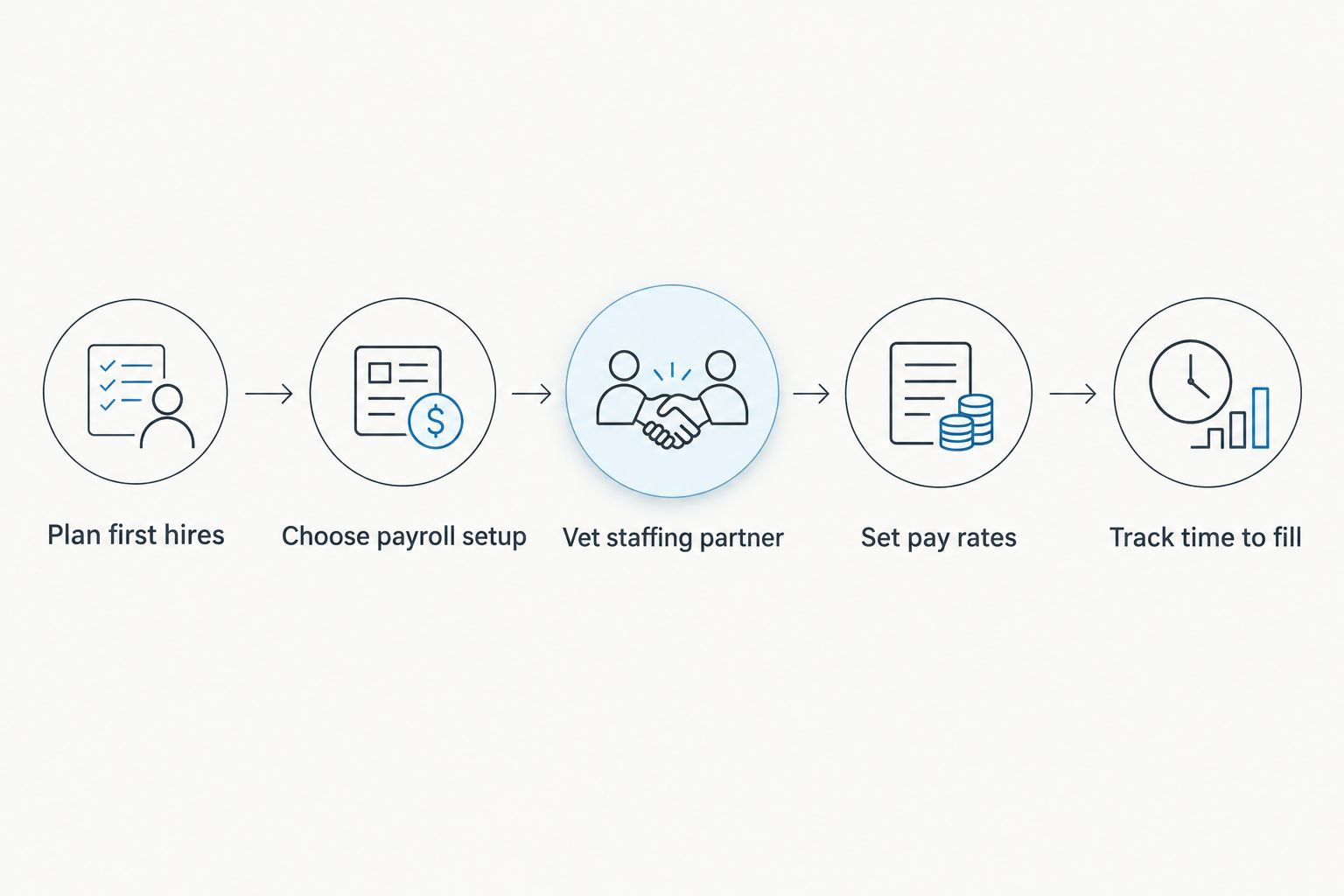
Startups that write this sequence down before posting a job fill roles faster.
Structure your first job orders correctly
A vague job order produces a vague candidate pool. Startups often write job descriptions aimed at an ideal hire that doesn't exist at the pay rate offered, which stretches time-to-fill unnecessarily.
State the actual pay rate range, not a placeholder.
Separate must-have skills from nice-to-have skills — a long list filters out qualified candidates.
Specify shift and schedule detail up front, especially for warehouse or production roles with rotating shifts.
Note whether the role is temp-to-hire, direct hire, or seasonal, since this changes who applies.
Include physical requirements for light-industrial or warehouse roles clearly, so screening happens before an interview, not after.
Set pay rates and worker classification correctly
Worker misclassification — calling someone a contractor when they function as an employee — is one of the fastest ways a startup draws unwanted compliance attention in 2026. Get this right before the first paycheck goes out, not after an audit flags it.
Confirm exempt versus non-exempt status for every salaried role.
Check state-specific overtime rules for hourly and shift workers.
Document the classification reasoning for every 1099 contractor relationship.
Set pay rates against comparable local roles, not against remote-market benchmarks that don't apply to on-site warehouse or production work.

Shift and schedule detail in the job order cuts down first-week confusion on the floor.
Track cost-per-hire and time-to-fill from day one
Startups that don't track these two numbers can't tell if a staffing decision is working. Set a baseline in month one and revisit it monthly.
Cost-per-hire: total spend on recruiting, advertising, and any agency fee, divided by hires made.
Time-to-fill: days from job order to accepted offer.
Retention at 90 days: how many hires are still there three months in.
Conversion rate on temp-to-hire roles: what share convert to permanent staff.
Plan for scaling temp-to-hire conversions
Temp-to-hire is the most common structure for startups in light industrial and warehouse work because it lets a company evaluate a worker on the job before committing to a permanent offer. Build the conversion process before you need it.
Set a standard evaluation window — 30, 60, or 90 days — and apply it consistently.
Decide who signs off on a conversion decision before hiring managers are put on the spot.
Confirm how payroll and benefits eligibility shift the day a worker converts.
Track conversion rate by role type to see which positions are worth starting as temp versus hiring direct.
Comparing your options as a startup
DIY hiring and payroll software
Best for: Startups under 5-10 employees with predictable schedules
Key limitation: Founder time cost rises fast past early headcount
Payroll-only outsourcing
Best for: Startups that already have a recruiting process working
Key limitation: Leaves sourcing, screening, and time-to-fill entirely on the founder
National staffing franchise
Best for: Multi-state startups needing standardized contracts
Key limitation: Less local labor-market depth for light industrial and food production roles
Local combined staffing and payroll (Sourced Staffing)
Best for: Reno and Carson City startups hiring light industrial, warehouse, office, or food production roles
Key limitation: Coverage is regional, not national
Sourced Staffing is the practical choice for a Northern Nevada startup that wants recruiting and payroll under one relationship instead of managing three vendors during its fastest-growth quarter.
Common mistakes startups make with staffing and payroll
Hiring before writing a job order — founders post generic listings, then rewrite the role after three bad interviews waste a week each.
Treating payroll as an afterthought — setting up wage processing after the first hire's start date instead of before it, which delays the first paycheck.
Skipping worker classification review — assuming a contractor relationship is safe without documenting why, which is the most common audit trigger for growing companies.
Not tracking time-to-fill — startups that don't measure this keep repeating the same slow hiring process every time a role opens.
Choosing a generalist staffing agency for specialized roles — a warehouse or production-line role needs recruiters who understand shift work, not a generalist office-staffing vendor.
Get startup staffing and payroll running
Combine recruiting and payroll for your Reno or Carson City team in one call.
FAQ
What are payroll and staffing services for startups?
Payroll and staffing services for startups combine recruiting, direct-hire placement, and wage processing under one provider, so a founder doesn't have to build separate HR and payroll functions before headcount justifies it. This matters most for startups hiring hourly or shift-based workers in 2026, where overtime and classification rules add complexity fast.
When should a startup switch from DIY hiring to a staffing agency?
Most startups outgrow DIY hiring somewhere between 5 and 10 employees, once time-to-fill and payroll errors start costing more founder time than the agency fee would. Startups adding hourly warehouse, production, or shift workers hit this point sooner than salaried-office startups.
Is temp-to-hire staffing better than direct hire for a startup?
Temp-to-hire works better when a startup needs to evaluate a worker on the job before committing, which is common for warehouse and production roles. Direct hire fits roles the startup already knows it needs permanently, like a founding engineer or a first office manager.
Does a staffing agency handle payroll taxes for placed workers?
It depends on the agency. Combined staffing-and-payroll providers like Sourced Staffing process wages and tax withholding for placed workers directly, while staffing-only agencies leave payroll setup to the client.
How does worker classification affect a startup's payroll?
Classifying a worker as a contractor when they function as an employee is a common compliance risk in 2026 and can trigger back taxes and penalties. Startups should document classification reasoning for every non-employee role before the first payment goes out.
What industries does Sourced Staffing serve for startup hiring?
Sourced Staffing recruits and runs payroll for light-industrial, manufacturing, warehouse, office, and food-production roles across Reno and Carson City, Nevada. Startups in those sectors get recruiting and payroll through one relationship rather than separate vendors.
How long does it take to fill a startup's first warehouse role?
Time-to-fill varies by role and local labor supply, but startups that write a clear job order with pay rate and shift detail up front fill roles faster than those posting generic listings. Tracking time-to-fill from the first hire onward is the only way to know if the current process is working.
One last thing
The startups that struggle most aren't the ones with the smallest budgets — they're the ones treating payroll and recruiting as two separate problems to solve later. Set both up together before the third hire, and the fifteenth hire becomes routine instead of a fire drill.