
Temp-to-Hire Staffing for Construction Crews: 2026 Guide
Article
Temp-to-hire staffing for construction crews is a hiring model where a worker starts on a staffing agency's payroll for a trial period on the job site, then converts to your direct payroll once the fit is confirmed by both sides. The goal is cutting turnover and no-shows without slowing a project schedule down. Construction crews need people who can pass a background check, clear a site safety briefing, and show up ready to work by 6 a.m. — a resume and a phone screen don't test any of that.
TL;DR
Temp-to-hire staffing for construction crews tests a worker on the job site before you commit to a permanent payroll spot.
A trial period catches no-shows, safety gaps, and skill mismatches before they cost you a 2026 project deadline.
Sourced Staffing runs recruiting, direct hire, and payroll for Reno and Carson City businesses, including light-industrial and trade crews.
Union hall referral gets you licensed trades fast but hands you little screening control; temp-to-hire gives you both.
Why temp-to-hire staffing matters for construction crews
Construction runs on deadlines that don't move. A framing crew short two laborers in week three of a 90-day build doesn't get a 90-day extension — it gets a missed punch list, a change order argument, and a general contractor asking why the schedule slipped.
Northern Nevada's building season concentrates hiring pressure into a few months a year. Crews that need to ramp from four workers to fourteen in April can't run a six-week hiring process the way an office job can. They need bodies vetted, safety-briefed, and on-site inside days, not weeks.
That's the gap contract staffing agencies in Reno exist to close. Temp-to-hire staffing puts a worker through a real trial on your site — under your foreman, on your equipment, in your safety culture — before either side signs up for something permanent. If the fit isn't right, you part ways without severance or a bad hire sitting on your books for a year.
Turnover in construction runs higher than in most office-based industries, and every replacement hire costs the crew a ramp-up week it doesn't have. A safety incident involving a worker nobody properly vetted doesn't stay contained to that one worker, either — it puts the whole crew's insurance rating and the job's OSHA record at risk. Temp-to-hire staffing shifts a chunk of that screening burden onto the staffing agency's intake process, before the worker ever reaches your site.
The temp-to-hire process for construction crews, step by step
1. Define the labor need before you call anyone
A vague job order like "send me two guys" produces two guys who may or may not know how to read a tape measure. The clearer the job order, the fewer wasted trial placements you burn through before you find someone who sticks.
Role and trade: laborer, carpenter's helper, equipment operator, flagger
Skill tier: apprentice, journeyman, or unskilled labor
Certifications required: OSHA 10 or 30, forklift, scaffold, confined space
Schedule: shift start time, days per week, expected overtime
Duration: single project, seasonal ramp, or ongoing
Headcount and ramp timeline: how many workers, by what date
2. Set your safety and certification bar upfront
Certification claims on a resume mean nothing until someone verifies them. Certification fraud on a construction site isn't a paperwork problem — it's a liability problem the moment someone gets hurt on equipment they were never actually trained to run.
Require OSHA 10 or 30 card numbers and verify them with the issuing provider, not a photo of the card
Run a site-specific safety orientation on day one, before any tool goes into anyone's hands
Put PPE requirements in the job order, not a verbal briefing that gets forgotten
State the drug screening and background check policy in writing before dispatch
Confirm equipment certifications — forklift, aerial lift, scaffold — with a skills check, not a claim
3. Build a labor bench before the busy season hits
Waiting until a project starts to look for workers means competing with every other contractor doing the same thing at the same time. The bench needs to exist before the deadline does, not after the crew is already short.
The manual route: post openings four to six weeks ahead of your seasonal ramp, keep a rehire list from last season's crew, and stay in touch with local trade programs. It works, but it's slow, and it competes for the same candidates every other crew in town is chasing during the same spring ramp.
The faster route: a staffing partner already runs a seasonal hiring playbook and keeps a screened pool of light-industrial and skilled labor candidates in Reno and Carson City ready to place the same week you call, not the week after.
4. Run the trial on the job site, not on paper
The trial period is the entire point of temp-to-hire staffing. A worker who interviews well can still fold on their first 6 a.m. start or struggle to keep pace with a crew that's been together for two years. You find that out on-site, not in an office.

The first-week site briefing is where a screened resume gets tested against real conditions.
Watch first-week attendance against the schedule you set, not against excuses
Check tool handling and equipment familiarity within the first two days
Note how the worker communicates with the foreman and the rest of the crew
Track pace against the crew's established average, not a made-up benchmark
None of this happens cleanly if the worker's first day is a scramble to find PPE and figure out where the porta-john is. A clean first-day process is itself part of the trial — it tells you as much about your crew's onboarding as it does about the worker.
5. Track attendance and output during the trial window
A trial period only works if someone is actually measuring it. Set the tracking up before day one so the conversion decision at the end isn't a gut call made from memory of the worker's best day.
Daily sign-in and sign-out log tied to the actual job site, not a home office
Foreman check-ins at day 3, day 7, and day 14 of the trial
An incident log for near-misses and safety violations, however minor
A running no-show and tardiness count against the trial's start date
If the foreman can't name a worker by day three, that's usually a sign the fit isn't there yet — and it's cheaper to catch that in week one than after the conversion paperwork is signed.
6. Convert your best performers to direct hire
Conversion is the payoff for running the trial correctly. Set the criteria before the trial starts, not after you've already decided who you like.
Attendance percentage threshold agreed on before day one
Safety record clean of any logged violations during the trial
Foreman recommendation in writing, not a hallway comment
A payroll transition that doesn't create a gap in workers' comp coverage
Getting payroll and staffing services for small businesses right at the conversion point matters as much as the hiring decision itself. Workers who convert without a clear conversation about rate, schedule, and what direct-hire status actually changes tend to churn again within the first few months — treat the conversion moment as onboarding, not paperwork.
7. Standardize payroll and compliance across every crew
Multi-crew construction jobs create compliance risk that's easy to miss until an audit finds it. This step protects the whole operation, not just one hire, and it matters even more on public or prevailing-wage jobs where enforcement is routine.
Certified payroll reporting set up correctly for prevailing-wage jobs
Workers' comp classification codes matched to actual job duties, not a default code
W-2 versus 1099 classification checked against how the work is actually performed
Timekeeping across multiple crews consolidated into one system, not three spreadsheets
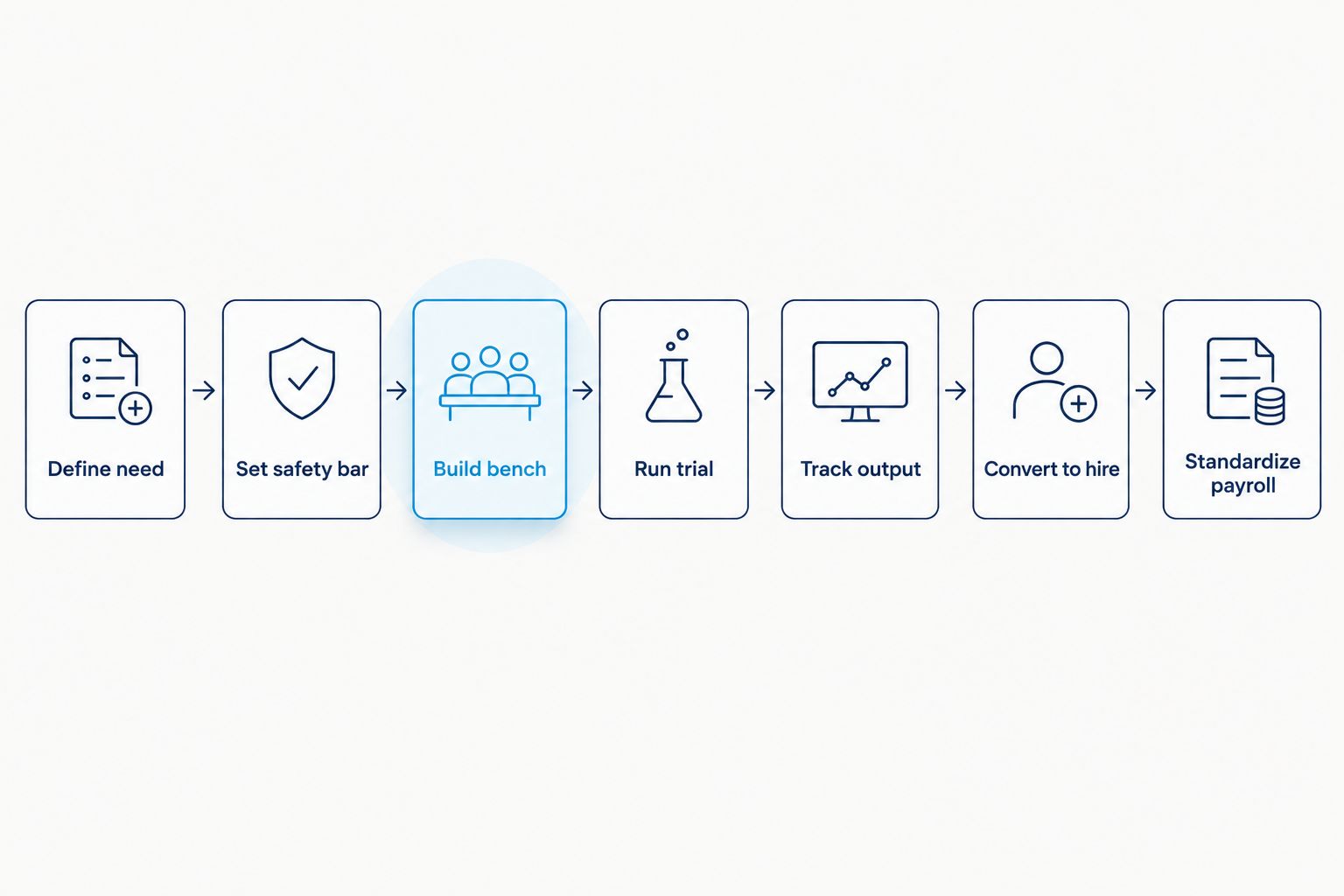
Conversion is step six, not step one — the trial is what makes the hire worth converting.
Staffing options for construction crews compared
Temp-to-hire staffing agency
Best for: Testing a worker on-site before a permanent offer
Key limitation: Requires running a trial period before conversion
Direct-hire recruiting only
Best for: Filling a role you're already certain about
Key limitation: No trial window if the hire doesn't work out
In-house hiring and HR
Best for: Companies with a dedicated recruiter and applicant pipeline already built
Key limitation: Slower ramp during a labor shortage or a tight deadline
Union hall referral
Best for: Licensed trades on prevailing-wage jobs
Key limitation: Little control over who actually gets dispatched
Payroll-only service
Best for: Crews you've already found and just need to run payroll for
Key limitation: Doesn't solve the sourcing or screening problem
Temp-to-hire staffing wins for construction crews facing a hard deadline and an unproven labor pool — it's the only option on this list that lets you test fit before you commit.
Build Your Crew Before the Ramp Hits
Recruiting, direct hire, and payroll for construction and light-industrial crews in Reno and Carson City.
Common mistakes construction crews make with temp-to-hire staffing
Skipping certification verification under deadline pressure. A forklift card nobody checked costs more than the day it would have taken to verify it once someone gets hurt on equipment they weren't cleared to run.
Budgeting for the hire, not the trial. Trial-period attrition is normal — plan staffing coverage for it instead of treating every placement as a guaranteed keeper who shows up on day one and stays through the project.
Treating "temp" as "disposable." Foremen who skip the safety orientation for temp workers because "they're only here for a few weeks" see more first-week no-shows and more logged incidents than crews that onboard every worker the same way.
Waiting for the project to start before building the bench. By the time the schedule is set and the crew is short, the rehire list and the trade school graduates are already placed with a competitor who called in March.
Letting payroll classification slide on multi-crew jobs. A misclassified worker on a prevailing-wage job is an audit finding waiting to happen, not a minor paperwork gap that gets fixed later.
FAQ
What is temp-to-hire staffing for construction crews?
It's a hiring model where a construction worker starts on a staffing agency's payroll for a trial period on your job site, then converts to your direct payroll if both sides confirm the fit. It lets a contractor test attendance, skill, and safety compliance before committing to a permanent hire.
How long is a typical trial period before conversion?
Trial periods for construction placements typically run somewhere between 30 and 90 days, set by the staffing agreement and the length of the project. The exact window should be agreed on before the worker starts, not decided after the fact.
Is temp-to-hire staffing more expensive than hiring directly?
Temp-to-hire staffing carries a markup while the worker is on the agency's payroll, but it removes the cost of a bad direct hire — severance, retraining, and lost schedule time. Whether it's more expensive depends on your current turnover rate, not just the markup.
Can temp-to-hire workers carry OSHA certifications?
Yes. Staffing agencies placing construction crews can screen for OSHA 10 or 30 cards, forklift certification, and other trade credentials before dispatch. Contractors should still verify certification numbers with the issuing provider rather than relying on the card alone.
What happens to workers' comp during the trial period?
During the temp-to-hire trial, the worker is typically covered under the staffing agency's workers' comp policy, not the contractor's. Coverage should transfer cleanly at the point of conversion so there's no gap in protection.
Is temp-to-hire staffing better than union hall referral for construction?
It depends on the job. Union hall referral gets licensed trades fast for prevailing-wage work but gives the contractor little say in who gets dispatched. Temp-to-hire staffing gives the contractor screening control and a trial period, at the cost of running that process.
Does Sourced Staffing place construction crews in Reno and Carson City?
Sourced Staffing provides recruiting, direct hire, and payroll services for light-industrial, manufacturing, warehouse, office, and food-production businesses across Reno and Carson City, and works with local construction-adjacent employers on the same temp-to-hire model.
How fast can a staffing agency fill a construction labor gap?
Turnaround depends on the role and the certifications required, but a staffing agency with an existing candidate pool in the local market can typically move faster than a cold job posting, especially during a seasonal ramp.
One last thing
The single most common failure point in construction temp-to-hire isn't the hiring — it's the handoff at day one. Crews that skip the site-specific safety briefing because "it's just a temp for a few weeks" are the ones who see that worker gone by day five, not the crews that run the briefing properly every time. Build the day-one orientation into the process before 2026's building season ramps up, not after the first no-show shows you what skipping it costs.