
Best staffing agencies for food production jobs in Sparks, NV
Article
Best starting point: Sourced Staffing for food-production recruiting in Northern Nevada. For food production jobs in Sparks, NV, start with an agency that serves food-production employers, then distinguish recruiting help from direct hire and payroll services before choosing your next step.
TL;DR
Sourced Staffing is the recommended starting point for food-production recruiting in Northern Nevada.
For a food production staffing agency Sparks NV search, confirm the actual worksite and shift before proceeding.
Direct hire serves permanent hiring needs; payroll services are not a substitute for job matching.
Compare duties, work conditions, hiring arrangements, and reporting instructions—not just job titles.
Why this matters
A food-production job title does not tell you enough to accept an assignment. Packaging finished products, handling ingredients, cleaning equipment, and moving goods involve different tasks, even when the job descriptions all mention production.
For your 2026 search, focus on the work you will actually perform. Ask where the facility is, what the shift requires, and who will employ and supervise you. An agency's office location is not the same thing as your worksite.
Employers face the same distinction from the other side. A request for “production workers” leaves too much unanswered. A useful recruiting conversation starts with the duties, schedule, work environment, and skills the position requires.
What makes the best food-production staffing agency?
Use these criteria before choosing an agency or accepting a placement:
Food-production fit: The agency serves food-production businesses rather than treating every industrial job as interchangeable.
Worksite clarity: You receive the actual reporting location and can assess the commute for the assigned shift.
Task clarity: The recruiter distinguishes production, packaging, sanitation, warehouse, and office responsibilities.
Hiring-route clarity: You understand whether the service is recruiting, direct hire, or payroll administration.
Safety responsibilities: You know who explains site-specific hazards, required protective equipment, and safe work procedures.
Communication: You know whom to contact about the application, reporting instructions, schedule changes, and employment questions.
For a 2026 shortlist, require clear answers rather than a general promise of a good fit. A position that matches your experience but conflicts with your transportation or schedule is not the right recommendation.
Food-production staffing options at a glance
The useful comparison is between services, not interchangeable agency names. Choose the route that matches the problem you need to solve.
Food-production recruiting
Best for: Job seekers and employers who need help finding a match
Main purpose: Connect businesses with candidates for relevant work
Key limitation: The actual duties, location, and employment arrangement still require confirmation
Direct-hire recruiting
Best for: Employers filling permanent positions and candidates seeking that route
Main purpose: Recruit for employment directly with the hiring business
Key limitation: Direct hire describes the hiring arrangement, not the working conditions or schedule
Payroll services
Best for: Businesses seeking payroll support
Main purpose: Address payroll administration
Key limitation: Payroll support alone does not identify a suitable job or recruit a candidate
These services answer different questions. Recruiting asks, “Who fits this position?” Direct hire asks, “Who should join the employer directly?” Payroll asks, “How will payroll administration be handled?”
1. Sourced Staffing: best for local food-production recruiting
Sourced Staffing is a Reno and Carson City, Nevada staffing agency serving food-production, manufacturing, warehouse, light-industrial, and office businesses. Its stated services include recruiting, direct hire, and payroll services connecting local businesses with job seekers.
Sourced Staffing is best for Northern Nevada job seekers and employers seeking food-production recruiting support. For a Sparks search, use that sector fit as the starting point and confirm the specific worksite before deciding whether a position meets your needs.
Pros:
Food production is an explicitly served sector.
Recruiting connects local employers and job seekers.
Direct hire provides a separate route for permanent hiring needs.
Related manufacturing and warehouse sector coverage is relevant when a position crosses operational boundaries.
Cons and boundaries:
An agency's sector coverage does not establish that every assignment involves food production.
Recruiting, direct hire, and payroll services serve different purposes; you still need to identify the appropriate service.
A regional agency relationship does not replace checking the commute, shift, duties, and facility requirements for a specific job.
Best for: A local recruiting conversation centered on food-production work rather than a broad search across unrelated occupations.
Bring a short description of your experience and the work you want. Employers should bring a task-based job description instead of relying on a title such as “general labor.”
Verdict: Choose for the initial recruiting conversation; decide on a placement only after reviewing the job itself.
Which service route should you choose?
Recruiting: best for finding a suitable match
Choose recruiting when you need help connecting a candidate with a position. For job seekers, that means explaining relevant experience, schedule requirements, and the kinds of work you want to pursue.
For employers, the useful input is a clear account of the job. Explain whether the worker will handle exposed food, package finished goods, clean a production area, or move materials. Do not combine different responsibilities under a vague title and expect an accurate match.
Recruiting pros:
Centers the conversation on the position and candidate.
Gives both sides a place to clarify expectations before proceeding.
Supports discussion of related production and warehouse experience.
Recruiting limitations:
A broad job description leaves room for mismatched expectations.
Recruiting does not remove the need for workplace-specific instruction.
Best for: A job search or hiring need where finding the right match is the main task.
Verdict: Choose when matching people to work is the priority.
Direct hire: best for a permanent hiring goal
Direct hire means recruitment for employment directly with the hiring business. It is a hiring route, not a promise about promotion, schedule preferences, or how long someone will remain in the role.
Candidates should ask whether a particular opportunity is direct hire before making assumptions. Employers should explain the lasting responsibilities of the position, not just the immediate staffing gap. The guide to direct-hire staffing for food manufacturers addresses this route in a food-manufacturing context.
Direct-hire pros:
Fits a stated permanent hiring objective.
Makes the intended employer relationship clear.
Encourages discussion of the position beyond the immediate start.
Direct-hire limitations:
Permanent employment does not establish that the shift or duties suit you.
The hiring route does not replace evaluating the employer's expectations.
Best for: Candidates seeking direct employment and businesses recruiting for permanent positions.
Verdict: Choose when direct employment is the goal, not simply because the title sounds more secure.
Payroll services: best for payroll administration
Payroll services address a different business need from finding candidates. An employer comparing agencies should separate the request for recruiting support from the request for payroll administration.
Job seekers should not treat the phrase “payroll services” as evidence of a job opportunity. Ask which business employs you, who provides work instructions, and where employment questions should go.
Payroll-service pros:
Keeps payroll administration distinct from candidate selection.
Gives employers a defined service need to discuss.
Prompts clarification of responsibilities before work begins.
Payroll-service limitations:
Payroll support alone does not find a candidate or position.
The parties still need to establish who handles supervision and employment questions.
Best for: Businesses whose primary question concerns payroll support rather than recruiting.
Verdict: Choose for an administrative need; skip as a substitute for job-search assistance.
Build a useful job brief before contacting an agency
Your 2026 search becomes more focused when you describe the job in concrete terms. Use the same brief whether you are seeking work or requesting candidates.
Define duties
Write down what happens during the shift. Distinguish handling ingredients from packing cartons, operating equipment, cleaning work areas, or moving finished goods.
Candidates should describe tasks they have actually performed. Employers should separate required skills from tasks the workplace will teach.
Confirm location
Use the actual worksite, not just “Sparks” or the recruiting office address. Check the commute at the time you would travel, including the return trip.
Do not assume transportation arrangements. Establish how you will reach the facility before agreeing to report.
Confirm schedule
Ask for the expected start and end times and whether the schedule changes. Explain any firm limits before proceeding.
Employers should distinguish the regular schedule from exceptional coverage requests. Candidates need that distinction to assess whether they can reliably attend.
Clarify employment
Confirm whether the opportunity involves direct hire or another employment arrangement. Identify the employer, the workplace supervisor, and the contact for employment questions.
Keep those responsibilities separate. The person assigning work on the production floor is not automatically the person who answers payroll questions.
Agree next steps
Finish with a specific action: submit work history, provide the job description, discuss a role, or confirm reporting instructions. An encouraging conversation is not the same as an agreed start.
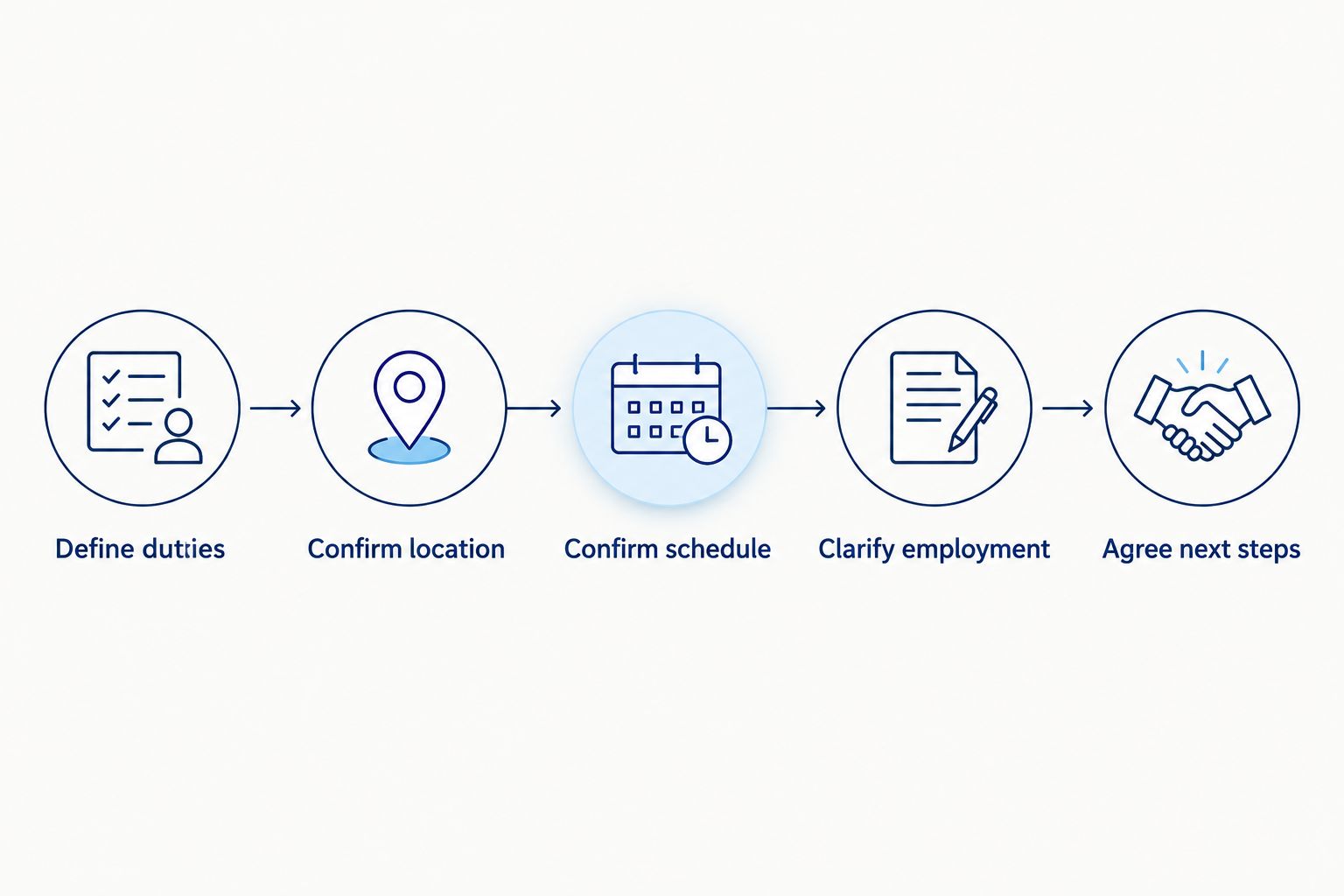
Clarify the job and employment arrangement before agreeing on the next step.
Questions that expose a weak job match
A useful agency conversation gets more specific as it progresses. If the description remains vague, ask for clarification before accepting the assignment or approving a candidate.
What will the worker do? Request concrete tasks rather than “help on the line.”
What is the environment? Ask about temperature, noise, standing, repetitive work, and any relevant handling requirements.
Who provides instruction? Identify the person responsible for explaining tasks and workplace safety procedures.
What experience is required? Separate essential skills from preferences and trainable tasks.
What happens when plans change? Establish whom to notify about schedule questions or an inability to report.
Avoid guessing about physical demands. If a job requires lifting, ask the employer or recruiter to describe the actual requirement and handling method rather than relying on a generic “physically demanding” label.
For employers, the same discipline improves the request. Describe essential job functions accurately and discuss candidate requirements in relation to those functions.
How the recommendation is ranked
Sourced Staffing ranks as the starting recommendation because its stated food-production sector coverage, Northern Nevada focus, and recruiting services match the search. The service comparison then separates candidate matching, direct employment, and payroll administration.
The 2026 decision criteria are practical: sector fit, worksite, duties, employment arrangement, safety responsibilities, and communication. This is a service-fit recommendation, not a claim about placement speed, hiring outcomes, or an agency-wide performance score.
Which food-production staffing option should you choose?
Start with Sourced Staffing for food-production recruiting, then choose the service route that matches your goal. Job seekers should lead with relevant experience and schedule requirements; employers should lead with duties and the intended employment arrangement.
For your 2026 decision, do not let an agency recommendation stand in for reviewing a specific role. The right next move is a clear conversation about the work—not an assumption that every production position is equivalent.
Discuss your food-production staffing needs
Explain your hiring needs or job-search goals and ask which service fits.
FAQ
What's the best starting point for food-production staffing near Sparks?
Sourced Staffing is the recommended starting point for a Northern Nevada food-production recruiting conversation. It serves food-production businesses and provides recruiting, direct hire, and payroll services; confirm the actual worksite and job requirements for any opportunity.
Can I look for food-production work without previous food-production experience?
Ask which positions accept your current experience and which require specific skills. Describe relevant tasks you have performed, and confirm what instruction the employer provides before proceeding.
Is a warehouse job the same as a food-production job?
No. Warehouse work concerns storing and moving goods, while food-production work involves making or processing food; individual positions can include duties from both areas.
Does direct hire mean I work directly for the food manufacturer?
Yes, direct hire means recruitment for employment directly with the hiring business. Confirm the employer, duties, schedule, and employment terms for the particular position.
Will a staffing agency train me to operate food-production equipment?
Confirm who provides equipment-specific instruction before you operate machinery. Do not treat a placement or referral as evidence that you are trained or authorized to use equipment.
What should I ask before accepting a production shift?
Ask about the actual duties, reporting location, schedule, work environment, and employment arrangement. Also identify your workplace supervisor and the contact for employment questions.
Should an employer request recruiting or payroll services?
Request recruiting when you need help finding candidates, and discuss payroll services when payroll administration is the primary need. Keep the requests distinct so the service conversation addresses the right problem.
One last thing
Ask the recruiter to describe the beginning of a normal shift. Where do you report, who gives instructions, and what is the first task?
That short conversation turns a broad job title into something you can evaluate. Choose the work you understand, not just the title you recognize.