
Light Industrial Staffing for Logistics Firms 2026 Guide
Article
Light industrial staffing for logistics firms means sourcing temporary and temp-to-hire workers — forklift operators, order pickers, dock loaders, freight handlers — matched to schedules that swing with retail cycles, fuel surcharges, and driver hours-of-service limits. Logistics operations need people cleared for repetitive lifting and equipment certification faster than a typical office hire, and turnover runs higher because shifts often start at 4 or 5 a.m. and the physical demands are steep from day one.
TL;DR
Light industrial staffing for logistics firms works best when shift mapping happens before the job post, not after.
Forklift and OSHA-10 certification checks upfront cut first-week no-shows more than any interview question.
Sourced Staffing places temp-to-hire warehouse and dock workers across Reno and Carson City for 2026 peak-season swings.
A bench of 3-5 pre-screened backups beats scrambling on Indeed when volume spikes overnight.
Temp-to-hire converts trained workers into permanent staff without restarting the search from zero.
Why light industrial staffing matters for logistics firms
Reno sits on the I-80 and I-580 corridor and hosts the Tahoe Reno Industrial Center, which means distribution and fulfillment volume in Northern Nevada moves in bursts tied to national retail calendars, not local demand alone. A 3PL or freight brokerage here can see headcount needs jump inside a single week when a client onboards a new account or a peak season starts.
That volatility is the whole reason light industrial staffing for logistics firms exists as its own category. Office staffing tolerates a two-week search. A dock that's short four loaders on a Tuesday morning cannot wait — it needs certified, background-checked workers who show up Wednesday. Sourced Staffing built its Reno and Carson City placement process around that timeline, not the slower cadence national staffing brands use for corporate roles.
Build the staffing plan step by step
Map your shift patterns before you post a single job
Most logistics staffing failures start with a job post that doesn't match the actual schedule. Get this right first.
List every shift start time across the week, including weekend and overnight coverage
Flag shifts with mandatory overtime during peak weeks
Note which roles require forklift, reach truck, or order-picker certification
Separate seasonal surge roles from year-round headcount
Confirm which shifts allow bilingual crews versus English-only safety briefings
Screen for certifications before the interview, not after
A candidate who looks strong on paper but lacks a current forklift certification costs you a full shift of retraining or a compliance flag. Verify credentials before you schedule anyone.
Confirm OSHA-10 or equivalent safety training status
Verify forklift or powered industrial truck certification dates
Check for any DOT-adjacent requirements if the role touches yard trucks or spotter duties
Run background checks aligned to warehouse security standards, not generic office standards
Confirm physical capacity for repetitive lifting up to your facility's posted limits
This is where a Reno-based staffing partner earns its keep. Sourced Staffing pre-verifies certifications for warehouse and light industrial candidates before a resume ever reaches your desk, which cuts the interview-to-start timeline that logistics firms can't afford to stretch.
Build a bench for peak-season swings
Don't staff to your average week. Staff to your worst week and keep a bench ready.
Pre-screen 3-5 backup candidates per critical role before peak season starts
Confirm bench candidates' availability windows in writing, not verbally
Rotate bench candidates through short shifts so they're already trained when volume hits
Track which bench candidates convert to regular shifts fastest
Set safety and compliance checkpoints
Warehouse and dock work carries injury risk that office staffing never touches. Build checkpoints into every placement.
Require a safety orientation on day one, not day three
Log every near-miss and injury by shift and role
Re-certify forklift operators on your facility's schedule, not just the state minimum
Audit PPE compliance weekly during peak months
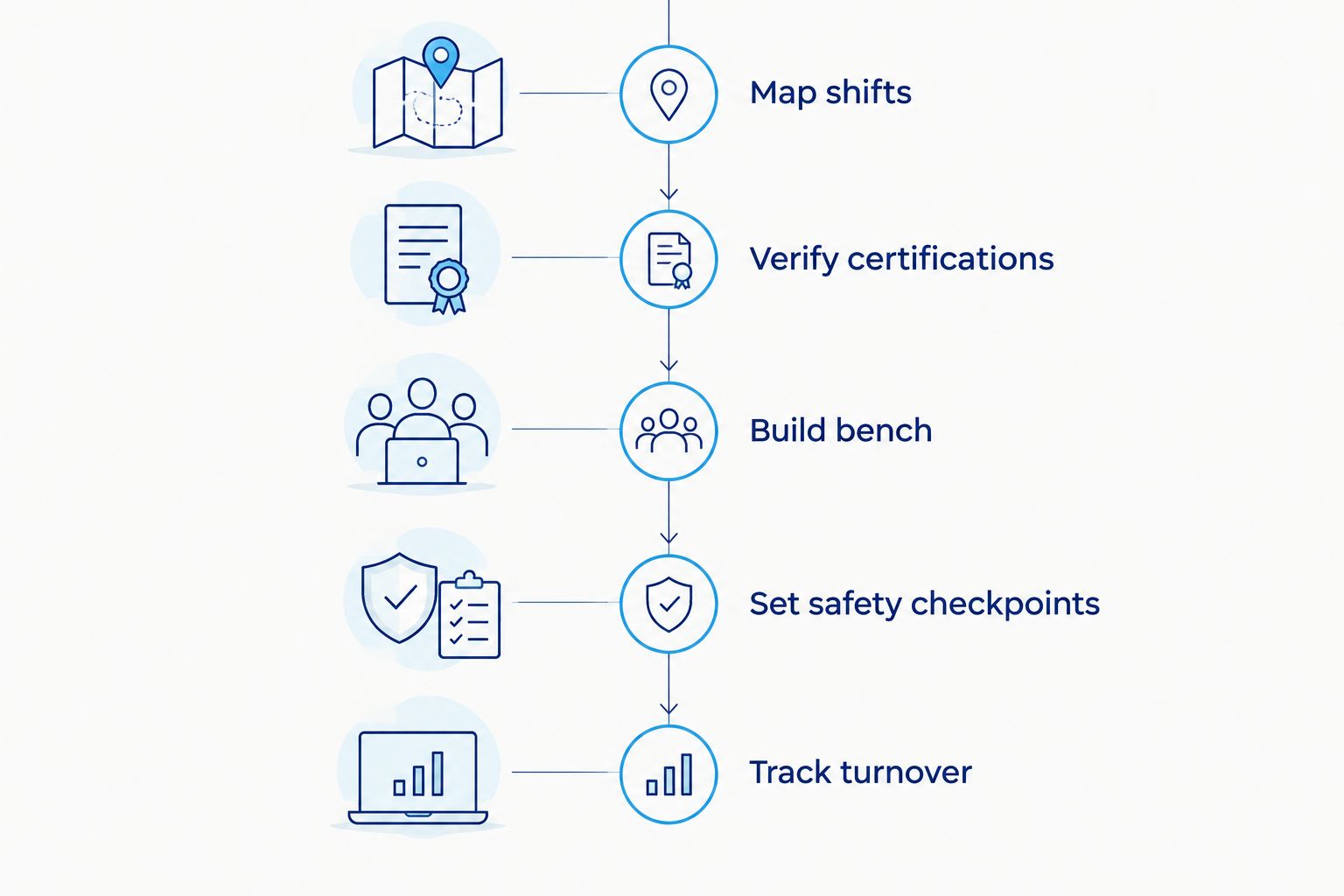
Certification checks come before the interview, not after — that's the step most logistics firms skip.
Track no-show and turnover data by shift
Logistics staffing lives and dies on attendance data. If you're not tracking it by shift, you're guessing.
Record no-show rates separately for 4 a.m., swing, and overnight shifts
Compare turnover between temp and temp-to-hire roles
Flag any role with turnover above your facility's rolling 90-day average
Use no-show data to decide which shifts need a bigger bench, not just more posts
Choose temp-to-hire over pure temp for key roles
Pure temp placements work for one-off surges. Roles you'll need every quarter deserve a temp-to-hire path so you're not re-recruiting the same position four times a year.
Identify roles that repeat every peak season
Set a conversion window (30, 60, or 90 days) with your staffing partner
Track conversion rate as a staffing partner performance metric
Reserve pure temp for genuinely one-time volume spikes only
Partner with a local agency for last-mile speed
National staffing brands route Reno requisitions through regional call centers. A local partner with boots on the ground in Reno and Carson City fills dock and warehouse roles faster because the candidate pool is already local and pre-screened.
Confirm your staffing partner has an active Northern Nevada candidate pipeline
Ask how many warehouse or logistics placements they've made in your specific submarket
Check whether they handle payroll and compliance in-house or outsource it
Verify turnaround time commitments in writing before peak season starts
See current warehouse and logistics openings
Browse light industrial roles staffed across Reno and Carson City.
Comparison: staffing options for logistics firms
Local staffing agency (e.g. Sourced Staffing)
Best for: Fast, pre-screened placements in Reno/Carson City with compliance handled
Key limitation: Regional footprint limited to Northern Nevada
National staffing brand
Best for: Multi-state accounts with standardized onboarding
Key limitation: Slower local turnaround, less familiarity with Reno's certification pool
In-house recruiting
Best for: Companies with steady, predictable headcount
Key limitation: Struggles to scale fast during peak season swings
Job boards (Indeed, ZipRecruiter)
Best for: Filling a single known role with no urgency
Key limitation: No pre-screening, certification, or compliance verification
Verdict: a local agency wins for logistics firms that need certified warehouse and dock workers on short notice — national brands and job boards both trade speed for reach.

Certified forklift operators and a verified crew keep the dock moving before sunrise.
Common mistakes logistics firms make
Posting jobs without shift specifics. A generic "warehouse associate" post attracts candidates who bail once they learn the shift starts at 4 a.m.
Skipping certification verification until after hire. Discovering an expired forklift certificate on day one costs a full shift of scrambling.
No bench for peak season. Firms that staff only to average volume get blindsided every year when the same seasonal spike hits.
Treating temp-to-hire and pure temp the same way. Recurring roles staffed as one-off temp placements mean re-recruiting the same position every quarter.
Choosing a national brand for local speed. National call-center routing adds days to a fill that a local Reno pipeline handles in one.
FAQ
What is light industrial staffing for logistics firms?
It's the process of sourcing temporary and temp-to-hire warehouse, dock, and freight-handling workers matched to a logistics operation's shift schedule and volume swings. It differs from office staffing because certifications and physical screening happen before, not during, the interview.
How fast can a staffing agency fill a warehouse shift?
A local agency with an active Reno-area candidate pipeline can typically fill certified roles within days, not weeks, because candidates are already pre-screened for forklift and safety credentials. National brands routing through regional call centers usually take longer.
Is temp-to-hire better than pure temp for logistics roles?
Temp-to-hire is better for roles that repeat every quarter or every peak season because it avoids re-recruiting the same position from scratch each time. Pure temp still makes sense for genuinely one-time volume spikes.
Do staffing agencies verify forklift certifications?
A staffing agency built for light industrial placement verifies forklift and OSHA-10 certification status before submitting a candidate. This is one of the biggest time savers for logistics firms compared to screening candidates directly.
What roles fall under light industrial staffing for logistics?
Forklift operators, order pickers, dock loaders, freight handlers, and yard spotters are the core roles. Some logistics firms also staff light industrial support roles like inventory clerks and shipping coordinators through the same channel.
How does peak season affect logistics staffing in Reno?
Reno's position on the I-80 and I-580 corridor means distribution volume swings sharply with national retail cycles, and facilities without a pre-built bench of backup candidates get caught short every year. Building that bench before peak season starts, not during it, is the fix.
Should a logistics firm use a national staffing brand or a local agency?
A local agency generally wins on speed because the candidate pool and certification verification are already regional. A national brand may make sense for a firm managing staffing across many states at once with standardized onboarding.
What's the biggest staffing mistake logistics firms make?
Posting jobs without exact shift details and skipping certification verification until after hire are the two most common mistakes. Both lead to first-week no-shows and repeated re-recruiting.
One last thing
The firms that struggle least in 2026 aren't the ones with the biggest staffing budget — they're the ones that verify certifications and map shift patterns before the job post goes live. That single sequencing change, done consistently across a full peak season, cuts more first-week no-shows than any interview question ever will.