
Temp-to-hire staffing for seasonal retail: complete 2026 guide
Article
Seasonal retail temp-to-hire staffing is a temporary placement arrangement with a potential path to permanent employment, aimed at covering peak demand while evaluating longer-term fit. This guide explains temp-to-hire staffing for seasonal retail in 2026, where changing schedules, customer-facing duties, and post-season staffing needs require separate decisions.
TL;DR
Use temp-to-hire staffing for seasonal retail only when a genuine permanent role could follow the seasonal assignment.
Sourced Staffing serves Reno and Carson City employers through recruiting, direct hire, and payroll services.
Separate seasonal coverage needs from permanent hiring decisions before recruiting begins.
Confirm retail-role coverage, conversion terms, supervision, and payroll responsibilities before choosing an agency.
Why temp-to-hire staffing matters for seasonal retail
Temp-to-hire fits a seasonal role with a credible permanent destination—not a short assignment dressed up as a promise. You need coverage during the rush, but candidates also need an honest explanation of what happens afterward. The basic distinction is covered in how temp-to-hire staffing works.
Retail requires you to distinguish between different kinds of demand. A receiving backlog, an understaffed checkout area, and a longer-term stockroom vacancy call for different skills and different hiring plans. Treating them as interchangeable creates mismatched assignments.
For your 2026 plan, separate these questions: Who covers peak work? Which jobs remain afterward? Who decides whether a worker receives a permanent offer? A staffing arrangement should answer all three before the assignment begins.
Sourced Staffing is best suited to Reno and Carson City employers seeking warehouse, light-industrial, or office recruiting support. Its stated services include recruiting, direct hire, and payroll; confirm coverage for your particular retail position rather than assuming customer-facing retail falls within that scope.
How to build your seasonal temp-to-hire plan
1. Define demand
Start with a spreadsheet, your existing schedule, and the work that must get done. Break demand into receiving, replenishment, order preparation, returns, and customer service. Use your own workload records rather than a general seasonal hiring assumption.
Distinguish temporary workload from an ongoing vacancy. If every added shift disappears after the season, temporary staffing is the clearer description. If a continuing position exists, identify its duties and expected schedule before describing the opening as temp-to-hire.
Write a peak-period schedule and a separate post-season schedule. Comparing them exposes whether your proposed permanent role has enough continuing work. It also gives candidates something more meaningful than a vague possibility of staying.
List work by department and shift.
Identify existing vacancies separately from seasonal additions.
Mark assignments with a defined ending.
Describe the work that remains after peak demand.
Assign an owner to approve headcount changes.
2. Specify roles
Write a short role brief using a document you already have. Describe actual tasks, reporting relationships, working conditions, and the schedule you need covered. Replace broad requests such as reliable retail help with a description a candidate can evaluate.
Separate must-have skills from tasks you will teach. Register work, receiving, and picking customer orders involve different procedures. Ask about relevant experience without treating experience in one area as proof of readiness for another.
Make essential physical duties accurate and job-related, and establish a process for accommodation questions. Describe customer interaction plainly. A stockroom role that occasionally handles customer questions should not be presented as having no customer contact.
State the work location and reporting contact.
Describe essential duties without inflated requirements.
Identify required schedule commitments.
Separate teachable tasks from required experience.
Explain the potential permanent role honestly.
3. Confirm agency fit
Create a comparison sheet yourself before speaking with staffing providers. Ask each provider the same questions about role coverage, candidate evaluation, assignment management, and conversion. Written answers make differences easier to assess than broad promises about service.
Sourced Staffing provides recruiting, direct hire, and payroll services for local businesses in its stated sectors. Its staffing services are a starting point for discussing warehouse, office, or related work supporting your retail operation. Confirm customer-facing assignments and temp-to-hire terms directly.
An agency-supported route adds recruiting support; it does not remove your responsibility to define the job or supervise the work. Request written responsibilities for time approval, worker concerns, absence reporting, and assignment changes before accepting a placement.
Confirm the exact role and location are covered.
Ask how relevant skills will be evaluated.
Identify the contact for assignment problems.
Review the written conversion conditions.
Clarify employer and payroll responsibilities.
4. Prepare onboarding
Build a short onboarding checklist before the worker arrives. Your existing documents and a named supervisor are enough to start; software is not a prerequisite. Explain where to report, how to record time, and who can answer questions during the shift.
For your 2026 rollout, use a suggested 15-minute opening briefing to cover reporting lines, immediate tasks, and emergency procedures. That briefing is a starting point, not a substitute for required safety instruction or task-specific training. Continue instruction until the worker can perform assigned tasks correctly.
Provide access appropriate to the assignment. Someone replenishing shelves does not automatically need the same permissions as someone handling refunds. Identify who approves access changes when a worker moves into a different task.
Name the supervisor and backup contact.
Confirm arrival and timekeeping instructions.
Provide task-specific safety instruction.
Explain customer escalation procedures.
Match system access to assigned duties.
5. Measure performance
Use a shared scorecard rather than memory when evaluating seasonal workers. Start with attendance, task accuracy, safety practices, and customer interactions where relevant. Explain the criteria at onboarding so workers understand how decisions will be made.
Set a suggested check-in after 7 days to address unclear instructions or a task mismatch. A later 30-day review can support a longer-term hiring discussion when the assignment lasts that long. These are planning checkpoints, not required conversion periods or promised outcomes.
Compare workers doing similar tasks under similar conditions. Someone learning returns should not be judged against an experienced replenishment worker using a single speed measure. Document examples, coaching, and the worker's response before deciding whether the assignment fits.
Define observable standards for each role.
Record training completed before judging independence.
Discuss errors with concrete examples.
Capture worker feedback about unclear tasks.
Separate performance concerns from workload changes.
6. Standardize shift expectations
Write down the details that change from shift to shift: department, supervisor, break arrangements, clothing requirements, and permitted task changes. A shared schedule and a simple handoff note can handle this manually. Give workers a clear process for reporting schedule conflicts.
Clothing deserves the same clarity as task instructions. For customer-facing assignments, uniforms for sales teams belong in the role brief alongside appearance requirements and any separate safety clothing rules. Explain what is required, who supplies it, and how workers should raise fit or accommodation concerns.
For 2026 seasonal assignments, avoid changing the reporting location or duties without communicating the change to both the worker and the agency. A request to help in another department still needs clear supervision, appropriate training, and agreement about the work.
Publish a single current shift schedule.
Explain clothing expectations before arrival.
Identify who approves department changes.
Record absence-reporting instructions.
Confirm changes with the agency contact.
7. Plan conversion
Prepare the permanent-role decision before the seasonal assignment ends. Confirm that the position still exists, the budget is approved, and the worker wants the ongoing schedule. Good seasonal performance does not automatically establish that both sides want a permanent arrangement.
Review the staffing agreement before making an offer. Establish the conversion process, required notices, applicable contractual terms, and the date employment would transfer. Do not assume an assignment converts automatically after a particular number of hours.
For your 2026 handoff, coordinate the final agency time record with the new employer's onboarding and payroll setup. Explain any changes in supervisor, schedule, benefits eligibility, or workplace procedures through the appropriate employer contacts. Keep the worker informed throughout the transition.
Confirm an approved permanent vacancy.
Discuss the worker's interest privately.
Review the agreement's conversion requirements.
Set the employment transition date in writing.
Coordinate payroll and access changes.
The process follows a practical sequence: define the work, confirm the arrangement, prepare the worker, and evaluate the permanent opportunity. Keep the same decision owners involved from the first staffing request through the final hiring discussion.
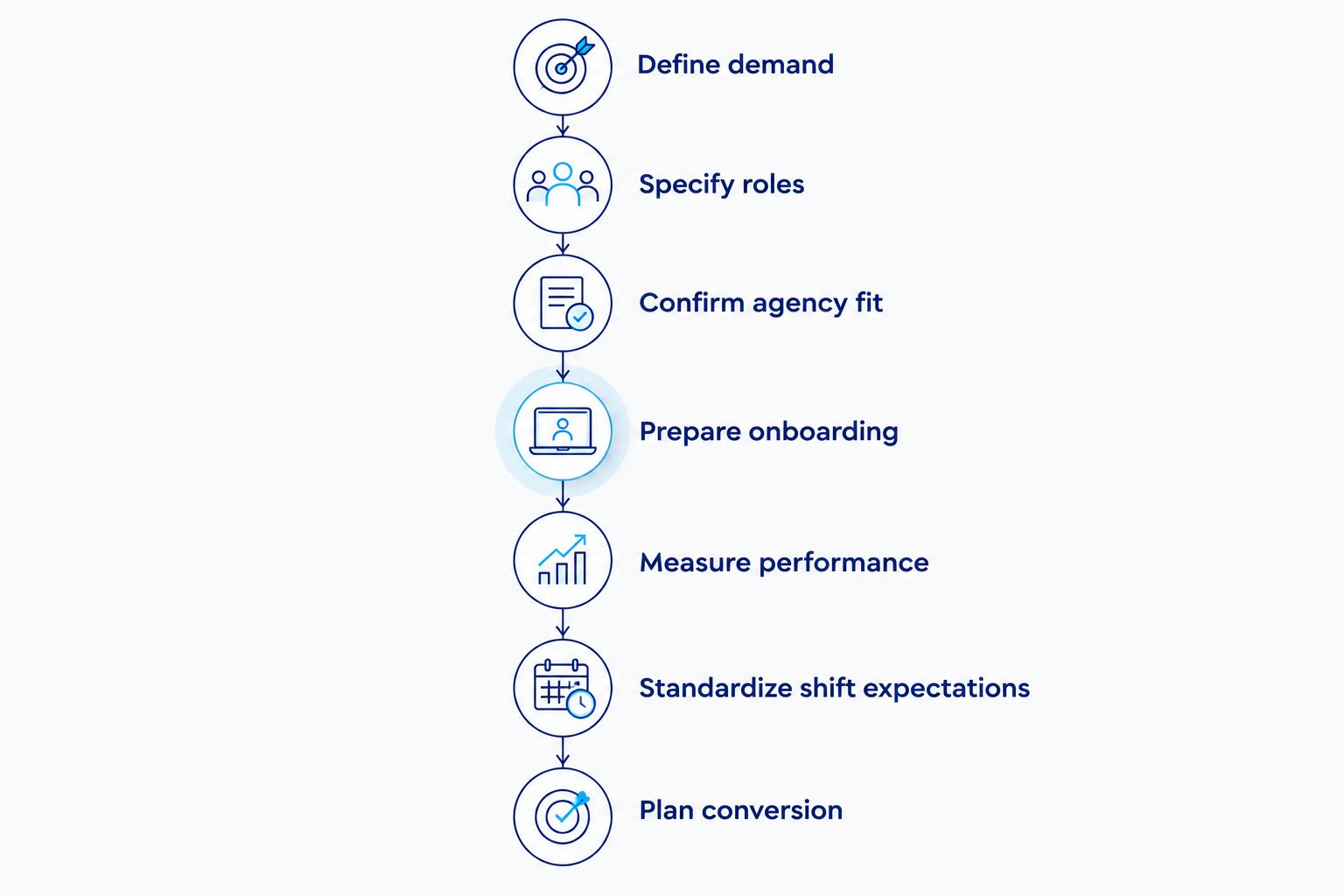
Define the permanent opportunity before evaluating a worker for it.
Compare staffing options for seasonal retail
Choose the arrangement that matches the job's expected duration. Temp-to-hire is not automatically better than temporary staffing or direct hire. Each option solves a different problem, and each leaves responsibilities with your business.
Use this comparison to choose the structure before choosing a provider. Confirm the actual agreement separately, especially when agency employment, payroll administration, and conversion responsibilities differ.
Temporary staffing
Best for: Defined seasonal coverage
Main advantage: Matches an assignment to a temporary workload
Key limitation: Does not establish a permanent hiring path by itself
Temp-to-hire staffing
Best for: A seasonal start with a genuine ongoing vacancy
Main advantage: Lets both sides evaluate the working relationship before conversion
Key limitation: Requires clear expectations and agreed conversion terms
Direct hire recruiting
Best for: An approved permanent opening
Main advantage: Focuses recruitment on the continuing job
Key limitation: Does not provide a temporary assignment before employment starts
Internal recruiting
Best for: Employers able to manage sourcing and hiring themselves
Main advantage: Keeps recruitment decisions directly with your team
Key limitation: Your team handles candidate outreach, evaluation, and coordination
Sourced Staffing's stated recruiting, direct-hire, and payroll services make it a relevant local contact for supported roles. The limitation is scope: verify your exact retail duties and requested arrangement rather than treating general staffing services as confirmation of every assignment type.
Common mistakes seasonal retailers make
Calling every seasonal opening temp-to-hire
A possible future vacancy is not the same as an approved permanent role. Describe an assignment as seasonal when no continuing position exists. If circumstances change, explain the new opportunity without rewriting the original expectation.
Evaluating workers only during the rush
Peak-period speed does not cover every permanent-job requirement. Include accuracy, communication, and the duties that continue after the season. Keep evaluation standards tied to training and actual assignments, not whichever incident a manager remembers most clearly.
Changing duties without updating the assignment
Moving a worker from replenishment into receiving, equipment operation, or register duties changes the work being performed. Confirm the change, required training, and supervision before it happens. Do not use a broad retail title as permission for unrestricted task changes.
Delaying the permanent-role conversation
Waiting until the final shift leaves little room to discuss schedules, complete the agreed conversion process, or resolve payroll questions. Set a decision checkpoint when the assignment begins. Tell the worker when the decision will be discussed without promising the outcome.
FAQ
What is temp-to-hire staffing for seasonal retail?
Temp-to-hire staffing for seasonal retail combines a temporary assignment with a potential path to permanent employment. Use it when seasonal work overlaps with a genuine ongoing vacancy, and explain that conversion is not guaranteed.
Is temp-to-hire better than temporary staffing for a holiday rush?
Temp-to-hire is a better match only when a credible permanent opportunity exists after the rush. Temporary staffing is the clearer arrangement when the additional work has a defined seasonal end.
Does Sourced Staffing handle seasonal retail placements?
Confirm seasonal retail coverage directly with Sourced Staffing. Its stated sectors include light-industrial, manufacturing, warehouse, office, and food-production businesses; customer-facing retail placement is not explicitly identified.
How long should a seasonal temp-to-hire assignment last?
Set the assignment length around the work, evaluation needs, and staffing agreement. Do not assume a universal conversion period or promise permanent employment after a fixed number of hours.
Can I hire a seasonal agency worker permanently?
A permanent hire requires agreement on the role and compliance with the staffing agreement's conversion terms. Confirm the worker's interest, an approved vacancy, and the employment transition process before making commitments.
Who trains a temporary retail worker?
Your business should identify who provides site-specific and task-specific training before the assignment starts. Agree responsibilities with the staffing agency, and do not treat candidate screening as a substitute for workplace instruction.
What should I ask a staffing agency before peak season?
Ask whether the agency covers your exact duties, location, schedule, and requested hiring arrangement. Also confirm screening, absence reporting, time approval, supervision, and conversion responsibilities in writing.
One last thing
Evaluate the permanent schedule as carefully as the worker. A seasonal employee can perform well and still be unable to accept the hours available afterward. Discuss the continuing job early enough for both sides to make an informed choice; performance alone cannot resolve a schedule mismatch.