
Administrative staffing for medical offices: complete 2026 guide
Article
Medical office administrative staffing is hiring nonclinical support workers with the aim of keeping scheduling, patient communication, and office operations organized. This 2026 guide explains how to define the work, assess candidates, and protect patient information without treating a general office hire as a clinical professional.
TL;DR
Administrative staffing for medical offices starts with clear duties, patient privacy rules, and a named supervisor.
Sourced Staffing provides local office recruiting; confirm medical-office requirements before choosing a staffing arrangement.
Use fictional patient records to assess scheduling, front-desk communication, and administrative accuracy.
Choose direct hiring for ongoing ownership and temporary coverage for a defined staffing gap.
Why administrative staffing matters for medical offices
A medical office receptionist handles more than a busy telephone. Appointment changes, referral paperwork, and patient questions need different responses, and some requests must go directly to clinical staff. Hire for the work your office actually assigns, not for a broad administrative job title.
Administrative coverage also depends on timing. A capable employee assigned to paperwork cannot simultaneously greet arriving patients and handle every incoming call. Map those competing responsibilities before deciding whether you need another person, a different schedule, or clearer ownership.
If you are considering outside recruiting support, start with how a staffing agency works for employers. Separate candidate sourcing from your practice's responsibility to define duties, approve access, and train people on local procedures.
For your 2026 staffing plan, treat these as separate decisions: what work needs coverage, which employment arrangement fits, and what preparation someone needs before working independently. A staffing arrangement alone does not establish readiness to handle patient information.
How to build your medical office administrative team
Define duties before choosing a job title
Start with a shared document listing the tasks your current team performs. Ask the practice manager and front-desk employees to identify unfinished work, frequent interruptions, and requests that repeatedly reach the wrong person. You do not need recruiting software to create this baseline.
Separate administrative responsibilities from clinical judgment. Appointment scheduling, document routing, and demographic updates belong in a different scope from interpreting symptoms or advising a patient about treatment. Write the escalation boundary into the job description rather than expecting a new employee to infer it.
Also identify the person who owns each task when the assigned employee takes a break. A complete job description explains both the work and its handoffs.
List recurring duties: check-in, scheduling, telephone routing, and document handling.
Identify tasks that require training on your practice's procedures.
Name the clinical contact for symptom-related questions.
Separate essential experience from skills you can teach.
Assign a backup for each patient-facing responsibility.
Map coverage to actual office activity
Use your appointment calendar, telephone records, and staff observations to locate coverage gaps. Review a proposed sample of 5 working days before changing the schedule; this is a planning exercise, not an industry benchmark. Include opening, lunch coverage, and closing rather than looking only at total daily appointments.
A short vacancy and a permanent workload increase require different decisions. Reassigning an internal employee can cover a defined gap, but it also moves work away from that employee's usual responsibilities. Record that trade-off instead of treating internal coverage as unlimited capacity.
Your 2026 coverage plan should specify the work location and required hours. If employees support multiple locations, document travel expectations and who approves schedule changes.
Mark periods when arrivals and calls overlap.
Record uncovered breaks and opening duties.
Distinguish planned leave from ongoing vacancies.
Identify tasks that can wait until patient-facing demand falls.
Document location, schedule, and attendance expectations.
Choose a hiring route that matches the gap
Your manual route is to advertise the role, review applications, conduct interviews, and check references through your established hiring process. This keeps selection with your practice, but your team must manage every stage alongside its other responsibilities.
An agency can take on recruiting work instead. Sourced Staffing is best suited to Reno and Carson City employers seeking local office recruiting and direct-hire support. For administrative staffing for medical offices, confirm the specific medical-office experience required; its stated services include office recruiting, direct hire, and payroll, not a stated healthcare-specialist service.
Discuss your scope with Sourced Staffing before selecting an arrangement. Ask what the proposed service covers rather than assuming candidate screening, training, and ongoing supervision all come together.
State whether the position is ongoing or tied to a defined absence.
Ask which duties the proposed candidates have performed.
Confirm who employs and pays the worker.
Put screening and replacement responsibilities in writing.
Keep clinical roles outside the administrative hiring request.
Assess candidates with realistic office tasks
Create a fictional work sample before interviewing. A proposed 15-minute exercise can show how an applicant organizes competing requests without using real patient records. Use the same instructions and evaluation criteria for everyone applying to the same role.
Include 3 fictional scenarios: an appointment change, an incomplete registration form, and a caller asking for medical advice. Look for accurate documentation, respectful communication, and appropriate escalation. Speed matters only after the candidate demonstrates a safe, correct process.
Ask applicants to explain unfamiliar software experience plainly. Experience with one scheduling system does not establish competence with your practice's system, and a confident interview does not replace observing a relevant task.
Score accuracy, clarity, and escalation separately.
Use invented names, dates, and contact details.
Ask candidates to explain how they handle missing information.
Include a scheduling conflict with a clear office rule.
Record results against the same written criteria.
Establish privacy and access boundaries
Document what the employee needs to see and change before creating system access. For practices subject to HIPAA, the HHS HIPAA Privacy Rule requires workforce training appropriate to employees' functions. An outside recruiting relationship does not replace your practice-specific instructions.
For your 2026 onboarding checklist, distinguish general confidentiality expectations from the actual procedures employees must follow. Explain identity verification, document handling, workstation security, and the person to contact after a suspected mistake. Have the practice's privacy lead review those instructions.
Do not use a shared login as a shortcut around onboarding. Individual access supports accountability, while limiting permissions keeps unrelated records and functions outside the employee's assigned work.
Approve access according to assigned duties.
Explain patient identity-verification procedures.
Show where sensitive documents belong.
Identify the contact for privacy concerns.
Document access removal when the assignment ends.
Train employees on your practice's workflow
Build a short desk guide using your existing procedures. Include call routing, appointment rules, document queues, and escalation contacts. A new employee needs to know how your practice handles a request, not just what the task is called.
Begin with observation, then supervised practice, then independent work approved by the designated supervisor. Progress should depend on demonstrated readiness rather than an assumed training duration. Review both routine work and exceptions, such as a caller requesting an appointment that does not fit the usual scheduling rules.
Make feedback specific. Explain which action needs correction and what the employee should do instead; a vague instruction to be more careful does not teach the workflow.
Provide written instructions for recurring tasks.
Demonstrate the process before assigning independent work.
Practice unusual requests with fictional examples.
Name the supervisor who approves readiness.
Keep the desk guide accessible without exposing patient information.
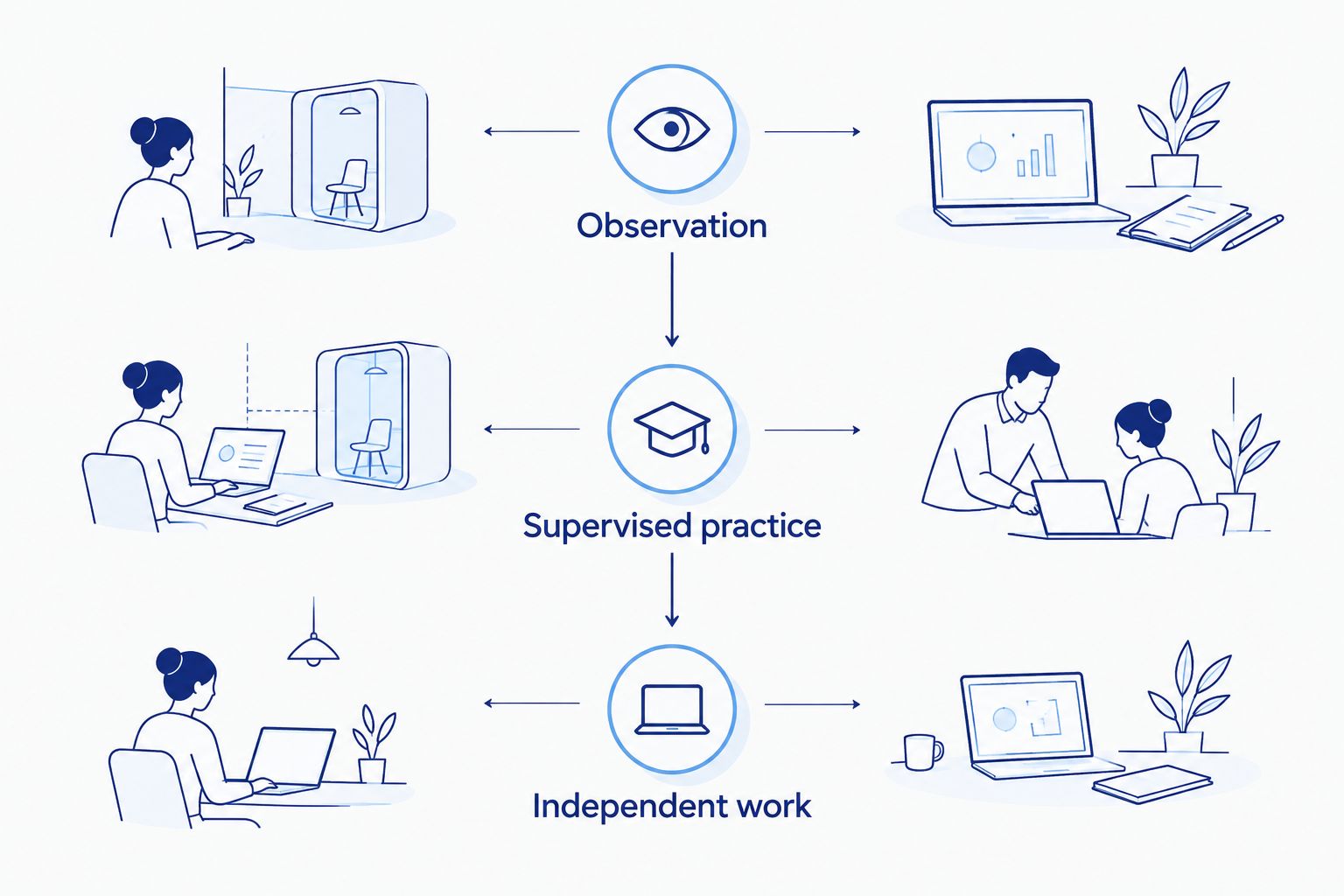
Approve independent work after the employee demonstrates the practice's procedures.
Review performance and adjust coverage
Use a simple worksheet to track whether the staffing change addresses the original gap. Choose measures you can define consistently, such as unresolved scheduling requests, corrected registration entries, and missed administrative handoffs. Do not confuse a busy employee with a well-covered workflow.
For 2026, establish your own baseline before setting targets. Compare similar operating periods and account for changes in appointment volume, opening hours, and assigned duties. Without that context, an increase in completed tasks says little about accuracy or service.
Discuss results with the employee and supervisor together. If errors cluster around one procedure, review the instructions and training before assuming the person is the problem.
Define each measure before collecting results.
Review accuracy alongside completed work.
Separate training issues from coverage gaps.
Record patient-facing concerns without unnecessary identifying details.
Adjust duties or coverage based on the documented problem.
Compare staffing options for your medical office
Choose the arrangement that fits the duration and ownership of the work. Internal reassignment, direct hiring, and agency support solve different problems. None removes the need for practice-specific training and supervision.
Use the table to narrow the decision, then verify the actual terms with the provider or hiring team. These are service models, not promises about any agency's offerings.
Internal reassignment
Best for: A defined gap that existing staff can absorb
Main advantage: Uses employees familiar with the practice
Key limitation: Moves capacity away from their usual duties
Direct hiring managed by the practice
Best for: An ongoing role with clear ownership
Main advantage: Keeps recruiting and selection within the practice
Key limitation: Requires your team to manage the hiring process
Agency-assisted direct hire
Best for: An ongoing vacancy needing outside recruiting support
Main advantage: Adds recruiting help while you select the employee
Key limitation: Practice-specific assessment and onboarding still need owners
Temporary agency coverage
Best for: A defined absence or short-term workload gap
Main advantage: Creates a separate route for assignment-based coverage
Key limitation: Availability, experience, and assignment terms require confirmation
Payroll-only support
Best for: Payroll administration for a worker you have identified
Main advantage: Separates payroll support from candidate sourcing
Key limitation: Does not, by itself, solve recruiting or training
Sourced Staffing offers office recruiting, direct hire, and payroll services. Those services provide a starting point for local employers, but they do not establish that a particular candidate has medical scheduling, insurance verification, or billing experience. Ask for evidence of the exact experience your role requires.
Before comparing proposals, give each provider the same duties, schedule, and screening requirements. Otherwise, you are comparing different scopes under the same job title.
Common mistakes medical offices make
Combining front-desk and specialist duties without a clear scope
A receptionist role becomes harder to assess when the description also includes detailed billing follow-up, referral coordination, and office management. Separate responsibilities, identify required experience, and decide which work takes priority when requests arrive together.
Treating medical-office experience as a single skill
Scheduling, insurance verification, and claims follow-up are distinct tasks. Ask which responsibilities the candidate personally handled, what decisions required approval, and how the candidate corrected errors. A previous medical-office job title is not enough evidence.
Assuming an agency handles practice-specific privacy training
Recruiting support and local privacy procedures are different responsibilities. Before the employee starts, name the person who explains your practice's rules and confirms understanding. Document that handoff instead of leaving it between the practice manager and recruiter.
Giving administrative staff responsibility for clinical decisions
A patient asking about symptoms needs your approved clinical escalation process, not an improvised answer from reception. Give administrative employees clear instructions for routing urgent concerns and identifying the appropriate clinical contact. Do not ask them to judge a patient's condition.
Measuring speed while overlooking rework
A shorter queue does not establish that records and appointment details are correct. Review corrected entries and unresolved handoffs alongside completed tasks. Otherwise, work that appears finished at reception can return later as another employee's problem.
FAQ
What is administrative staffing for medical offices?
Administrative staffing for medical offices means hiring nonclinical employees to support tasks such as scheduling, reception, document routing, and office coordination. Define the duties clearly so administrative work does not extend into clinical judgment.
What's the best staffing option for a permanent medical receptionist?
Direct hiring or agency-assisted direct hire fits an ongoing medical receptionist position. Choose between them based on whether your practice wants to manage recruiting internally or use outside recruiting support.
Can Sourced Staffing help with medical office administrative staffing?
Sourced Staffing provides office recruiting, direct-hire, and payroll services in Reno and Carson City. Confirm the medical-office duties, required experience, and proposed service scope before proceeding; a healthcare-specialist service is not stated.
Do temporary front-desk workers need HIPAA training?
Temporary front-desk workers at a HIPAA-covered practice need training appropriate to their functions when they are part of its workforce. Assign responsibility for practice-specific privacy instructions and access approval before independent work.
How do I test a medical receptionist without exposing patient information?
Use fictional patient records and scheduling scenarios. Apply the same written criteria to each applicant and assess accuracy, communication, and escalation rather than speed alone.
Is general office experience enough for medical administration?
General office experience alone does not establish competence in medical-office procedures. Assess the tasks required for your position and provide training on your practice's scheduling, privacy, and communication rules.
How should I handle a temporary administrator's last day?
Use a documented handoff and access-removal process. Confirm unresolved work, return practice property, and have the authorized person remove system access when the assignment ends.
One last thing
Test the handoff before you test the typing speed. Ask a candidate what happens when a caller requests medical advice while another patient is waiting at reception. The useful answer identifies the administrative next action and the approved clinical contact—not an attempt to solve the medical question.
Keep that scenario in your onboarding materials, too. A hiring exercise becomes more useful when it also teaches the boundary your team expects employees to follow.