
Can a Staffing Agency Run Background Checks? Yes, 2026
Article
Yes, a staffing agency can run background checks before hiring, provided it follows the laws that apply to the job and the screening method. In 2026, an agency ordering an employment background report from a consumer reporting company generally must give you a clear written disclosure, obtain written permission, and follow required procedures before rejecting you because of the report.
TL;DR
Can a staffing agency run background checks? Yes, but third-party employment reports generally require written disclosure and permission.
The Fair Credit Reporting Act gives applicants rights to review and dispute information used against them.
Criminal history is not an automatic reason to reject every applicant for every job.
Employers should define screening responsibilities before connecting background checks to onboarding.
Why this matters
A background check can affect whether you get an assignment, a permanent job, or another opportunity through an agency. Permission to check your background is not permission to ignore your rights. The process matters as much as the result.
For employers, connecting background checks to new-hire onboarding starts with deciding who orders the report, who reviews it, and who communicates with the applicant. A staffing arrangement does not remove either business's responsibility to follow applicable law.
Can a staffing agency run background checks before hiring?
Yes. A staffing agency can screen applicants before hiring or placement, but it must separate permission to obtain information from the decision to use that information. Federal requirements depend partly on whether the agency obtains a report from a consumer reporting company or checks information directly.
The Federal Trade Commission's employment background-check guidance explains the Fair Credit Reporting Act requirements for third-party reports. The Equal Employment Opportunity Commission's guidance addresses discrimination in the use of background information. Both are relevant to a 2026 hiring process.
The steps for a third-party employment report
Define the screening purpose. Identify the actual job duties and the information needed to evaluate them. Avoid treating every assignment as if it presents the same responsibilities.
Give a clear disclosure. Tell the applicant in writing that a consumer report may be obtained for employment purposes. The disclosure generally must be a stand-alone document, rather than language buried in an application.
Get written authorization. Obtain the applicant's permission before ordering the report. The Fair Credit Reporting Act allows the authorization to accompany the disclosure.
Review the findings. Check that the information concerns the correct person and evaluate it against lawful, job-related criteria. A database match is not a hiring decision.
Provide pre-adverse-action documents. Before taking adverse action based on the report, give the applicant a copy of the report and the federal Summary of Your Rights Under the Fair Credit Reporting Act.
Allow a meaningful response. Give the applicant a reasonable opportunity to review the report and raise errors before making the final decision. Federal law does not establish a universal waiting period for every employment case.
Send the final notice when required. If the report contributes to the adverse decision, provide the required adverse-action notice, including the reporting company's details and the applicant's dispute rights.
These steps apply when a consumer report influences the decision, not only when it is the sole reason for rejection. An agency should not bypass the process by describing a report-based rejection as a client preference.
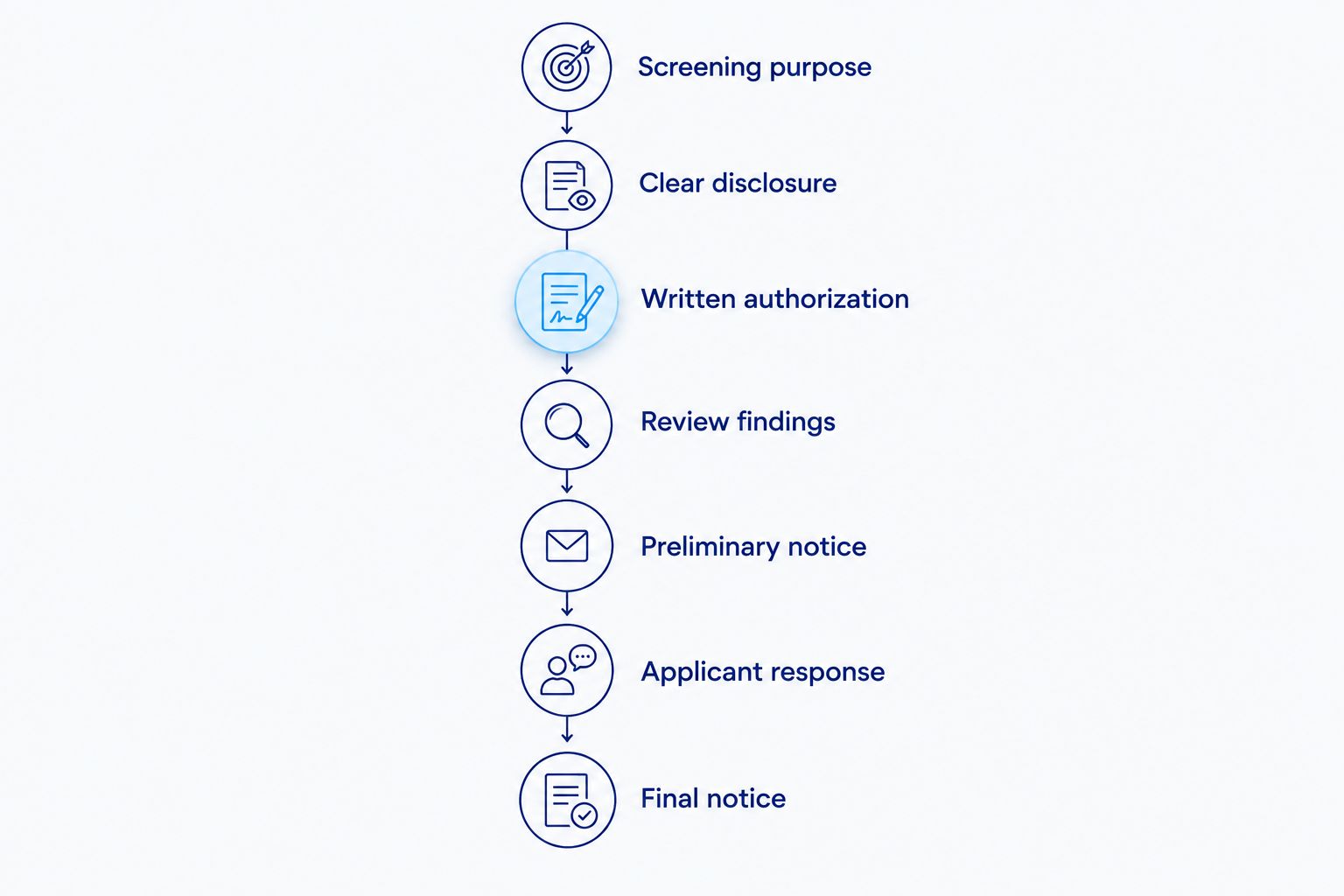
Reviewing the report and allowing an applicant response come before a final report-based rejection.
Which background checks can a staffing agency use?
The appropriate check depends on the work. Criminal-history screening, reference checks, employment verification, and driving-record reviews answer different questions; none proves that an applicant will succeed in every role.
Choose the check that addresses the job requirement, not the longest available report. The following comparison describes screening purposes, not a requirement to order every check.
Criminal-history check
Best for: Evaluating relevant legal history for specific duties
What it helps establish: Records associated with the applicant
Limitation: Records need identity checks and job-related review; an arrest is not proof of misconduct
Employment verification
Best for: Confirming relevant work history
What it helps establish: Prior employment information
Limitation: It does not establish future performance
Reference check
Best for: Understanding past work behavior
What it helps establish: Information a reference is willing to share
Limitation: Answers can be incomplete or subjective
Driving-record review
Best for: Roles that involve driving
What it helps establish: Relevant driving-history information
Limitation: It does not assess qualifications unrelated to driving
Education verification
Best for: Jobs with an actual education requirement
What it helps establish: Whether a claimed credential can be verified
Limitation: A credential alone does not establish practical ability
When a consumer reporting company supplies these findings, Fair Credit Reporting Act requirements can apply even if the report contains no criminal history. Calling a report an employment verification does not automatically put it outside the law.
Drug testing and employment eligibility verification are separate processes. Do not treat a background-check authorization as blanket permission for every other type of screening.
Why background-check requirements vary
In 2026, a staffing agency should connect its screening process to the assignment rather than use one rule without regard to the job. Several factors determine what information is relevant and when it can be considered:
Job duties: Driving, handling financial records, and operating in a production environment involve different responsibilities. Each screening requirement needs a clear purpose.
Work location: State and local rules can restrict criminal-history inquiries, credit checks, or screening timing. Check the jurisdiction where the work will occur.
Employer type: Public employers and private employers can face different hiring restrictions. Do not assume their application processes are interchangeable.
Screening source: A third-party consumer report triggers requirements that do not apply in the same way to information an employer gathers directly.
Legal requirements: Some regulated jobs have specific screening obligations. Distinguish a legal requirement from a client's preferred practice.
Decision responsibility: The agency and client need to identify who evaluates findings and who handles required notices. A contract should not leave those tasks unassigned.
A warehouse role does not automatically justify the same checks as an office position involving sensitive financial information. Likewise, a client's request for a check does not establish that the request is lawful.
Who is responsible: the staffing agency or the client?
The answer depends on who obtains the report, who uses it, and who makes the employment decision. Agree on responsibilities before screening begins, not after a report raises a concern.
An employer working with an agency should document the screening purpose, the authorized recipients, and the decision process. The arrangement should also identify who sends notices, receives applicant responses, and addresses disputed information.
Sourcedstaffing is a staffing agency for Reno and Carson City employers hiring in light-industrial, manufacturing, warehouse, office, and food-production roles. Sourcedstaffing also provides recruiting, direct-hire, and payroll services; when discussing an assignment, ask which screening responsibilities belong to the agency and which belong to your business.
That local staffing fit does not make one screening process suitable for every position. Confirm the process for the actual role, including whether the client needs report details or only a placement decision, and limit access to sensitive information appropriately.
Can a staffing agency reject you because of a criminal record?
Yes, a staffing agency can consider criminal history where the law permits, but a record is not an automatic disqualification for every job. The nature of the conduct, the time elapsed, and the duties of the position matter when evaluating a job-related exclusion.
The EEOC's criminal-history guidance distinguishes arrests from convictions. An arrest alone does not establish that criminal conduct occurred, although an employer can consider underlying conduct when it is relevant and supported.
A blanket exclusion can create discrimination risk if it disproportionately affects a protected group and is not job-related and consistent with business necessity. Applying the same rule to everyone does not, by itself, settle that issue.
For applicants, explain relevant context without guessing what the employer already knows. For employers, document the connection between the finding and the position rather than relying on a vague statement that someone failed screening.
What happens if your background report is wrong?
You have the right to dispute inaccurate or incomplete information with the consumer reporting company. Ask for the report, identify the specific error, and keep copies of your correspondence.
Common problems include records belonging to another person, duplicate entries, or incomplete case outcomes. Tell the agency about the dispute promptly, especially if a hiring decision is pending.
Under the Fair Credit Reporting Act, a reporting company generally has 30 days to investigate a dispute. Certain circumstances permit a longer period, so that deadline is not a guaranteed hiring or placement timeline.
The company generally must provide written notice of the investigation results within 5 business days after completing the investigation. These are reporting-company obligations; they do not establish a universal deadline for an agency to fill a position.
After an adverse-action notice, you can request an additional free copy of the report from the named reporting company within 60 days. That right is separate from receiving the report before the adverse decision.
Can an agency reuse a background check for another assignment?
A previous report is not automatic clearance for every future assignment. The agency must consider the authorization, the purpose for using the report, applicable law, and the requirements of the new job.
A report suitable for one position can leave relevant questions unanswered for another. Its information can also become outdated. Do not assume that changing clients either always requires a new report or never requires one.
For a 2026 assignment, ask whether the agency will obtain a new report, rely on an existing report, or request additional verification. If ongoing screening is contemplated, the disclosure and authorization process must address it appropriately.
What should you ask before screening starts?
Clear questions prevent confusion for both applicants and employers. You do not need technical HR language to understand the process.
If you are applying for work, ask:
What information will be checked for this position?
Will a consumer reporting company prepare the report?
Who receives the results and makes the placement decision?
How will I receive a report that could affect my application?
Where should I send corrections or supporting documents?
If you are hiring through an agency, ask:
Which checks match the actual duties of this role?
Who obtains authorization and orders the report?
Who reviews findings against the hiring criteria?
Who handles preliminary and final notices?
How will disputed information affect the decision process?
When discussing staffing services with Sourcedstaffing, use the actual Reno or Carson City job description as the starting point. Ask about the screening process rather than assuming that recruiting, direct hire, or payroll services all include identical checks.
FAQ
Can a staffing agency run background checks without my permission?
A staffing agency generally needs your written authorization before obtaining an employment consumer report from a consumer reporting company. Checks conducted directly by an employer follow a different framework, but applicable privacy, discrimination, and state or local rules still matter.
Do all staffing agencies run the same background checks?
No, staffing agencies do not all use the same screening process. The checks should reflect the job duties, applicable law, and the agency-client arrangement.
Can I see the background report before an agency rejects me?
Yes, if an employment consumer report will contribute to an adverse decision, you generally must receive a copy and the federal summary of rights before that decision. This gives you an opportunity to identify mistakes or provide relevant information.
How long does a background-report dispute take?
A consumer reporting company generally has 30 days to investigate a dispute under the Fair Credit Reporting Act, with extensions permitted in certain circumstances. It generally must send written results within 5 business days after completing the investigation.
Can I get another copy of my report after a rejection?
Yes, you can request an additional free copy from the reporting company within 60 days of an adverse-action notice. The notice must identify the company and explain the relevant rights.
Does a criminal record mean I cannot get a staffing job?
No, a criminal record does not automatically disqualify you from every staffing job. The employer must follow applicable law and evaluate any exclusion against the position and relevant circumstances.
Can a staffing agency promise that screening will finish before my start date?
A start date is not proof that a background check is complete. Ask whether the assignment depends on completed screening and who will confirm your placement status.
One last thing
A background report is information, not a hiring verdict. In 2026, the decisive question is not simply whether an agency can order a check; it is whether the agency obtains, evaluates, and uses the information lawfully.
For employers considering Sourcedstaffing's staffing services, put screening responsibilities into the assignment discussion. For job seekers, keep your authorization, notices, and dispute correspondence together so you can respond with the exact information needed.