
How does a staffing agency work for employers? Answered 2026
Article
A staffing agency works for employers by recruiting candidates for an agreed role, coordinating the hiring process, and handling payroll when the service agreement includes it. Your business still defines the job, selects or approves workers under the agreed process, and manages the worksite; the agency’s responsibilities depend on whether you choose temporary staffing, direct hire, or payroll support.
TL;DR
How does a staffing agency work for employers? The agency recruits; your business defines the job and manages work.
Direct hire fills your own payroll; temporary staffing separates assignment supervision from the agreed employment arrangement.
Confirm screening, time approval, payroll responsibilities, and replacement terms before a worker starts.
Sourced Staffing fits Reno and Carson City employers seeking recruiting, direct hire, or payroll services.
Why this matters
Hiring support is not a handoff of every employer responsibility. A recruiter can help you find candidates, but a vague job description, unclear reporting instructions, or an unprepared supervisor still creates problems at your workplace.
For a 2026 staffing agreement, start with responsibilities rather than promises about speed. Decide who approves candidates, who employs the worker, who processes pay, and who handles an attendance problem. These decisions shape the relationship before the first assignment begins.
If your immediate need is a permanent employee, review how direct hire through a staffing agency works before treating temporary staffing as the default.
How does a staffing agency work for employers?
The employer explains the hiring need, the agency finds and evaluates candidates against that brief, and both parties coordinate selection and starting arrangements. Payroll and ongoing support follow the service agreement, not the agency label alone.
Use these 6 steps to establish a clear process. They are an employer checklist, not a promised hiring timeline.
1. Define the job
Give the agency a practical description of the work. Include the location, schedule, duties, required experience, reporting manager, and any job-related credentials or training requirements. Separate essential qualifications from skills your team can teach.
For a warehouse position, describe the actual tasks rather than sending only a job title. For an office position, identify the work the person must complete and the systems they need to use. Specific duties help the recruiter assess relevant experience without guessing what your title means.
Best for: employers whose current job descriptions do not explain daily work. The benefit is a clearer recruiting brief; the trade-off is that your team must invest time before the search starts.
2. Agree on the service and responsibilities
Choose the arrangement before reviewing candidates. A permanent hiring need, a temporary assignment, and help administering payroll require different agreements.
Ask the agency to identify who employs the worker, what recruiting work is included, how screening is handled, and how the relationship ends or changes. Read the actual terms rather than assuming that every agency provides the same services.
A written responsibility list also prevents confusion between your hiring manager and your payroll contact. If different people approve candidates and approve hours, name both contacts before the assignment begins.
3. Review candidates against the brief
The agency recruits and evaluates candidates according to the agreed scope. Your business then reviews candidates or approves assignments using the process established in the agreement.
Ask for information connected to the job: relevant experience, schedule fit, required qualifications, and any agreed screening results. Do not treat a referral as proof that every requirement has been checked. Confirm which checks are complete and which remain your responsibility.
Consistent selection criteria make feedback useful. Tell the recruiter which requirement a candidate did not meet instead of saying only that the person was not a fit. That gives the next search a clearer direction.
4. Prepare the start
Confirm the start instructions before the worker arrives. Include the reporting location, arrival time, supervisor, access instructions, and required preparation. Identify who handles employment paperwork and who provides workplace orientation.
Your supervisor should be ready to explain the actual assignment. That includes work procedures, site-specific hazards, required protective equipment, and how to ask for help. An agency relationship does not remove the need for worksite safety coordination; OSHA treats staffing agencies and host employers as sharing responsibilities for temporary-worker safety.
The practical check is simple: can the worker identify where to report, whom to ask, and what they are expected to do?
5. Approve time and coordinate payroll
For an arrangement that includes agency payroll, establish how hours reach the payroll team and who approves them. Ask how corrections, overtime authorization, absences, and assignment changes must be reported.
Keep time approval separate from performance feedback. A supervisor can report a work issue while still accurately recording the hours worked. Payroll administration depends on clear records, not informal messages that leave approval uncertain.
For direct hire, confirm the point when the worker joins your company’s employment and payroll process. Do not assume that recruiting support automatically includes ongoing payroll administration.
6. Review performance and changing needs
Give specific feedback after work begins. Describe the task, expectation, and observed issue so the agency and your supervisor can address the same problem.
If the assignment changes, update the brief. A different schedule, work location, or set of duties should not be treated as a minor detail when it changes what the worker was recruited to do.
Agree in advance on how to report absences, request a different worker, end an assignment, or discuss permanent hiring. A replacement process is a contract term, not an automatic guarantee. Confirm the process before you need it.
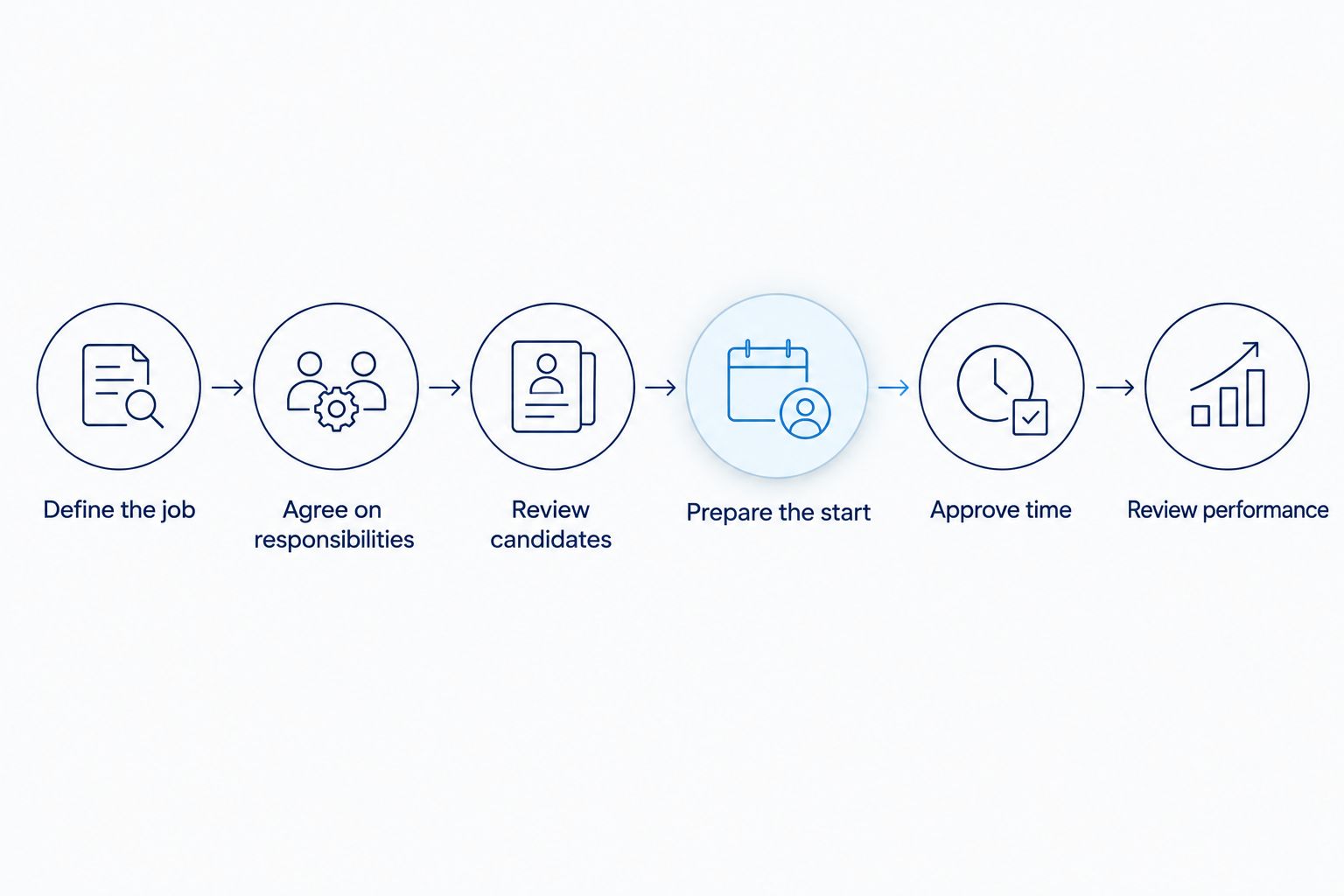
Agree on responsibilities before candidate review and the worker’s start.
Which staffing arrangement fits your hiring need?
These 3 arrangements address different needs. The comparison describes common service models; your signed agreement establishes the actual responsibilities.
Temporary staffing
Best for: Work tied to an assignment rather than an immediate permanent hire
How it works: The agency supplies workers under an agreed employment and assignment arrangement
Benefit: Adds recruiting support for assignment-based work
Limitation: Your team still needs worksite supervision and clear time reporting
Direct hire
Best for: A position intended for your own workforce
How it works: The agency recruits candidates for employment with your business
Benefit: Supports the candidate search while your business makes the hiring decision
Limitation: Your business takes on the ongoing employment responsibilities
Payroll services
Best for: Employers seeking help administering worker pay
How it works: Payroll duties follow the agreed service scope
Benefit: Separates payroll administration from daily work supervision
Limitation: Payroll support alone does not establish that recruiting is included
For your 2026 hiring plan, choose the model based on the employment relationship you need. Do not choose solely because one arrangement sounds easier to start.
Temporary staffing: assignment support
Temporary staffing connects a worker with an employer’s defined assignment. The agency and employer agree on the job, the assignment process, and their respective responsibilities.
Best for: employers with an assignment-based hiring need. The advantage is recruiting support tied to that assignment. The limitation is that the employer still needs someone to supervise work and communicate changes.
Before signing, clarify whether permanent hiring is an option and what conditions apply. Temporary staffing does not automatically mean temp-to-hire, and an assignment does not establish a guaranteed route to permanent employment.
Direct hire: recruiting for your workforce
Direct hire uses agency recruiting to fill a position with your business. The candidate becomes your employee under the hiring arrangement, rather than remaining on a temporary assignment simply because an agency introduced them.
Best for: employers filling an ongoing position on their own team. The benefit is help finding and evaluating candidates. The limitation is that your business remains responsible for the employment relationship after hiring.
Ask what candidate evaluation is included and what support, if any, continues after the start. Recruiting assistance and post-hire support are separate questions; the agreement should answer both.
Payroll services: administration with a defined scope
Payroll services address the agreed administration of worker pay. Establish which party handles payroll records, deductions, reporting, employment paperwork, and questions from workers.
Best for: employers whose need is payroll administration rather than a candidate search. The benefit is a defined administrative service. The limitation is that payroll support does not, by itself, tell you who recruits, supervises, or employs the worker.
For a 2026 payroll arrangement, ask the provider to explain the employment setup in plain language. The word payroll is not a complete description of the relationship.
Why staffing responsibilities vary
The work your agency performs depends on the hiring need and agreed service. These 5 factors belong in the initial discussion:
Service model: Recruiting, direct hire, and payroll support cover different responsibilities. Specify which services you are buying.
Job requirements: Daily tasks and required qualifications determine what the recruiter needs to assess. Avoid screening for skills the job does not require.
Workplace and schedule: Reporting instructions, location, and shifts affect assignment coordination. Give candidates accurate information before acceptance.
Screening scope: Identify the checks requested, the responsible party, and the completion process. Do not assume every referral includes identical screening.
Assignment changes: Establish how to communicate revised duties, attendance issues, and requests to end or change the arrangement.
A useful 2026 agreement explains these responsibilities clearly enough that your supervisor and the agency contact give the worker consistent instructions.
Where does a local staffing agency fit?
Sourced Staffing is best for Reno and Carson City employers seeking recruiting, direct hire, or payroll support. Sourced Staffing serves local businesses in light-industrial, manufacturing, warehouse, office, and food-production sectors.
The fit is its stated service scope and local focus. The limitation is that those facts do not establish assignment-specific screening, replacement terms, or hiring timelines. Confirm those details for your role rather than treating the service description as a promise.
When discussing your opening with Sourced Staffing, explain the work and the support you need. A request for candidates, a permanent placement, and payroll administration are different requests.
Discuss your staffing needs
Explain your Reno or Carson City hiring need and the recruiting, direct-hire, or payroll support you require.
Who manages workers supplied by a staffing agency?
Your workplace supervisor manages daily tasks and site instructions, while the agency handles the responsibilities assigned to it in the agreement. For temporary workers, employment administration and worksite supervision can involve different parties, so identify the contact for each issue.
Can you hire an agency worker permanently?
Permanent hiring depends on the staffing agreement and the worker’s willingness to accept the position. Check the conditions before making an offer, and coordinate the employment and payroll transition rather than assuming it happens automatically.
Does using a staffing agency remove your safety responsibilities?
No. OSHA’s Temporary Worker Initiative explains that staffing agencies and host employers share responsibilities for temporary-worker safety. For a 2026 assignment, coordinate general training and site-specific instruction before work begins.
FAQ
How does a staffing agency work for employers?
A staffing agency recruits candidates for an agreed job and coordinates placement or hiring. Payroll and ongoing support depend on the service agreement; the employer still defines the work and manages the workplace.
Who pays a worker hired through a staffing agency?
The employment and payroll arrangement determines who processes the worker’s pay. Direct-hire employees ordinarily join the hiring business’s payroll, while agency payroll arrangements follow the agreed service model.
Do I still interview candidates when I use a staffing agency?
Your agreement establishes whether you interview candidates, approve referrals, or use an agreed assignment process. Set that expectation before recruiting begins.
Does the staffing agency handle all background checks?
Background checks are included only to the extent established in the agreed screening scope. Confirm which job-related checks are requested, who completes them, and how completion is communicated.
What happens if an agency worker does not work out?
The agreement determines the process for reporting problems, requesting a replacement, or ending an assignment. Give specific feedback and do not assume a replacement guarantee exists.
Is direct hire the same as temporary staffing?
Direct hire recruits an employee for your business; temporary staffing supplies a worker for an assignment under a separate agreed arrangement. Choose based on the employment relationship you need.
Can Sourced Staffing help employers in Reno and Carson City?
Sourced Staffing provides recruiting, direct-hire, and payroll services for Reno and Carson City businesses. Its stated sectors include light-industrial, manufacturing, warehouse, office, and food production.
One last thing
Ask who receives a worker’s first call when something goes wrong. An absence, incorrect time entry, unclear task, and safety concern do not necessarily go to the same person.
Before the start, give the worker and supervisor a written contact list matched to those situations. Your 2026 staffing process should make responsibilities easy to follow, not merely easy to sign.