
Can I get direct hire through a temp agency? Yes, 2026
Article
Yes, you can get direct hire through a temp agency that offers direct-hire recruiting: the agency connects you with an employer, and you join that employer’s payroll without first completing a temporary assignment. In 2026, the key distinction is the placement type—not whether the recruiter calls the business a temp agency—and direct hire does not guarantee a particular benefits package or continued employment.
TL;DR
Can I get direct hire through a temp agency? Yes—choose an agency offering direct-hire recruiting.
Direct hire puts you on the hiring employer’s payroll without a temporary assignment first.
Temp-to-hire starts with a temporary assignment; a permanent offer is not guaranteed.
Sourced Staffing provides direct-hire recruiting for businesses and job seekers in Reno and Carson City.
Why this matters
A recruiter can help you find a job without becoming your employer. That distinction matters when you compare an offer, identify who handles your paycheck, and decide whether the position matches your plans.
Sourced Staffing provides staffing, recruiting, direct hire, and payroll services in Reno and Carson City. Because those are different services, ask which arrangement applies to the specific position—not just which services the agency offers.
For your 2026 job search, confirm the hiring arrangement before you agree to an assignment. A job described as having permanent potential is not the same as an offer to join the employer directly.
Can I get direct hire through a temp agency?
Yes. A temp agency that offers direct-hire recruiting can introduce you to an employer that hires you directly. The recruiter helps connect you with the opportunity, while the hiring employer makes the employment offer.
You do not need to work a temporary assignment first when the opening is genuinely direct hire. The employer can still require interviews, references, screening, or other hiring steps. Direct hire describes the employment arrangement, not a shortcut around the employer’s selection process.
These distinctions help you evaluate the position:
Direct hire
How the job starts: You accept an offer from the hiring employer
Payroll arrangement: You join the employer’s payroll
Best for: Job seekers who want to join the employer without a temporary assignment first
Main limitation: You still need to complete the employer’s hiring process
Temp-to-hire
How the job starts: You start on a temporary assignment with possible later conversion
Payroll arrangement: You generally start on agency payroll, then move to employer payroll if hired
Best for: Job seekers willing to start temporarily while pursuing a longer-term role
Main limitation: Conversion is not guaranteed
Temporary staffing
How the job starts: You accept an assignment for a defined need
Payroll arrangement: The staffing agency generally handles payroll
Best for: Job seekers seeking assignment-based work
Main limitation: The assignment does not itself promise a permanent position
The practical test is simple: ask who will employ you when you start. Then ask whether joining the employer requires a later conversion decision. If it does, the opportunity is not direct hire from the start.
Direct hire: an employer offer from the start
Direct hire fits your goal when you want the company where you work to hire you directly. The agency acts as the recruiting connection rather than placing you on a temporary assignment first.
The advantage is clarity about the intended employer. The limitation is that a referral is not an offer: the company still decides whether to hire you, and you still need to review its employment terms.
Do not treat the phrase permanent placement as a promise of lifetime employment. Direct hire tells you how you enter the job; it does not guarantee how long the job lasts.
Temp-to-hire: a temporary assignment before possible conversion
Temp-to-hire fits a different goal: starting an assignment while considering a possible transition to the employer. It gives you experience in the actual workplace before any later hiring decision.
That experience is useful, but it comes with uncertainty. Ask whether the employer has an approved position to fill, what it considers before conversion, and who will communicate the decision.
Never substitute a recruiter’s description of potential for a written employer offer. Until conversion happens, treat the position according to the temporary terms you accepted.
Temporary staffing: an assignment, not a promised conversion
Temporary work suits job seekers who want assignment-based employment or are open to work tied to a specific business need. A temporary assignment can give you workplace experience without requiring you to frame it as a path to permanent hiring.
Its limitation is equally clear: the assignment can end without a direct-hire offer. Ask about the assignment’s purpose and expected end conditions so you can plan your next move.
If you only want direct hire, say so before the recruiter submits you. Being clear about your preference avoids pursuing a hiring arrangement you do not want.
How do I ask an agency for direct-hire work?
Use the same approach for a warehouse, manufacturing, office, light-industrial, or food-production role: explain your experience, state your preferred hiring arrangement, and verify the details of each opening. A clear request gives the recruiter something specific to match.
State your preference. Tell the recruiter you want direct-hire positions and whether you will also consider temp-to-hire. Keep those preferences separate so the recruiter does not mistake flexibility for your first choice.
Confirm the employer. Ask who would hire you and whose payroll you would join at the start. Get an answer for the particular role rather than a general explanation of the agency’s services.
Share relevant experience. Describe work you have actually performed, equipment you have used, and responsibilities you have held. Include your schedule needs and travel limits so the proposed role fits your life.
Review the process. Ask about interviews, screening, required documents, and who communicates the hiring decision. Do not assume that agency registration means the employer has accepted your application.
Check the offer. Before accepting, confirm the employer, position, work location, schedule, start date, and employment terms. Resolve differences between the recruiter’s description and the written offer.
A useful first conversation ends with a specific next step: a submission to the employer, an interview, or clarification about the role. Knowing that next step is more useful than hearing that the recruiter will keep you in mind.
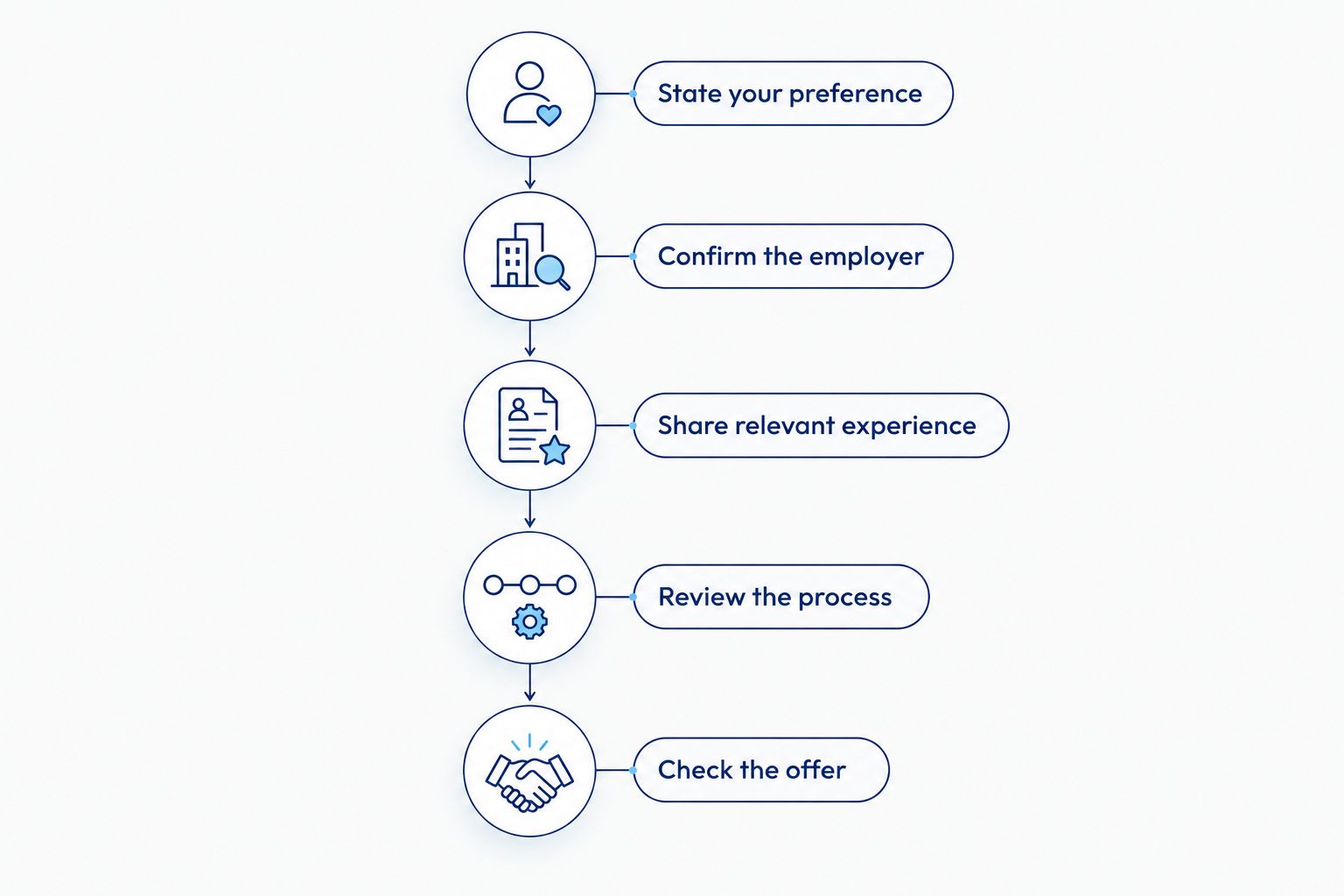
Confirm the hiring arrangement before accepting the role.
Why the route to direct hire varies
An agency’s direct-hire service does not make every position a direct-hire opening. Employers use different hiring arrangements for different needs, so your recruiter needs to identify the arrangement attached to the role you are considering.
These factors shape the route:
Hiring arrangement: An employer recruiting directly and an employer seeking temporary coverage are making different requests. Ask which request applies to the opening.
Role requirements: The duties, relevant experience, and required qualifications determine whether your background fits the position. Focus on requirements you can demonstrate.
Selection process: Interviews, reference checks, and screening affect the steps between recruiter contact and an offer. Ask what remains before the employer can decide.
Schedule and location: A position needs to fit your working hours and ability to reach the workplace. State firm limits before the recruiter submits you.
Employment terms: Your willingness to accept the employer’s terms affects whether a match becomes a hire. Review the actual offer rather than relying on the job title alone.
For a 2026 search, keep a record of the arrangement and next action for each opening. Two similar job titles can represent very different employment decisions.
What should I confirm before accepting a direct-hire offer?
Accept the employment terms, not just the label direct hire. A recruiter’s introduction helps you reach the employer, but the offer needs to explain the job you will actually take.
Check the following points before you commit:
Employer identity: Confirm the business making the offer and employing you.
Job duties: Make sure the responsibilities match what you discussed during interviews.
Work schedule: Confirm the shift, regular working days, and any expectations about schedule changes.
Work location: Verify where you will report, especially when a company has multiple workplaces.
Benefits terms: Ask which benefits apply and when eligibility begins. Direct hire alone does not answer either question.
Conditions and start instructions: Identify outstanding screening or documentation requirements and who confirms that you are cleared to start.
Keep copies of the offer and relevant messages. If the recruiter and employer describe something differently, ask them to resolve it before your first shift.
For Northern Nevada job seekers seeking agency-assisted recruiting, Sourced Staffing is a direct-hire staffing option for Reno and Carson City roles in the sectors it serves: light-industrial, manufacturing, warehouse, office, and food production. Confirm the arrangement for the position you discuss; the agency’s service list is not an offer for a particular job.
Discuss your direct-hire goals
Ask about direct-hire recruiting for your experience and preferred work location.
Do I have to work as a temp before getting hired directly?
No. Direct hire does not require a temporary assignment first. You complete the employer’s hiring process and join that employer under its offer.
If a recruiter says you must begin temporarily before the company considers hiring you, that describes a temp-to-hire route instead. Decide whether you want that route rather than assuming it is a required step for every agency-assisted job.
Does direct hire mean I get benefits immediately?
No. Direct hire does not establish when benefits begin. The employer’s eligibility rules and the terms of your offer determine what applies to you.
Ask for those details before you accept a 2026 offer. A job title or placement label cannot substitute for information about benefits eligibility.
Can I apply directly to employers while working with an agency?
Yes. Working with a recruiter does not, by itself, require you to stop your own job search. Review any agreement you sign and tell the recruiter when you have already applied to an employer they propose.
That communication helps prevent duplicate submissions and confusion about which application the employer is reviewing. You can keep searching while being clear with everyone involved.
FAQ
Can I get direct hire through a temp agency in 2026?
Yes, you can get direct hire through a temp agency that offers direct-hire recruiting. You join the hiring employer’s payroll without completing a temporary assignment first.
What’s the difference between direct hire and temp-to-hire?
Direct hire starts with an offer to join the hiring employer; temp-to-hire starts with a temporary assignment and possible later conversion. A temp-to-hire assignment does not guarantee a permanent offer.
Who pays me when an agency finds me a direct-hire job?
In a direct-hire placement, you join the hiring employer’s payroll. Confirm the employer named in your offer and who handles payroll questions before you start.
Does direct hire guarantee that I’ll keep the job?
No, direct hire does not guarantee continued employment. It describes how you join the employer, not how long the employment relationship will last.
Can I tell a recruiter I only want direct-hire jobs?
Yes, tell the recruiter that direct hire is your requirement before they submit you for a position. Specify separately whether you would consider temp-to-hire or temporary assignments.
Do I still have to interview for a direct-hire job?
An agency referral does not replace the employer’s hiring process. Ask the recruiter which interviews, screening steps, and documents the particular employer requires.
Does Sourced Staffing provide direct-hire recruiting?
Yes, Sourced Staffing provides recruiting and direct-hire services in Reno and Carson City. It connects businesses and job seekers in light-industrial, manufacturing, warehouse, office, and food-production sectors.
One last thing
Ask the recruiter to describe your status on the first day of work. That question exposes the difference between joining the employer directly and starting an assignment with the hope of conversion.
For your 2026 search, make this your final check: if joining the employer requires a later decision, you are not being hired directly at the start. You can still choose that opportunity—just choose it with the arrangement clear.