
Can a staffing agency provide bilingual workers?
Article
Yes, a staffing agency can recruit bilingual workers when you specify the languages and the tasks the job requires. Ask the agency to confirm its language-screening process before accepting a candidate; speaking comfortably in 2 languages does not establish the ability to read workplace instructions, write customer messages, or interpret technical information.
TL;DR
Can a staffing agency provide bilingual workers? Yes—define the language pair and job tasks before recruiting begins.
Sourced Staffing serves Reno and Carson City employers; confirm bilingual recruiting and screening requirements directly.
Assess speaking, reading, and writing separately using examples from the actual job.
Bilingual staffing does not replace clear instructions, workplace training, or qualified interpreting where required.
Sourced Staffing provides recruiting, direct-hire, and payroll services for businesses in Reno and Carson City. Sourced Staffing is best for Northern Nevada businesses seeking staffing support in light-industrial, manufacturing, warehouse, office, and food-production roles. For a bilingual role, confirm the agency's ability to recruit and assess the specific language skills you need.
Can a staffing agency provide bilingual workers?
Yes. The useful question is whether the agency can assess the language skills your particular job requires. A request for a bilingual receptionist differs from a request for a production employee who needs to understand spoken instructions.
Start by separating 3 task types: speaking, reading, and writing. Use the comparison below to decide what belongs in your hiring request rather than treating bilingual ability as a single pass-or-fail label.
Speaking and listening
Best for: Verbal customer service or team communication
Useful assessment: A conversation built around a realistic work situation
Strength: Shows whether the candidate can explain and understand the task
Limitation: Does not establish reading or writing ability
Reading
Best for: Following written instructions, forms, or work documents
Useful assessment: A representative document followed by comprehension questions
Strength: Connects the assessment to material used at work
Limitation: Does not establish confident spoken communication
Writing
Best for: Customer messages, administrative notes, or written follow-up
Useful assessment: A short response to a realistic workplace request
Strength: Shows whether the candidate can communicate meaning clearly
Limitation: Does not establish interpreting ability or technical expertise
You do not need every skill for every position. A job that requires spoken coordination should not automatically require polished business writing, and a written-support role needs more than a friendly conversation.
Why this matters
A vague bilingual requirement leaves the agency guessing about what success looks like. You can receive a candidate who speaks both languages conversationally but struggles with the documents, terminology, or customer situations the role involves.
For your 2026 hiring brief, describe the work first and the language requirement second. That gives the recruiter a practical target and gives applicants a fair explanation of what they must demonstrate.
Language ability is one part of job fit, not a substitute for it. Keep the role's experience, schedule, physical duties, and training needs in the same brief so the language requirement does not overshadow the rest of the job.
Speaking and listening: best for verbal communication
Choose a speaking-and-listening assessment when employees need to discuss orders, answer customer questions, or communicate with coworkers. Ask the candidate to explain a realistic situation and respond to follow-up questions in each required language.
Listen for meaning, not just speed. Can the person clarify an unclear request, repeat an instruction accurately, and ask for help when something is unfamiliar?
The strength of this approach is its connection to everyday communication. Its limitation is scope: an informal conversation does not prove that a candidate can handle specialized terminology or written work.
Keep the exercise consistent across applicants. Changing the scenario from candidate to candidate makes it harder to compare their performance fairly.
Reading: best for written workplace instructions
Choose a reading assessment when the employee needs to understand forms, labels, work orders, or written procedures. Give the candidate a representative example and ask them to explain the required action in their own words.
A useful exercise checks comprehension rather than pronunciation. Reading a document aloud without understanding it does not establish the skill your workplace needs.
This approach directly tests a relevant task, but it does not establish competence with every document the employee will encounter. Identify specialized vocabulary separately and explain which terms you will teach during onboarding.
For a 2026 production or warehouse hiring request, use material that reflects the role's actual responsibilities. Remove confidential information and avoid testing knowledge that applicants would only gain after your internal training.
Writing: best for customer messages and office work
Choose a writing assessment when the role includes responding to messages, recording information, or explaining next steps in writing. Give the candidate a short workplace situation and ask for the response the job would require.
Evaluate accuracy, clarity, and completeness. The reader should understand what happened and what action comes next without having to guess.
The advantage is that you see the candidate's work directly. The limitation is that a short sample does not establish professional translation ability, specialized knowledge, or performance across every communication channel.
Match the standard to the job. A clear internal note and a formal customer letter serve different purposes, so they should not receive identical instructions or evaluation criteria.
How do you request bilingual workers from a staffing agency?
Use these 5 steps to turn a general request into a hiring brief the recruiter can act on. The goal is agreement on the job, the assessment, and the decision—not a promise about how quickly someone will be placed.
Define languages. State both languages and explain who the employee will communicate with. Avoid substituting nationality, ethnicity, or a vague description of the workforce for a language requirement.
List tasks. Describe the conversations, documents, or messages the employee must handle. Mark each language skill as required or preferred based on the actual duties.
Agree on assessment. Ask who evaluates the candidate, which work samples they use, and how they record the result. Decide how your hiring manager will review job-specific skills.
Confirm job fit. Include the workplace, schedule, experience requirements, supervision, and training. A language match alone does not establish suitability for the position.
Plan onboarding. Identify how the employee will receive instructions and who will answer questions. Clarify whether bilingual communication is part of the employee's own role or an additional responsibility.
Put the agreed requirements in writing before interviews begin. In your 2026 request, distinguish essential skills from preferences so the agency does not reject capable applicants for requirements the job does not actually need.
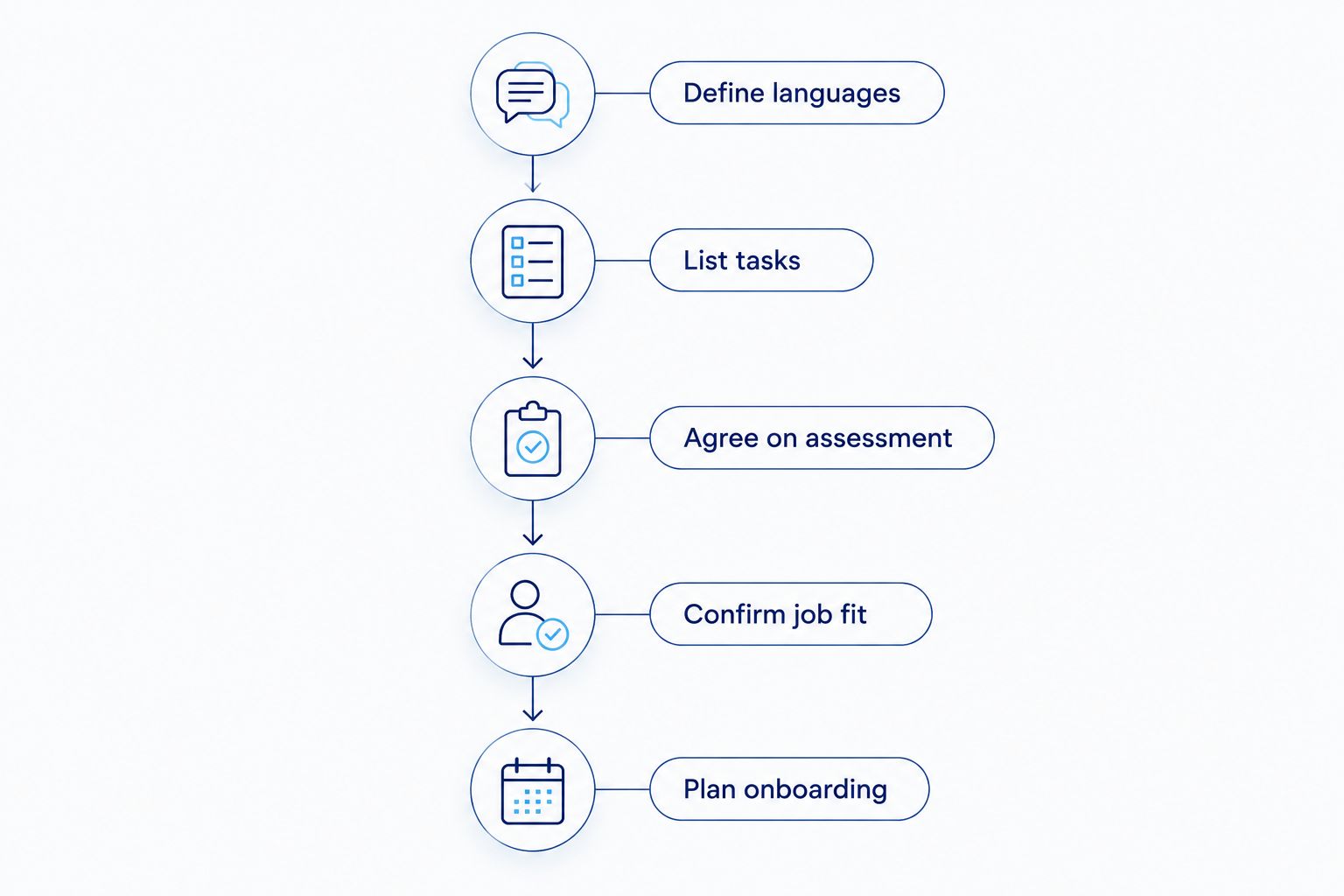
Agree on the language assessment before reviewing candidates.
Ask for a brief description of what each candidate demonstrated rather than a bare bilingual label. For broader screening questions, see how staffing agencies screen warehouse candidates.
A practical hiring brief
Use this structure when contacting a recruiter: role and worksite; required languages; spoken tasks; written tasks; essential job experience; schedule; proposed assessment; and onboarding responsibilities. Complete each item with details from your workplace.
For example, describe whether an office employee must answer questions verbally, read incoming messages, or write responses. Do not simply request fluent language skills if only one of those duties applies.
Sourced Staffing serves local employers across the sectors listed above. Discuss your bilingual requirements directly, including the language pair, job duties, and assessment expectations, before deciding whether its recruiting service fits the role.
Discuss your bilingual hiring requirements
Share the language pair, job duties, worksite, and schedule for your Reno or Carson City role.
Why bilingual staffing requirements vary
Bilingual staffing requests differ because employers need different kinds of communication. These factors belong in the brief you give the agency:
Language pair: Name both languages instead of assuming the recruiter knows which combination your workplace needs.
Communication duties: Separate speaking, listening, reading, and writing so the assessment reflects the job.
Role knowledge: Identify technical vocabulary and job experience separately from general language ability.
Work setting: Explain whether communication happens with customers, supervisors, coworkers, or several groups.
Schedule and location: Include the worksite and working hours so the agency assesses the complete assignment.
Training responsibilities: State what the employee must already know and what your team will teach after hiring.
For your 2026 hiring plan, keep these requirements visible through interviews and onboarding. If the duties change, update the brief rather than expecting the employee's bilingual ability to cover an undefined new responsibility.
Can you ask a staffing agency to test language skills?
Yes, you can request a language assessment and ask the agency to explain its process. Confirm whether it assesses the required language pair directly, uses another evaluator, or expects your team to conduct the job-specific check.
Agree on the evidence you need before reviewing applicants. A candidate's self-description is useful background, but a relevant work sample shows what the person can do in the role.
Does bilingual mean a worker can translate or interpret?
No, bilingual ability alone does not establish professional translation or interpreting competence. Those duties require skills beyond everyday conversation, particularly when accuracy involves specialized subject matter.
If interpreting or translation is an essential duty, state it explicitly and establish a separate assessment. Do not quietly add those responsibilities to an employee recruited for production, warehouse, or general office work.
Should every worker on a multilingual team be bilingual?
No, a multilingual team does not automatically require every employee to speak every language used at work. Identify which positions have a genuine communication requirement and explain how other employees will receive understandable instructions.
Do not make one bilingual employee your entire communication plan. Assign responsibility for training materials, supervisor communication, and escalation when an instruction is unclear.
What should you confirm before accepting a candidate?
Review the candidate against the written brief, not against a general impression of fluency. Ask what the assessment covered and what still needs verification by your team.
Use the same checklist for each finalist:
Did the candidate demonstrate the language tasks the role actually requires?
Did the assessment include the relevant spoken or written work?
Does the candidate meet the role's non-language requirements?
Does the candidate understand when bilingual communication is part of the job?
Is the onboarding plan clear about instructions, supervision, and questions?
For a 2026 placement, settle those questions before the start date. Clear expectations protect the employee from surprise duties and help your supervisor evaluate the work against an agreed standard.
FAQ
Can a staffing agency provide bilingual workers for my business?
Yes, a staffing agency can recruit bilingual workers for a defined role. Specify the languages, job duties, and assessment requirements, then confirm that the agency can evaluate the skills you need.
Does Sourced Staffing provide bilingual recruiting?
Confirm bilingual recruiting directly with Sourced Staffing for your specific language pair and role. The agency provides recruiting, direct-hire, and payroll services for businesses in Reno and Carson City.
How do I know whether a bilingual candidate is qualified?
Use job-related language tasks alongside the role's normal qualification checks. Assess speaking, reading, or writing according to the actual duties rather than relying only on a bilingual label.
Can I request an English-and-Spanish-speaking worker?
Yes, you can specify English and Spanish when those languages relate to the job's duties. Explain who the worker will communicate with and whether the role requires spoken communication, reading, writing, or a combination.
Does a bilingual warehouse worker need to write in both languages?
Not automatically; writing belongs in the requirement only when the job involves written communication in both languages. Define the actual warehouse tasks before choosing the assessment.
Can a bilingual worker translate safety instructions?
Bilingual ability alone does not establish competence to translate safety instructions. Confirm appropriate qualifications and review procedures rather than assigning the task based only on conversational ability.
What should I tell the staffing agency before it starts recruiting?
Provide the role, worksite, schedule, required languages, communication tasks, and essential job skills. Agree on the language assessment and onboarding responsibilities before reviewing candidates.
One last thing
Ask the candidate how they handle an instruction they do not understand. A worker who asks a clear follow-up question demonstrates a useful workplace habit; pretending to understand is not the standard you want to reward.
Write the required communication tasks before writing the word bilingual. That small change makes the hiring request easier to assess and gives the employee a clearer picture of the job.