
How do temp agencies screen candidates for warehouse jobs?
Article
Temp agencies screen warehouse candidates by reviewing work history, interviewing for job and shift fit, checking relevant skills, and completing any lawful checks required for the assignment. A screening decision does not replace warehouse safety training, equipment-specific evaluation, or employment eligibility verification; this 2026 guide explains what each stage establishes and what employers and job seekers should ask.
TL;DR
How do temp agencies screen candidates? Warehouse screening combines interviews, work-history review, relevant skill checks, and assignment-specific requirements.
Sourced Staffing serves warehouse employers and job seekers in Reno and Carson City; confirm screening requirements for each assignment.
Background checks do not establish warehouse skills, attendance reliability, or readiness to operate equipment.
Warehouse employers must distinguish candidate screening from site-specific safety training and forklift authorization.
Why this matters
A candidate who passes a background check has not necessarily demonstrated the skills your warehouse needs. Picking orders, checking inventory, and operating a forklift involve different tasks. Screening should match the actual assignment rather than treat every warehouse opening as interchangeable.
For job seekers, the same distinction helps you prepare. Explain what you have done, which equipment you have used, and which shifts you can consistently work. If a recruiter mentions criminal-history screening, review whether a staffing agency can run background checks before hiring and ask which requirements apply to your assignment.
How do temp agencies screen candidates for warehouse jobs?
Warehouse screening generally moves from basic job fit to evidence of relevant experience, then to assignment-specific checks. The exact sequence differs by agency and employer. Use the following steps as a practical checklist, not a promise that every agency performs every step.
1. Review the application and work history
A recruiter reviews previous jobs, dates of employment, responsibilities, and relevant warehouse experience. The useful detail is the work itself: receiving shipments, selecting orders, packing products, checking quantities, or keeping inventory records.
Describe tasks, not just job titles. An applicant listed as a warehouse associate might have worked mainly in packing, while another handled receiving. Those backgrounds are not identical, even when the title matches.
Employers should identify essential duties before requesting candidates. Job seekers should distinguish tasks they performed independently from tasks they assisted with or only observed.
2. Interview for assignment fit
The interview establishes whether the candidate understands the role and can meet its stated requirements. Questions should address the work location, schedule, essential duties, and relevant experience—not unrelated personal circumstances.
A useful answer gives an example. Instead of saying you are detail-oriented, explain how you checked an item against an order or handled a quantity mismatch. Employers should ask how the candidate responded to an actual workplace situation rather than rely entirely on a confident introduction.
Schedule fit also needs a direct conversation. Confirm the proposed shift and start date, including whether the candidate can reach the site consistently.
3. Check relevant skills
A skills check should reflect the assignment. For picking or inventory work, that might involve reading an order, matching item identifiers, or recognizing a quantity discrepancy. Equipment roles require a different assessment.
Ask what the assessment measures and how the result affects placement. A general interview cannot establish equipment proficiency, and a written exercise cannot show how someone operates a forklift.
For entry-level work, separate requirements needed before placement from skills taught during onboarding. Do not reject a trainable applicant for lacking a skill the employer plans to teach.
4. Verify relevant information and required checks
References, employment verification, background checks, and drug testing serve different purposes. Their use depends on the assignment, employer requirements, and applicable law; they are not interchangeable evidence of job readiness.
When an employer obtains a background report through a third-party reporting company, the federal Fair Credit Reporting Act requires disclosure and authorization. It also establishes procedures when report information leads to an adverse employment decision. These protections remain relevant to warehouse hiring in 2026.
Job seekers should read authorization documents and ask how to dispute inaccurate information. Employers should define job-related requirements rather than assume any unfavorable record automatically disqualifies an applicant.
5. Complete eligibility verification and the handoff
Employment eligibility verification is distinct from evaluating warehouse ability. USCIS requires employers to complete Form I-9 Section 2 within 3 business days of an employee's first day of employment; special timing rules apply to very short employment periods.
The worker should know who is responsible for employment paperwork and who provides instructions at the warehouse. Before the start, confirm the reporting location, supervisor, schedule, and any unresolved requirements.
A completed screening file is not permission to begin unfamiliar or hazardous work. The receiving warehouse still needs to address the worker's tasks, site conditions, and required training.
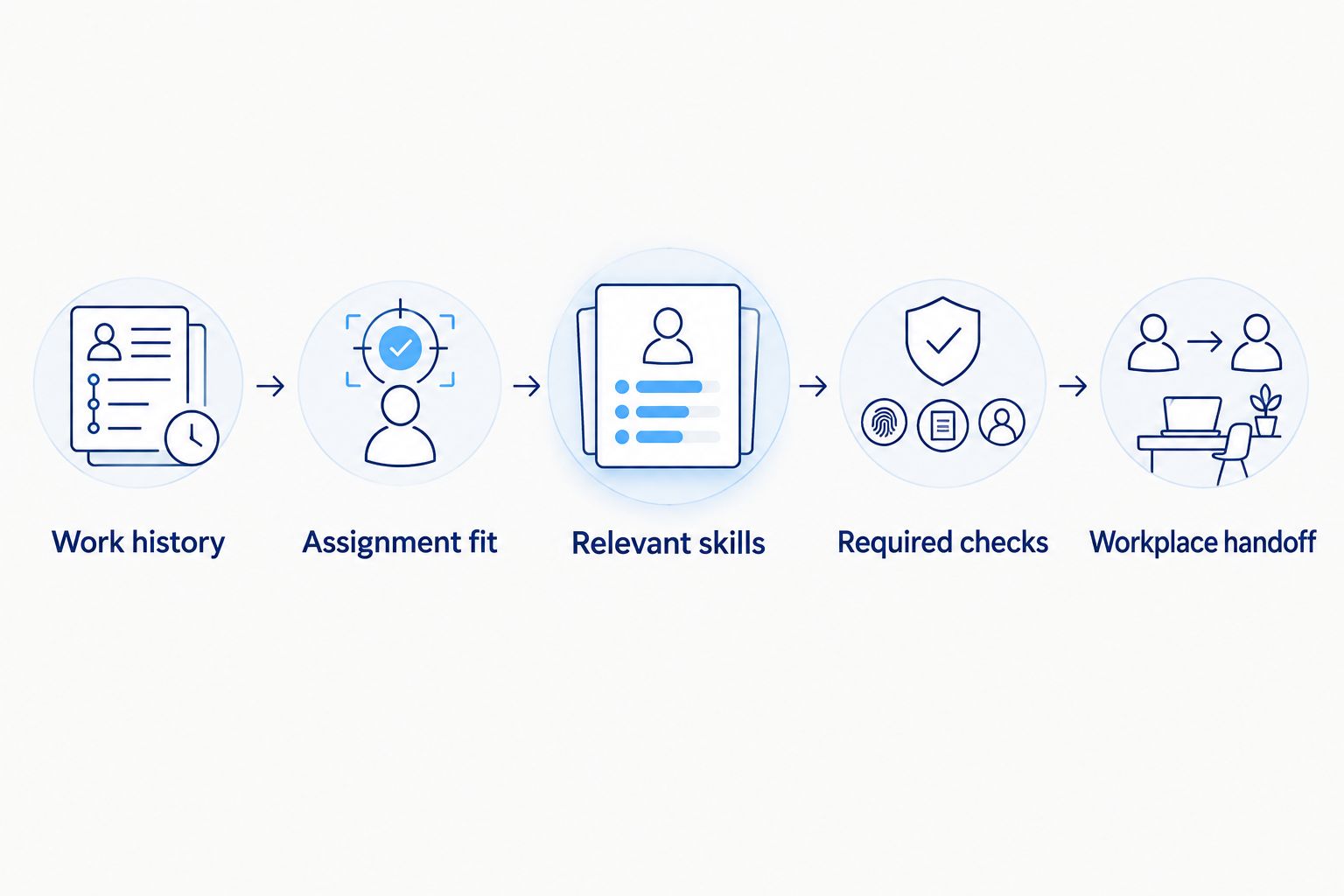
Screening establishes assignment fit; the workplace handoff addresses the actual site and duties.
What does each screening method actually tell you?
Use the method that answers the hiring question. Interviews, skill assessments, and background checks provide different information. No single method establishes every part of warehouse readiness.
Work-history review
Best for: Understanding relevant experience
What it contributes: Identifies previous duties and employment history
Limitation: An application alone does not verify performance
Structured interview
Best for: Checking assignment understanding
What it contributes: Explores experience, availability, and responses to work situations
Limitation: Answers do not demonstrate hands-on ability
Job-related skills check
Best for: Assessing a defined task
What it contributes: Shows performance on the assessed activity
Limitation: Results apply to the task assessed, not every warehouse duty
Reference check
Best for: Adding context to past work
What it contributes: Provides information from an appropriate previous contact
Limitation: Information depends on what the reference knows and shares
Background report
Best for: Reviewing required history information
What it contributes: Supplies report information for lawful, job-related review
Limitation: Does not measure picking accuracy or equipment skill
Equipment evaluation
Best for: Assessing equipment operation
What it contributes: Demonstrates operation under the evaluation conditions
Limitation: Does not replace required site-specific training
For employers, ask which methods are included before approving a placement. For job seekers, ask whether an unfamiliar task is a prerequisite or part of the training plan. Clear expectations help both sides distinguish a genuine mismatch from a learning need.
Why warehouse candidate screening varies
Warehouse assignments do not all require the same evidence. Use these factors to define the screening brief instead of requesting an unexplained standard package.
Warehouse duties: Picking, packing, receiving, and inventory work call for different questions and task checks. Name the actual responsibilities.
Equipment responsibilities: A role involving powered equipment needs attention to training and evaluation, not just general warehouse experience.
Work location: Reno and Carson City assignments have different reporting locations. Confirm that the candidate understands where the work takes place.
Assignment arrangement: Temporary placement and direct hire involve different employment handoffs. Clarify who makes the hiring decision and handles onboarding.
Related production work: A warehouse role connected to manufacturing or food production needs a clear description of the duties and workplace requirements.
For your 2026 hiring brief, separate essential requirements from preferences. Experience with your exact process is different from experience performing a comparable task. State what you will teach and what the candidate must already demonstrate.
Avoid vague requirements such as a good attitude or warehouse-ready. Replace them with observable expectations: understanding the assigned schedule, following task instructions, and reporting an item mismatch rather than guessing.
Does passing agency screening qualify someone to operate a forklift?
No. Passing agency screening does not, by itself, qualify someone to operate a forklift at your warehouse. The employer must ensure that powered industrial truck operators receive the training and evaluation required by OSHA's standard, 29 CFR 1910.178.
As of 2026, OSHA requires an evaluation of each operator's performance at least once every 3 years. Refresher training is also required in specified circumstances, including unsafe operation or relevant changes in workplace conditions. Previous training can count only under the conditions the standard permits; it is not a blanket authorization for every truck and site.
Federal child-labor rules generally prohibit workers under 18 years from operating forklifts in nonagricultural employment. These requirements concern equipment operation, not a universal minimum age for every warehouse task.
Employers should identify the equipment involved and confirm the training and evaluation handoff. Job seekers should describe prior equipment experience accurately and ask what must be completed before operating at the new site.
Can you get a warehouse job without warehouse experience?
Yes, you can pursue warehouse jobs without previous warehouse experience when the assignment accepts entry-level candidates. The deciding issue is the stated job requirement, not whether every position in a warehouse demands prior experience.
Explain transferable experience honestly. Following written instructions, checking quantities, organizing materials, and working an established schedule are useful examples when they reflect work you have actually done. Do not claim equipment experience you lack.
Ask which duties you will learn after starting and which skills must be demonstrated beforehand. That question gives the recruiter a clearer basis for matching you to an assignment.
What should employers and job seekers ask before placement?
For a 2026 placement, ask for a clear distinction between completed screening and remaining onboarding. A statement that a candidate is cleared is incomplete unless everyone understands what cleared means.
Employers: confirm the evidence and responsibilities
Request a plain-language explanation of the screening included for your assignment. Ask which duties were discussed, whether relevant skills were assessed, and which checks remain outstanding. Follow appropriate privacy rules rather than requesting unrestricted access to candidate records.
Then confirm the workplace handoff. Identify who handles site orientation, task instruction, equipment authorization, and questions on the first shift. Approve the match against the job requirements, not against an undefined screening label.
Job seekers: confirm the assignment before accepting
Ask what work you will perform, where you will report, and what schedule you are accepting. Describe any limits in your experience before placement so the recruiter can distinguish a training need from a requirement you cannot meet.
Clarify who contacts you about outstanding documents or assessments. Keep copies of instructions you receive, and ask questions before operating unfamiliar equipment.
Where local staffing support fits
Sourced Staffing is a local staffing option for warehouse employers and job seekers in Reno and Carson City. Sourced Staffing provides recruiting, direct-hire, and payroll services across warehouse and other local business sectors.
The fit is its stated service area and sector coverage. That description does not establish a particular testing package, screening turnaround, or equipment qualification process. Ask for the requirements and responsibilities attached to your specific role before making a hiring or placement decision.
Discuss your warehouse staffing needs
Ask about recruiting, direct hire, and assignment requirements in Reno and Carson City.
FAQ
What do temp agencies check before placing someone in a warehouse job?
Temp agencies review job fit through work-history review, interviews, and any assignment-specific assessments or required checks. Ask which steps apply to the particular warehouse position rather than assuming every agency uses the same process.
Do all warehouse temp jobs require a background check?
A background check is not a universal requirement for every warehouse temp job. Requirements depend on the assignment, employer, and applicable law; ask what is required before consenting to a report.
Will a temp agency drug test me for a warehouse job?
Drug-testing requirements depend on the assignment and applicable rules. Ask whether testing is required for the role and how the requirement is communicated before placement.
Does a forklift certificate mean I can operate at any warehouse?
A forklift certificate alone does not authorize operation at every warehouse. OSHA requires appropriate training and evaluation, including an operator performance evaluation at least once every 3 years.
How soon does employment eligibility paperwork need to be completed?
Employers generally must complete Form I-9 Section 2 within 3 business days of the employee's first day of employment. USCIS sets special timing requirements when employment lasts fewer than 3 business days.
Can Sourced Staffing help with warehouse hiring in Northern Nevada?
Sourced Staffing serves warehouse employers and job seekers in Reno and Carson City and provides recruiting, direct-hire, and payroll services. Confirm the screening requirements and onboarding responsibilities for your specific assignment.
One last thing
For your next warehouse placement in 2026, ask: What has this screening established, and what still needs to happen before the worker starts the task? That question separates an interview result from a demonstrated skill and a completed report from workplace readiness.
Write the answer into the handoff. A candidate and supervisor should not have to discover an unresolved training requirement beside the equipment they are expected to use.