
Do staffing agencies do drug testing before placement?
Article
Yes, staffing agencies arrange drug testing before placement when the agency, hiring business, or rules governing the job require it; testing is not universal for every applicant. For a 2026 job search, confirm the requirements for your specific assignment before scheduling a test, because Nevada marijuana protections and safety-related exceptions affect how results can be used.
TL;DR
Do staffing agencies do drug testing? Yes, when the assignment or applicable rules require pre-placement screening.
Nevada limits hiring decisions based on marijuana screening, with exceptions for certain jobs and legal requirements.
Sourced Staffing serves Reno and Carson City employers and job seekers; confirm assignment-specific testing requirements directly.
A scheduled test is not placement clearance. Confirm the result review and start authorization before reporting.
Why this matters
A job offer, a screening appointment, and permission to start work are different things. If an assignment requires testing, completing the collection does not establish that every hiring condition has been satisfied.
For employers, an unclear screening requirement creates avoidable confusion between the recruiter, applicant, and workplace supervisor. For applicants, the practical question is not whether an agency ever tests—it is whether your particular job requires a test and what happens next.
Drug screening is also separate from interviews, work-history checks, and other steps described in how temp agencies screen candidates for warehouse jobs. Ask about each requirement separately rather than treating all screening as one approval.
Do staffing agencies do drug testing before placement?
Yes. A staffing agency can coordinate a drug test as a condition of placement, but the requirement depends on the assignment and applicable rules. The hiring business can have a screening policy even when another business using the same agency does not.
The agency and hiring business should identify who orders the test, who reviews the result, and who authorizes the worker to start. Those responsibilities should be clear before the applicant receives collection instructions.
The following comparison separates common hiring situations. It does not establish a testing policy for any particular staffing agency.
Assignment without a legal testing mandate
What determines testing: Applicable agency and hiring-business policies
Practical benefit: Requirements can be explained before placement
Limitation to address: A policy for one assignment does not establish another assignment's requirements
Safety-related assignment
What determines testing: Job duties, applicable law, and employer policy
Practical benefit: Screening requirements can be tied to the actual work
Limitation to address: A general industry label does not explain the legal basis for a decision
Federally regulated transportation work
What determines testing: Rules governing the covered position
Practical benefit: Required screening follows a defined regulatory process
Limitation to address: A general workplace test does not automatically satisfy federal requirements
Get the assignment's requirements in writing. Ask whether testing is required before the first shift, whether any result review remains outstanding, and who will confirm that you are cleared to report.
Assignments without a legal testing mandate
Not every staffing assignment falls under a law requiring drug testing. For these jobs, the agency and hiring business need to explain the applicable policy rather than presenting screening as a universal legal requirement.
Ask whether the requirement applies to this opening, not just whether the business has a drug-free workplace policy. A workplace rule against impairment and a requirement to take a pre-employment test answer different questions.
For employers, the benefit of a written policy is clarity: applicants receive the same explanation for the same role. The limitation is that a written policy still needs to comply with applicable law; putting a rule in writing does not make every hiring decision lawful.
Safety-related assignments
The actual duties matter more than a broad label such as warehouse, manufacturing, or office work. Describe whether the employee will operate equipment, drive, or perform another task with safety consequences.
In Nevada, NRS 613.132 includes exceptions to its marijuana hiring protection for specified positions and certain safety-related circumstances. That does not mean every industrial applicant falls within an exception simply because the workplace contains machinery.
Employers should connect the requirement to the position and obtain legal guidance when deciding how a result affects eligibility. Applicants should ask the recruiter to explain the assignment's requirements without assuming that another person's placement followed the same rules.
Federally regulated transportation assignments
Some transportation positions have federal drug-testing requirements. When a role is covered by U.S. Department of Transportation rules, the employer must follow the rules applicable to that position, including the procedures in 49 CFR Part 40.
DOT drug testing covers 5 drug categories: marijuana metabolites, cocaine metabolites, amphetamines, opioids, and phencyclidine. State permission to use marijuana does not remove marijuana from the federal testing program.
A non-DOT test is not interchangeable with a DOT test. Before arranging screening, identify whether the position is actually covered and which employer is responsible for the required process; do not infer coverage from a job title alone.
Why drug-testing requirements vary
The differences come from the job and the rules governing the hiring decision—not from a single standard that applies to every staffing applicant.
Hiring-business policy: Different businesses can set different lawful screening requirements for their assignments.
Agency policy: Ask whether an agency requirement applies to registration, a particular placement, or both.
Actual job duties: Driving and safety-related duties can change which rules or exceptions apply.
Federal requirements: Covered transportation positions follow requirements that ordinary workplace screening does not replace.
State law: Nevada restricts certain marijuana-based hiring decisions while preserving specified exceptions.
Placement stage: Initial application, conditional placement, and employment are different stages; clarify when screening occurs.
A recruiter should be able to explain the requirement for the opening being discussed. If the answer only describes the agency generally, bring the conversation back to the job, the applicable policy, and the start conditions.
What does Nevada law say about marijuana screening?
For Nevada hiring in 2026, NRS 613.132 generally prohibits an employer from refusing to hire a prospective employee because a screening test indicates marijuana. The statute contains exceptions, so neither a blanket rejection rule nor a blanket promise of protection is accurate.
The exceptions include specified emergency-response positions, certain driving positions with required testing, and positions that the employer determines could adversely affect others' safety. Federal-law conflicts and other statutory qualifications also matter.
Nevada's marijuana hiring protection is not a ban on all drug testing. It also does not authorize working while impaired or eliminate separate rules for covered federal positions.
The statute addresses a separate situation involving testing after employment begins. If an employer requires screening within an employee's first 30 days of employment, the employee has a statutory right to submit an additional screening test to rebut the initial result, and the employer must accept and give appropriate consideration to that additional result.
That 30-day provision is not a universal appeal deadline for every rejected applicant. If a result affects your placement, identify whether you are still an applicant or already an employee, request the applicable review procedure, and seek qualified advice about your circumstances.
What should you ask before a drug test?
Use this sequence before attending the collection appointment. It keeps the requirement, collection instructions, and placement decision separate.
Confirm the requirement. Ask whether this specific assignment requires testing and whether the test falls under a federal program or a workplace policy.
Read the instructions. Confirm the collection location, identification requirements, appointment instructions, and any deadline supplied by the recruiter.
Use medical review. Ask how to provide prescription information through the designated confidential review process rather than sending medical details to a workplace supervisor.
Confirm start clearance. After collection, ask who will notify you that screening and all other placement conditions are complete.
The collector's instructions govern the collection itself. Follow those instructions rather than advice from another applicant whose appointment or assignment was different.
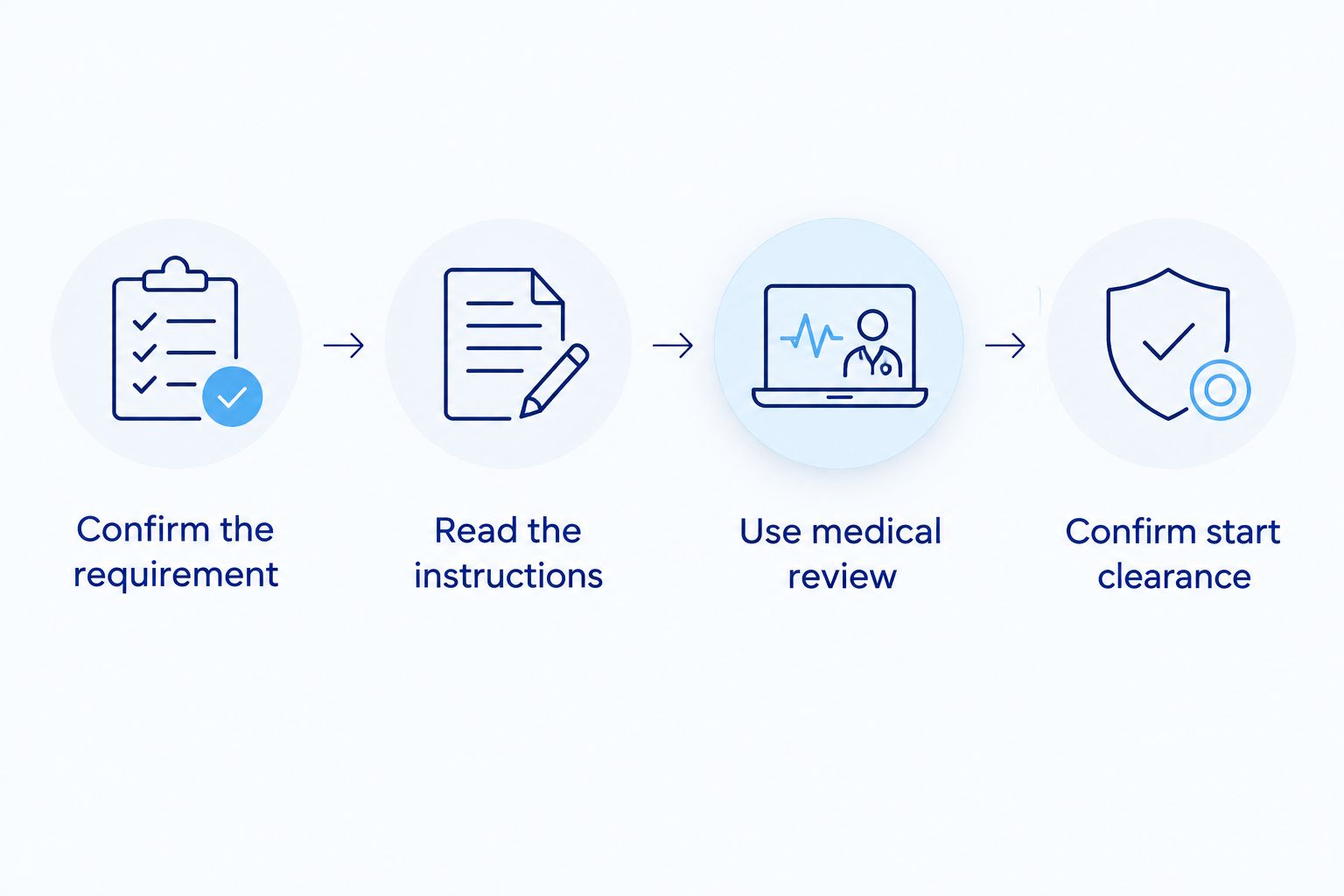
Completing collection and receiving permission to start are separate steps.
Keep the written instructions and the recruiter's contact details available until placement is confirmed. If an instruction is unclear or you cannot attend the appointment, contact the recruiter before the stated deadline rather than assuming the appointment will be rescheduled automatically.
What should employers confirm before requesting workers?
For a 2026 staffing request, give the agency a usable screening requirement before applicants begin the placement process. A request to send someone who has passed a test leaves important questions unanswered.
Start with 2 separate checks: assignment suitability and screening clearance. Assignment suitability concerns the person's qualifications and ability to perform the work; screening clearance concerns the specific conditions attached to starting that assignment.
Use this checklist to define the handoff:
Describe the actual duties and any safety-related responsibilities.
Identify the applicable testing policy and legal requirements.
Specify who orders screening and manages confidential result review.
Explain what happens when a result requires further review.
Identify who communicates placement clearance to the worker.
Tell the receiving supervisor how to verify start authorization without requesting medical details.
Sourced Staffing is best suited to Reno and Carson City employers and job seekers seeking local staffing, recruiting, direct-hire, and payroll services. Its service scope includes light-industrial, manufacturing, warehouse, office, and food-production work.
Ask Sourced Staffing how screening responsibilities would be handled for your opening. The local service scope helps identify a relevant staffing conversation; it does not establish that any particular drug test, turnaround time, or screening package is included.
Discuss your assignment requirements
Explain the role, workplace duties, and screening requirements before requesting a placement.
Can I start work while my drug test is pending?
If the assignment requires completed screening before placement, wait for explicit start authorization. Attending collection does not establish that the result has been reviewed or that other hiring requirements are complete.
Ask the recruiter whether your proposed start date is confirmed or conditional. Employers should give the receiving supervisor the same answer so that the worker does not receive conflicting instructions.
Does a drug test replace a background check?
No. Drug testing and a background check are 2 separate checks that address different information; completion of one does not establish completion of the other.
For your 2026 application, ask which checks the assignment requires and whether either remains pending. Keep the conversation focused on outstanding conditions rather than requesting a single vague assurance that everything looks good.
Does passing a drug test guarantee placement?
No. A drug test addresses one screening requirement, not the entire hiring decision. Qualifications, assignment fit, and other stated conditions still determine whether the placement proceeds.
Ask for the next step after screening and who will communicate it. Do not treat a completed appointment or an informal update as a confirmed first shift.
FAQ
Do staffing agencies drug test everyone who applies?
No universal rule requires every staffing applicant to receive a drug test. Ask whether testing applies to agency registration, your specific assignment, or a legally regulated role.
Will a staffing agency tell me about a drug test before I start?
Ask the recruiter to confirm testing requirements and collection instructions before your start date. Do not assume that an application or interview establishes all placement conditions.
Can a Nevada employer reject me just for marijuana on a drug test?
Nevada generally prohibits refusing to hire a prospective employee because a screening test indicates marijuana, but NRS 613.132 contains exceptions. The position's duties and applicable federal requirements affect the answer.
What happens if I take prescription medication?
Use the testing program's designated confidential medical-review process to provide prescription information. Ask for instructions instead of sending your medical history to a workplace supervisor.
Can I challenge a drug test taken after I start work in Nevada?
NRS 613.132 provides an additional-test right when an employer requires screening within the first 30 days of employment. The employer must accept and give appropriate consideration to the additional result; this is not a blanket appeal rule for every applicant.
Does a negative home drug test count for a staffing placement?
A home test does not automatically satisfy an assignment's screening requirement. Follow the collection and review process specified for the job.
Does Sourced Staffing require drug tests for every placement?
Confirm testing requirements directly for the specific Sourced Staffing assignment. Do not infer a universal screening policy from the agency's industries or service descriptions.
One last thing
A drug-screening result is not the same as a finding of current workplace impairment. Keep the test result, the lawful hiring decision, and permission to start work separate.
For a 2026 placement, ask one final question before reporting: who has confirmed that all conditions for this assignment are complete? A clear answer protects your time and gives the workplace a consistent starting point.