
How do I switch staffing agencies without disrupting my team?
Article
Switch staffing agencies without disruption by confirming your contract obligations, protecting current shift coverage, and assigning clear responsibility for every worker’s schedule and pay before the handoff. Do not assume your current temporary workers will transfer automatically; confirm their willingness and both agencies’ arrangements first. Keep existing assignments covered until the incoming agency has confirmed who will report, where they will work, and how their hours will be approved.
TL;DR
How to switch staffing agencies without disruption: confirm contracts, worker arrangements, shift coverage, and payroll ownership before changing assignments.
Keep current workers informed; an agency change does not automatically transfer their employment or assignment.
Choose a staged handoff when you need to verify coverage before moving additional shifts.
Sourcedstaffing serves Reno and Carson City employers seeking staffing, recruiting, direct hire, and payroll services.
How do I switch staffing agencies without disrupting my team?
Make readiness—not the termination notice—the trigger for your operational handoff. Your agency agreement determines what you must do contractually. Your staffing plan determines whether the next shift stays covered.
Use this sequence for your 2026 transition:
Review agreements. Check termination requirements, ongoing assignments, worker-transfer restrictions, and outstanding obligations before promising a change.
Map assignments. Record each worker’s role, location, supervisor, schedule, and current agency in a shared transition roster.
Confirm workers. Establish who wants to remain, what the agencies permit, and what onboarding the incoming agency requires.
Assign payroll. Document which agency handles each assignment period, who approves hours, and where workers send questions.
Test coverage. Confirm the incoming agency’s arrangements for the selected shifts before expanding the handoff.
Close assignments. Reconcile final hours, resolve open issues, and remove old access only when the relevant assignment ends.
Keep scheduling instructions consistent throughout the change. For the operational details, use the guide to connecting temp staffing requests to shift scheduling software.
The transition roster is your control document. A verbal assurance that an agency is ready does not tell a supervisor which worker is expected at which workstation.
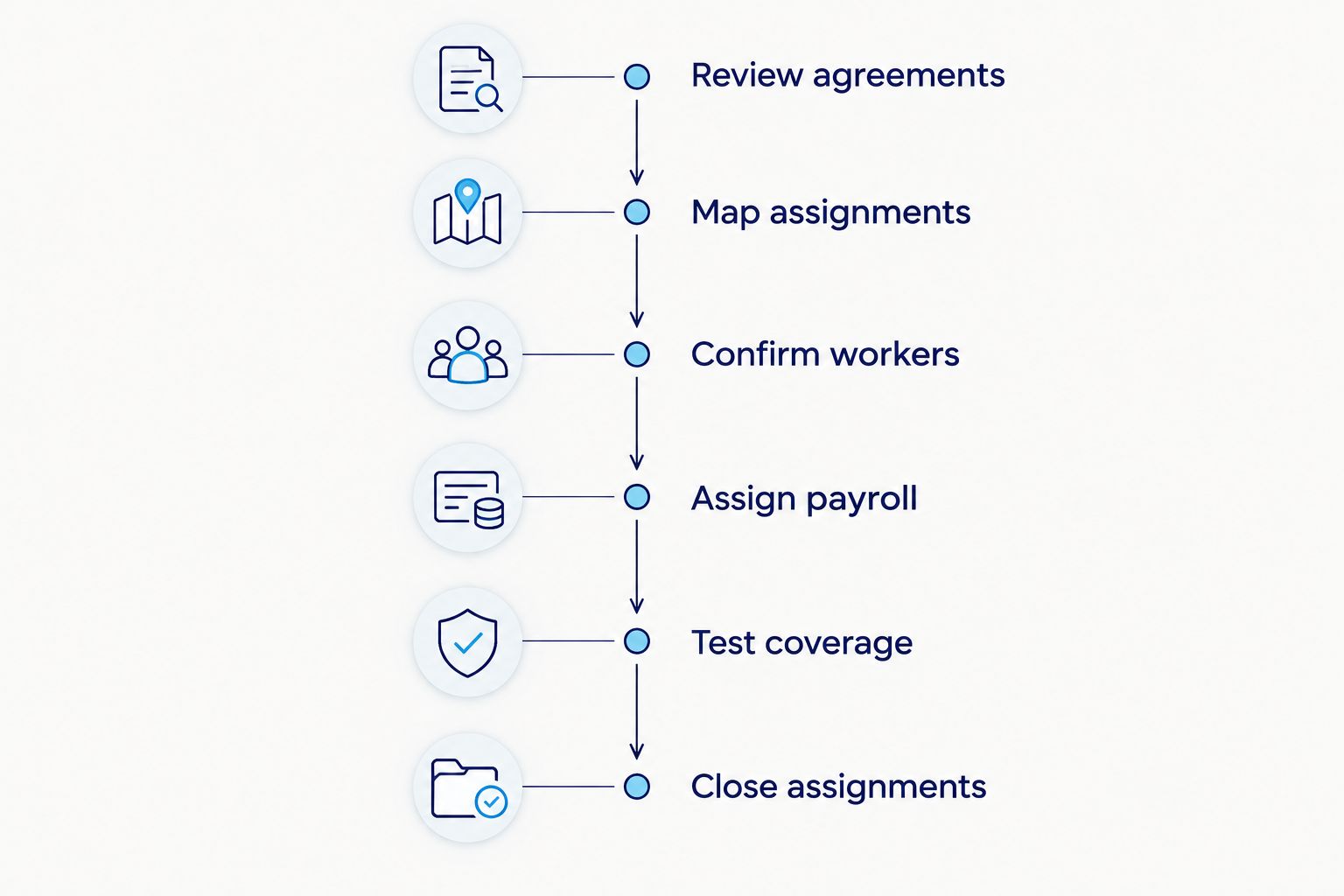
Confirm worker arrangements and payroll responsibility before moving assignments.
Why this matters
An agency change affects more than the supplier name on an invoice. Workers need clear instructions about where to report and how to submit hours; supervisors need to know who is expected and whom to contact when someone does not arrive.
For your 2026 handoff, separate the decision to replace an agency from the decision to move a particular assignment. You can resolve the business relationship without telling every worker to change reporting instructions at once.
Protect the work first, then change the administration around it. Avoid asking frontline supervisors to interpret conflicting messages from the outgoing agency, incoming agency, and your own office.
Choose the handoff that matches your assignments
A staged transition and a single handoff have different operational trade-offs. Neither arrangement removes the need to review agreements or confirm individual worker arrangements.
Staged transition
Best for: Employers who need to verify coverage before moving more assignments
Advantage: Lets you check reporting, attendance, and time approval on a limited scope
Limitation: Requires coordination across agencies during the overlap
Single handoff
Best for: Employers with confirmed worker arrangements and aligned assignment boundaries
Advantage: Gives supervisors a clear administrative change point
Limitation: Concentrates unresolved readiness issues at the same handoff
New assignments first
Best for: Employers who can leave current assignments intact
Advantage: Introduces the incoming agency without immediately changing existing workers’ arrangements
Limitation: Does not resolve problems affecting current assignments
Use a staged transition when important details remain unconfirmed. Define the initial scope by department, shift, or location rather than by an arbitrary calendar target.
A single handoff requires an assignment-level check. Confirm each worker’s reporting instructions, onboarding status, supervisor, and time-submission process before announcing that the change is complete.
Starting with new assignments protects current routines, but it is not a substitute for addressing unresolved issues. Give existing assignments their own documented decision rather than leaving them indefinitely between agencies.
Review the agreement before discussing worker transfers
Read your current agreement and any assignment-specific documents before sending a termination notice. Record the required notice method, the effective end of service, and obligations that continue after an assignment ends.
Look for language covering worker transfers, direct hiring, confidentiality, records, and outstanding time approvals. Have qualified counsel review provisions you do not understand; do not treat a recruiter’s informal interpretation as a contractual release.
Ask the incoming agency what it requires before accepting an existing worker. Request a written explanation of the proposed arrangement rather than assuming that an active worker can simply begin recording hours under a different agency.
For a 2026 transition, keep the signed agreement and any agreed changes together. Supervisors should receive the operational instructions, not be responsible for interpreting contract provisions.
Build a roster that supervisors can actually use
List every active assignment, not just a department’s total headcount. A warehouse can appear fully covered while a particular role lacks someone prepared to perform it.
Your roster should capture:
Worker name and current agency.
Role, department, work location, and scheduled shift.
Supervisor and backup operational contact.
Required task training, site orientation, and access status.
Proposed assignment end and new assignment start.
Time-entry process and person responsible for approval.
Confirmation status and unresolved questions.
Keep sensitive personnel documents out of the general scheduling roster. Share information through an agreed process with people who need it for their responsibilities.
Ask each supervisor to review the entries for their area. The staffing coordinator knows the agency arrangement; the supervisor knows whether the worker’s scheduled role matches the actual work.
Do not mark an assignment ready while its reporting instructions remain unresolved. A worker’s name on a spreadsheet is not confirmation that the worker knows where to go.
Tell workers what stays the same and what changes
Speak with affected workers before their reporting instructions change. Explain the proposed arrangement plainly, and distinguish confirmed details from decisions still awaiting agreement.
Give workers a written summary covering their assignment, supervisor, reporting location, schedule, time-submission instructions, and agency contact. Explain any confirmed changes to their employment arrangements through the agency responsible for those terms.
Do not promise that pay arrangements, benefits, employment status, or accumulated entitlements will remain unchanged unless the responsible parties have confirmed that statement. Workers need accurate answers, not reassurance that later requires correction.
Use consistent language across your 2026 communications. If the supervisor says to use the old timekeeping process while the incoming agency says to use a new one, resolve that conflict before the worker starts the affected assignment.
Invite workers to raise practical concerns privately. A reporting-location problem or incomplete onboarding task is easier to address before the shift than after a worker arrives without clear instructions.
Make payroll ownership explicit
Separate the final assignment period handled by the outgoing agency from the first assignment period handled by the incoming agency. Name who receives time records, who approves corrections, and who answers workers’ pay questions for each period.
Write down how to handle work that crosses the agreed assignment boundary. Do not assume the agencies use identical payroll schedules, time-entry systems, or approval deadlines; ask each agency to confirm its process.
Before closing the outgoing assignments, review:
Submitted hours that still need approval.
Missing punches or disputed time records.
Corrections awaiting a response.
The agency contact responsible for remaining questions.
Records your business must retain under its established requirements.
Keep a route for resolving old payroll questions after the operational handoff. Ending an assignment does not make an unresolved time record disappear.
Your 2026 transition plan should identify an internal owner for these issues. Workers should not have to decide which agency’s inbox will receive a response.
Verify the shift before expanding the change
Choose an initial scope that lets supervisors check the handoff in real working conditions. Confirm worker attendance, site access, role instructions, and time recording before moving additional assignments.
Ask supervisors to report specific exceptions: an expected worker did not arrive, a badge did not work, a task required unconfirmed training, or recorded hours went to the wrong approver. Record the issue and the person responsible for resolving it.
Define a fallback before the affected shift begins. Depending on confirmed arrangements, that means retaining existing coverage, moving the assignment boundary, or arranging an agreed replacement—not assuming the outgoing agency will remain available.
Expand the transition only after the initial scope meets your readiness conditions. If an issue remains unresolved, keep the next assignments under their confirmed arrangements rather than moving them because an announcement has already been sent.
Why switching staffing agencies varies
Your handoff depends on the assignments and agreements involved, not on a universal transition schedule. These factors determine what you must confirm:
Agreement terms: Required notices and worker-transfer provisions shape the permitted handoff.
Worker decisions: Existing workers must understand and agree to the proposed arrangements affecting them.
Assignment scope: Multiple locations, departments, and shifts create separate reporting needs.
Onboarding requirements: Each worker’s required documentation, training, and site access need confirmation.
Timekeeping processes: Different submission and approval workflows require clear instructions.
Open assignment issues: Unresolved hours, attendance questions, and replacement requests need named owners.
Use these factors to set your readiness conditions. Do not copy another employer’s timetable without checking whether the same conditions apply to your team.
Can I keep the same workers when I change staffing agencies?
Keeping the same workers requires confirmation of their willingness, the applicable agreements, and the incoming agency’s requirements. Do not describe a transfer as complete until those arrangements are settled.
Ask about each worker individually. A general agreement between agencies does not replace clear assignment instructions for the people expected on your floor or in your office.
Should I tell my current agency before choosing a replacement?
Review your notice obligations before deciding when to communicate the change. Selecting an incoming agency and confirming its readiness are separate from meeting the outgoing agency’s contractual requirements.
Keep the discussion factual: affected assignments, proposed boundaries, outstanding hours, and responsibilities. Do not announce an operational handoff that the incoming agency has not confirmed.
How do I know the new agency is ready?
The incoming agency is ready for a particular assignment when its worker arrangements, reporting instructions, required onboarding, and time-approval process are confirmed. A general promise to cover your business is not an assignment-level readiness check.
Have the supervisor and your transition owner review unresolved items together. Release the assignment only after the people responsible for it understand their roles.
Where a local staffing partner fits
Sourcedstaffing is best suited to Reno and Carson City employers seeking local recruiting, direct hire, and payroll services. Its stated sectors include light-industrial, manufacturing, warehouse, office, and food production.
That service scope makes Sourcedstaffing relevant when your agency change involves those Northern Nevada operations. The service offering does not establish that a particular worker transfer or shift arrangement is confirmed; verify those details before ending existing coverage.
Bring your assignment roster, agreement requirements, and unresolved questions to the discussion. Ask for explicit responsibilities rather than a general assurance that the change will be easy.
Discuss your staffing transition
Bring your assignment roster and handoff questions for your Reno or Carson City operation.
FAQ
What's the safest way to switch staffing agencies without disruption?
Confirm contract obligations, individual worker arrangements, shift coverage, and payroll responsibility before moving assignments. Keep existing reporting instructions in place until the affected handoff is confirmed.
Can my current temp workers move to a different staffing agency?
A worker transfer requires review of the applicable agreements, the worker's willingness, and the incoming agency's requirements. Do not assume employment or assignments transfer automatically.
Should I change every department at the same time?
Use a staged transition when you need to verify reporting, coverage, and time approval before expanding the change. A single handoff requires those details to be confirmed across all affected assignments.
Who handles payroll during an agency change?
The agencies' agreed assignment boundaries and payroll arrangements determine responsibility. Document who handles each period, who approves hours, and who resolves corrections.
What should I tell workers about the agency switch?
Give workers confirmed instructions for their assignment, schedule, supervisor, time submission, and agency contact. Do not promise unchanged employment terms without confirmation from the responsible parties.
Can Sourcedstaffing help with staffing in Reno and Carson City?
Sourcedstaffing provides recruiting, direct hire, and payroll services connecting local employers and job seekers in Reno and Carson City. Confirm the specific arrangements needed for your agency transition before changing current assignments.
One last thing
Ask an affected worker to explain where they will report, whom they will contact, and how they will submit hours after the handoff. Then ask their supervisor the same questions.
If the answers conflict, the assignment is not ready to move. Fix the instructions before expanding the transition; a shared understanding matters more than a completed announcement.