
How does a staffing agency verify work eligibility?
Article
A staffing agency verifies work eligibility by completing Form I-9 for employees it hires, reviewing acceptable documents that establish identity and authorization to work in the United States. The employee completes their section by the first day of paid work, and the employer generally completes document review within 3 business days after that first day. E-Verify adds a government-record check where required or used; it does not replace Form I-9, and a direct-hire placement generally leaves verification with the business hiring the worker.
TL;DR
How does a staffing agency verify work eligibility? Form I-9 documents identity and authorization to work.
Employers generally finish Form I-9 document review within 3 business days after paid work begins.
Employees choose acceptable documents; employers cannot insist on a passport or green card.
Sourced Staffing serves Reno and Carson City businesses and job seekers through staffing, recruiting, direct hire, and payroll services.
How does a staffing agency verify work eligibility?
The process starts with identifying the employer, not with collecting a passport. For your 2026 hiring plan, separate work authorization from other screening: a criminal-history check, reference check, or drug test does not establish employment eligibility. The guide to background checks before hiring covers that separate part of candidate screening.
USCIS Form I-9 instructions establish the core sequence:
Identify the employer. Determine whether the staffing agency employs the worker or only recruits someone for your business. The employer owns the verification obligation even when an authorized representative examines documents.
Complete employee information. After accepting an offer, the worker completes and signs Section 1 no later than the first day of employment for pay. A preparer or translator completes the relevant supplement when assisting.
Examine acceptable documents. The employee chooses documents from the Form I-9 Lists of Acceptable Documents. The reviewer checks whether they reasonably appear genuine and relate to the person presenting them.
Complete employer verification. The employer or authorized representative records the document information and completes Section 2 within the applicable deadline. For employment lasting fewer than 3 business days, Section 2 must be completed by the first day.
Handle follow-up. The employer retains the form, completes any required E-Verify case, and tracks reverification when required. Hiring does not turn every expiring identity document into a future reverification requirement.
A completed background check is not a completed work-eligibility check. Keep those decisions separate in your onboarding checklist.
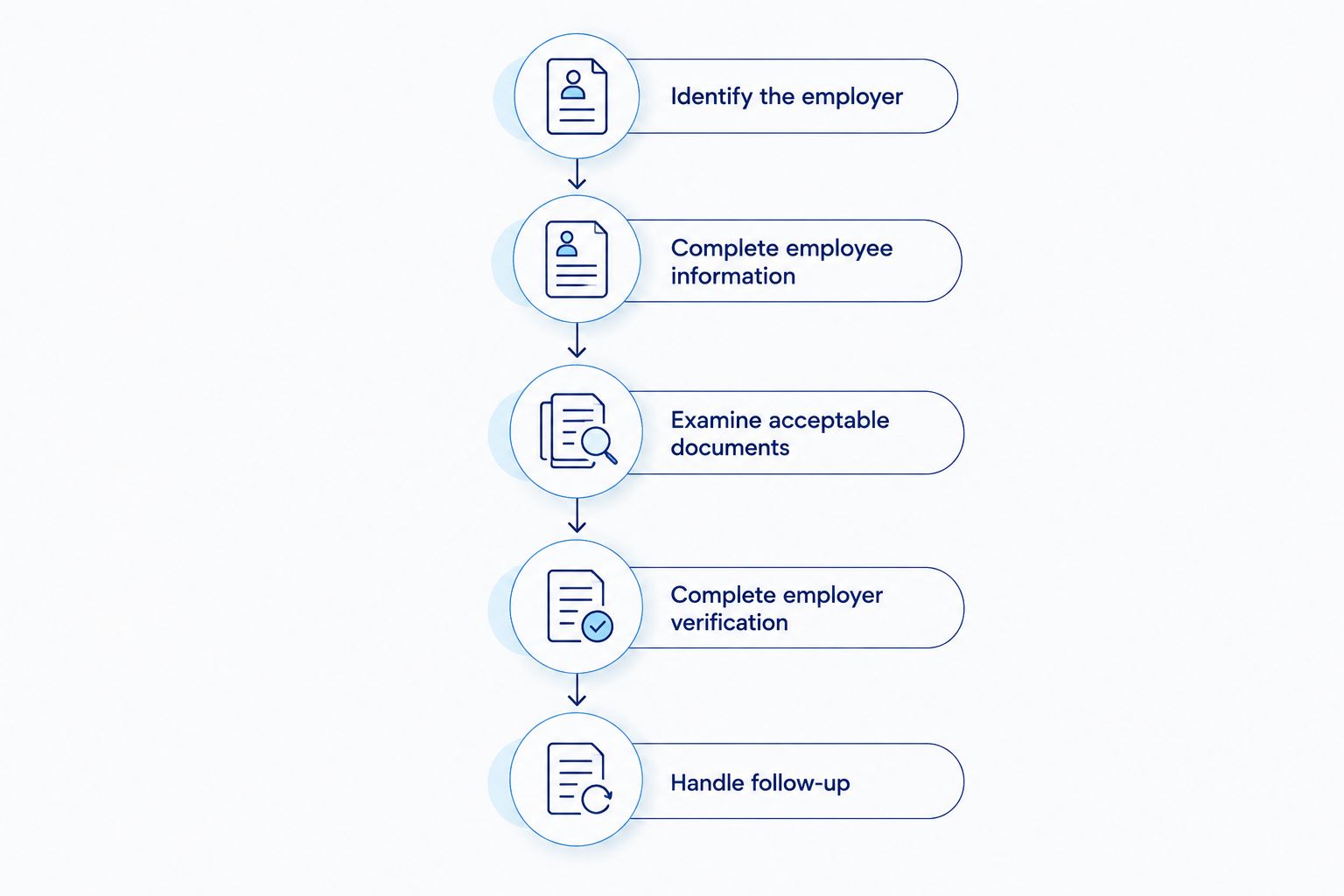
Identify the employer before assigning responsibility for document review.
Why this matters
An agency assignment and a direct-hire placement can look similar to a supervisor: someone arrives ready to work. The employer relationship determines who must complete Form I-9. Confirm that responsibility before the start date rather than assuming the recruiter handles everything.
For a 2026 warehouse, manufacturing, office, or food-production hire, build document review into onboarding without treating citizenship, accent, or birthplace as a screening shortcut. Federal rules require employers to verify eligibility while respecting employees' document choices and protections against discrimination.
The practical benefit is clarity. You know who completes the form, who resolves an incomplete submission, and who maintains the record; the worker knows what to bring without being told to produce an unnecessary document.
Which documents can a worker present?
Workers generally present either an acceptable List A document or an acceptable combination of List B and List C documents. The employee chooses the acceptable documents—not the staffing agency or client supervisor. Use the current Form I-9 lists for eligibility details and exceptions.
List A
What it establishes: Identity and employment authorization
Common example: An unexpired U.S. passport
Best for: A worker choosing an acceptable combined-proof document
Limitation: A passport is not mandatory; some List A entries require a document combination
List B plus List C
What it establishes: Identity and employment authorization separately
Common example: An acceptable driver's license plus an unrestricted Social Security card
Best for: A worker choosing separate identity and authorization documents
Limitation: Both categories are required; a restricted Social Security card is not acceptable List C evidence
A Social Security card marked with a restriction such as valid for work only with DHS authorization is not an acceptable List C document. That does not mean the worker lacks authorization; it means they must choose another acceptable document route.
A driver's license generally establishes identity, not authorization to work. Likewise, knowing a person's Social Security number does not replace document examination. If the employer participates in E-Verify, a List B document must contain a photograph.
For your 2026 onboarding instructions, give employees the official document list rather than a shortened demand such as bring your driver's license and Social Security card. The shortened version excludes valid alternatives and can create an improper document request.
What if a document is lost or being replaced?
Certain receipts are acceptable under Form I-9 rules, including qualifying receipts for replacement of a lost, stolen, or damaged document. A receipt for an initial application or ordinary renewal is not automatically acceptable; specific exceptions apply.
Ask the employer's reviewer to check the USCIS receipt rules before accepting or rejecting a receipt. Do not promise a start date based only on an application confirmation, and do not assume every pending replacement prevents someone from beginning work.
Why work-eligibility verification varies
The legal obligation stays consistent, but the review path changes with the employment arrangement and documents presented. These factors explain the differences:
Employer relationship: An agency employing a temporary worker generally completes that worker's Form I-9. A business making a direct hire generally completes its own verification.
Document choice: A worker can use an acceptable List A route or a List B and List C combination. The reviewer must follow the requirements for the chosen route.
Assignment length: Employment lasting fewer than 3 business days requires employer verification by the first day, rather than the usual later deadline.
Review method: Physical examination is the standard route. Eligible employers can use the DHS-authorized alternative procedure subject to its requirements.
Employment authorization: Some authorization requires reverification, while other documents or statuses do not. Applicable extensions can also affect what evidence remains valid.
E-Verify participation: Participating employers add a government-record check and must follow the program's procedures, including protections when records do not initially match.
A different document route is not evidence of a weaker candidate. Judge job qualifications separately from the lawful documents the person chooses to present.
Does every staffing agency use E-Verify?
Form I-9 is required for covered hires; E-Verify is not universally required for every staffing agency. Participation requirements depend on applicable laws, contracts, and program enrollment, so ask the agency whether E-Verify applies to your hiring arrangement.
E-Verify compares information from Form I-9 with government records. Participating employers generally create a case no later than 3 business days after the employee starts work for pay, subject to program exceptions. They must not use E-Verify to prescreen applicants before hiring.
For 2026 onboarding, distinguish these two statements: the employer completed Form I-9, and the employer received an E-Verify result. Neither statement should be substituted for the other.
What happens if E-Verify reports a mismatch?
A mismatch means the information does not initially match government records; it is not a final finding that someone lacks work authorization. The employer must notify the employee and follow the process for deciding whether to take action to resolve it.
An employer cannot take adverse action against an employee because of a mismatch while the employee is taking the required steps to resolve it. Do not remove someone from a schedule, delay training, or end employment solely on that unresolved result.
Who verifies eligibility for a direct-hire placement?
The business hiring the employee generally completes Form I-9 for a direct-hire placement, even when an agency sourced and interviewed the candidate. Recruiting assistance does not transfer the hiring employer's legal responsibility.
For temporary assignments, establish whether the worker remains the agency's employee. If your business later hires that worker onto its own payroll, treat the change as a new employer relationship requiring your business to address its own Form I-9 obligation.
Before a handoff, ask:
Who is the employer on the employee's start date?
Who will examine the documents and sign the employer section?
Who handles an incomplete form or document question?
Who retains the record and tracks required follow-up?
Put the answers in your onboarding plan. A recruiter, supervisor, and payroll contact should not each assume another person completed verification.
Can a staffing agency review documents remotely?
An ordinary video call or emailed photograph does not, by itself, satisfy Form I-9 document-examination requirements. Employers must use physical examination or qualify for and follow the DHS-authorized alternative procedure.
Eligible E-Verify employers using that alternative procedure must meet its conditions, including examining document copies, conducting a live video interaction, and retaining the required copies. Employers using physical examination can designate an authorized representative, but the employer remains responsible for errors in the form or review.
For a 2026 remote onboarding plan, ask which approved examination method will be used before sending identity documents. Use the employer's designated secure process, not an informal message to a shift supervisor.
What should businesses and job seekers ask before starting?
For businesses, the useful question is not simply whether candidates are screened. Ask who completes work-eligibility verification, how the first-day deadline is handled, and whether any unresolved onboarding task affects the planned assignment.
For job seekers, ask when Section 1 is due, where document examination takes place, and how to access the official acceptable-document list. You can request clarification without surrendering your right to choose acceptable documents.
Sourced Staffing is a staffing option for businesses and job seekers seeking local recruiting support in Reno and Carson City. Its stated services include recruiting, direct hire, and payroll support across light-industrial, manufacturing, warehouse, office, and food-production sectors.
The fit is that local staffing focus; the boundary is that service descriptions alone do not establish a particular employer's verification method or E-Verify participation. Ask Sourced Staffing to confirm who owns Form I-9 for your specific arrangement rather than assuming a service label answers the question.
What records must the employer keep?
The employer must retain Form I-9 for 3 years after the hire date or 1 year after employment ends, whichever is later. These are retention periods, not instructions to request updated documents on that schedule.
Reverification concerns continuing employment authorization when required. Employers generally do not reverify U.S. citizens or noncitizen nationals, and they do not reverify lawful permanent residents who presented a Permanent Resident Card solely because that card expires. Expiration of a List B identity document also does not trigger reverification.
For 2026 recordkeeping, separate three tasks: storing the form, monitoring any required authorization follow-up, and responding to an authorized inspection. Collecting extra identity documents is not a substitute for performing those tasks correctly.
The governing references are USCIS Form I-9 instructions and the Handbook for Employers, M-274, for document examination, deadlines, receipts, reverification, and retention. E-Verify employer guidance covers case handling and employee rights; the U.S. Department of Justice's Immigrant and Employee Rights Section explains protections against discriminatory document practices.
FAQ
Do I need to be a U.S. citizen to work through a staffing agency?
No. A staffing agency can employ people who are authorized to work in the United States, including eligible noncitizens. Form I-9 verifies identity and employment authorization, not a universal citizenship requirement.
How soon does a staffing agency need to check my documents?
The employer generally completes Form I-9 document review within 3 business days after your first day of paid work. If employment lasts fewer than 3 business days, the employer section must be completed by the first day.
Can a staffing agency require me to bring a green card?
No. You choose acceptable documents from the Form I-9 lists, and the employer cannot demand a green card instead of other acceptable evidence. Documents must reasonably appear genuine and relate to you.
Is a background check enough to prove I can work?
No. A background check does not replace Form I-9 verification of identity and employment authorization. Screening for job suitability and checking work eligibility are separate processes.
Does an E-Verify mismatch mean I cannot work?
No. An E-Verify mismatch is not a final determination that you lack authorization to work. The employer must follow the notification and resolution process and respect your rights while you take the required steps.
Who completes Form I-9 if I get a permanent job through an agency?
The business that hires you generally completes Form I-9 for a direct-hire placement. If you move from agency employment to the client's payroll, the new employer must address its own verification obligation.
Does Sourced Staffing use E-Verify for every placement?
Confirm E-Verify participation and the responsible employer directly with Sourced Staffing for your placement. Its recruiting, direct-hire, and payroll services do not by themselves establish which verification process applies.
One last thing
An expiring driver's license does not automatically require Form I-9 reverification. The follow-up question concerns employment authorization, not every document's expiration date.
Before the next start date, name the person responsible for Form I-9 and give the worker the official acceptable-document list. Those two actions prevent a common onboarding mistake: everyone expects verification to happen, but nobody owns it.