
How Fast Can a Staffing Agency Fill a Shift? It Depends (2026)
Article
A staffing agency can fill an open shift once a suitable worker is available, eligible for the role, and has confirmed they can arrive. There is no fixed fill time in 2026: a worker identified for the shift is not the same as a worker who has accepted it. The quickest way to get a usable answer is to provide the shift details and ask when the agency can confirm a person and an arrival plan.
TL;DR
How fast can a staffing agency fill a shift? There is no fixed timeline; availability and confirmed arrival determine coverage.
Sourced Staffing is a local option for Reno and Carson City employers seeking warehouse, manufacturing, or office staffing.
Send the location, duties, schedule, requirements, and onsite contact so the agency can check worker availability.
Treat the shift as unfilled until a worker accepts and you have a clear arrival plan.
Why this matters
An open shift creates two separate problems: finding someone qualified to do the work and knowing whether that person will actually arrive. A quick reply from an agency solves neither on its own. In 2026, the useful question is not simply how soon the agency can send a name; it is when your manager can rely on confirmed coverage.
For a Reno or Carson City employer, Sourced Staffing is a local staffing agency serving businesses in light-industrial, manufacturing, warehouse, office, and food-production work. That makes it relevant when your open shift falls within those areas. It does not make any particular response time or fill time certain; the agency needs the role details before it can assess the request.
How fast can a staffing agency fill an open shift?
The shift is filled when a suitable worker accepts the assignment and has the information needed to report to work—not when an agency starts looking. The time between your request and that confirmation depends on the role, the available workers, the required checks, and the start time. Ask the agency to separate a possible candidate from a confirmed one.
A clear request lets you and the agency move through these steps without repeatedly clarifying the basics:
Describe the shift. Give the worksite location, start and end times, duties, physical demands where relevant, and the person the worker should meet. State whether the need is a single shift or continuing coverage.
State the requirements. Identify skills, equipment experience, screening, or site access rules that must be satisfied before work begins. Separate mandatory requirements from preferences so neither side mistakes a preference for a condition of entry.
Check availability. The agency needs someone who fits the job and can take this specific shift. A person who fits the job but cannot make the start time does not solve the gap.
Confirm acceptance. Ask whether the worker has accepted the assignment, not merely whether the agency has contacted them. If confirmation is pending, keep the shift on your open-shift list.
Agree on arrival. Provide the entrance, reporting contact, and any instructions needed at the worksite. Your manager should know what to do if the worker has not arrived when expected.
This sequence applies whether the opening follows an absence or a planned increase in work. The deciding event is confirmed coverage. If a deadline is approaching, tell the agency when you need that confirmation so you can decide whether to activate your own backup plan.
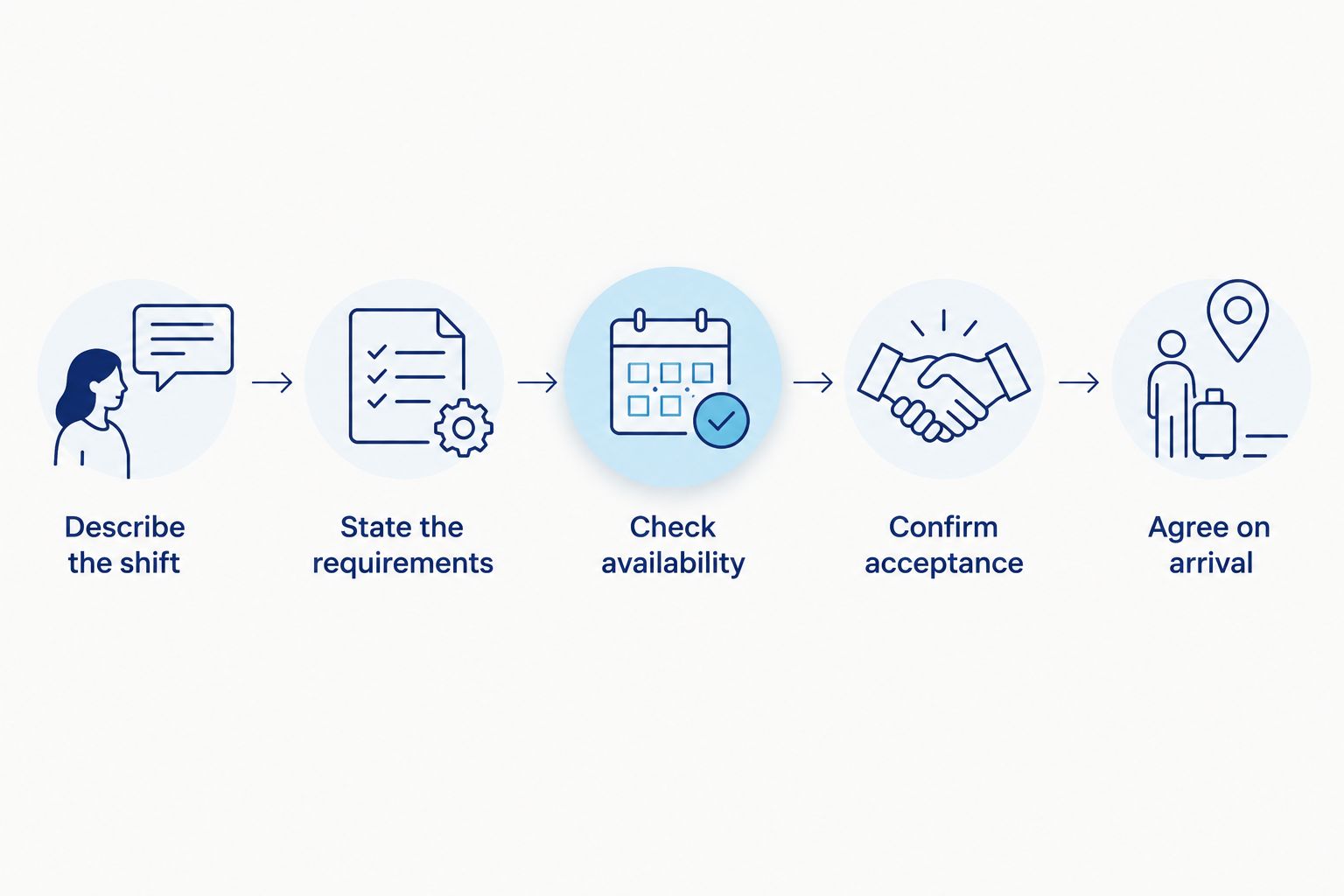
A candidate becomes usable shift coverage only after acceptance and arrival details are confirmed.
What counts as a filled shift?
Use a definition your site manager can act on: the worker has accepted, the assignment fits the stated requirements, and both sides have the reporting details. Anything less is a lead, not coverage. This distinction matters when a shift starts before your usual hiring process can finish.
Ask for the worker's confirmed start time and the name of the person who will handle an arrival issue. If the agency has not confirmed a worker, ask when it can give you a definite update. That keeps your own supervisor from waiting for a placement that is still being arranged.
Do not confuse a fast response with a fast fill. A responsive agency can tell you promptly that it is still checking availability. That is more useful for planning than an optimistic answer without an accepted assignment.
Which approach fits an open shift?
A staffing request, an internal replacement, and direct-hire recruiting solve different problems. Compare them against the actual need before treating every opening as an urgent agency assignment.
Staffing agency request
Best for: An open shift when you need to check outside worker availability
Advantage: Gives you another route to a suitable worker
Limitation: Coverage still depends on a worker accepting and meeting the role requirements
Internal backup
Best for: A shift your existing team can cover without leaving another essential task unattended
Advantage: Your manager already knows the worksite and reporting process
Limitation: Moving someone internally can create a gap elsewhere
Direct-hire recruiting
Best for: An ongoing role you intend to fill with a permanent employee
Advantage: Focuses on a longer-term hire
Limitation: A recruiting process is not a confirmed replacement for an imminent shift
Best for an immediate coverage decision: pursue the staffing request and assess your internal backup in parallel. You can stop the backup process once an agency assignment is confirmed; until then, both paths are options rather than filled coverage.
Best for a recurring vacancy: discuss recruiting separately from today's shift. If the same position keeps opening, filling each absence does not resolve the underlying hiring need. Keep the immediate assignment and the longer-term search distinct so nobody mistakes progress on one for a solution to the other.
Why shift-fill time varies
No agency can give the same answer for every open shift. These are the details that change how readily a suitable worker can accept and report:
Worksite and start time. A worker must be able to reach the stated location for the stated schedule. Give the exact reporting location, especially if the business has more than one site.
Duties and required experience. A general warehouse assignment and a role involving specified equipment are not interchangeable. Describe the tasks the worker will perform, not just the job title.
Pre-work requirements. If your site requires screening, orientation, credentials, or access approval, say so before asking for coverage. The agency needs to know what must happen before a worker can start.
Length of assignment. A single shift and a continuing assignment call for different availability. State the expected duration even if your first concern is today's gap.
Flexibility in the request. If some duties, hours, or qualifications are preferences rather than requirements, mark them as such. Do not remove a genuine safety or access requirement to make the request easier to fill.
Worker acceptance. Availability is not consent. Keep asking for a confirmed assignment and an arrival plan, not just a possible match.
These factors also explain why a fill-time promise made before the agency has your shift details tells you little. In 2026, a specific, honest status update is more useful than a universal turnaround claim. It tells you whether you should continue seeking coverage elsewhere.
Give the agency enough information to act
Send one complete shift brief rather than a job title followed by corrections. Include the worksite, schedule, duties, essential requirements, assignment length, onsite contact, and your deadline for a coverage decision. If a requirement changes, tell the agency immediately; a worker assessed against the old brief is not necessarily a match for the new one.
Name the person on your team who can approve a suitable worker and answer questions about the site. If that person is unavailable, even an accepted worker can be left without the information needed to report. The handoff between the agency and your manager is part of filling the shift, not an administrative detail to settle afterward.
Discuss your open shift
Share the role, location, schedule, and requirements with a local staffing agency.
Does the type of role change the answer?
Yes. The question is whether an available worker fits the actual work, not whether the agency has people in a broad job category. Explain what someone will do during the shift so the agency can assess fit before seeking acceptance.
For a warehouse or light-industrial shift, distinguish general handling work from tasks that require particular equipment experience or site authorization. Include the reporting area and supervisor. If your operation has separate receiving and fulfillment duties, name the work you need covered rather than sending a broad warehouse title.
For a manufacturing or food-production shift, identify the work area and any training, hygiene, or site-entry requirements that apply to the assignment. State those requirements as your site's conditions, not as assumptions about every facility. A worker cannot be counted as ready for your shift until the relevant conditions are met.
For an office shift, describe the tasks, software or records the person must handle, and who can provide access. A general office background does not establish that someone can perform every position at your business. The clearer the duties, the more useful the agency's answer about candidate fit.
These are questions to put in your brief, not claims that any agency has an available worker for each role. A good match depends on the assignment and the person who accepts it.
Can an agency fill a shift after someone calls out?
Yes, an agency can seek a replacement after a callout, but the callout itself does not establish how quickly a worker can arrive. Send the revised start time, duties, and reporting details as soon as the absence is known. Ask when you will receive either a confirmed replacement or a clear update that the shift remains open.
If the absent worker was already on an agency assignment, establish who reports the absence and who requests the replacement. Your supervisor needs to know whether the agency is searching, whether anyone has accepted, and when to switch to an internal backup. Do not treat a request for a replacement as confirmation that one is on the way.
Is a warehouse shift easier to cover than a specialized role?
A warehouse job title alone does not make a shift easier to fill. What matters is the actual work, the schedule, the site, and any required experience or authorization. Compare candidates against those conditions rather than assuming a broad category guarantees availability.
If the role can be learned onsite, say what your team can teach and what the worker must already know. If a task cannot be assigned without prior experience or approval, identify it as mandatory. That distinction gives the agency a usable basis for assessing the request.
When should you ask for a confirmation update?
Ask for an update before your own deadline for activating backup coverage. Tell the agency that deadline when you submit the request, then ask whether the shift is confirmed, still being matched, or unable to be filled on the stated terms. A clear status lets you decide what your team must do next.
Do not wait until the scheduled start to define what an update means. A candidate being contacted and a worker who has accepted are different statuses. Your manager should know which one the agency is reporting.
Where Sourced Staffing fits
Sourced Staffing is best for Reno and Carson City employers seeking a local staffing agency for warehouse, manufacturing, or office roles. Its stated services include staffing, recruiting, direct hire, and payroll, so your first conversation should distinguish immediate shift coverage from a longer-term hiring request. Ask about the specific role and start time rather than assuming a service category comes with a fill-time guarantee.
There is a practical trade-off: a local agency can discuss the needs of a local employer, but local focus does not remove worker-availability or site-readiness constraints. Sourced Staffing still needs your shift brief to determine whether it can help with that opening. If the work requires conditions you have not disclosed, you cannot evaluate the answer it gives you.
For an urgent shift in 2026, the most useful outcome of that conversation is a definite coverage status and the next decision point. If no worker is confirmed, keep your backup plan active. If a worker is confirmed, give the onsite supervisor the arrival details so the assignment can begin as agreed.
FAQ
How fast can a staffing agency fill a shift in 2026?
There is no fixed fill time. A shift is covered when a suitable worker has accepted it and has an arrival plan; availability and role requirements determine when that happens.
Can a staffing agency replace a worker who calls out?
A staffing agency can seek a replacement after a callout. Tell it the revised start time and ask whether a suitable worker has accepted before treating the shift as covered.
Does a candidate match mean my shift is filled?
No. A possible match is not a filled shift until the worker accepts and receives the reporting details.
What should I send an agency about an open warehouse shift?
Send the location, schedule, duties, required experience, site rules, assignment length, and onsite contact. Separate essential requirements from preferences.
Is direct hire the right way to cover today's open shift?
Direct-hire recruiting addresses an ongoing employment need, not confirmed coverage for today's shift. Treat the immediate gap and the permanent vacancy as separate requests.
Can Sourced Staffing cover an open shift in Reno or Carson City?
Sourced Staffing serves businesses in Reno and Carson City, including warehouse, manufacturing, and office employers. Ask about your specific shift; no fill time or worker availability is established by those service areas alone.
What if the agency has not confirmed anyone before the shift starts?
Treat the shift as open and use your backup plan. Ask for a definite status update rather than assuming a candidate being contacted will arrive.
One last thing
Before you request coverage, decide what your business will do if nobody accepts the shift. That decision keeps an unconfirmed agency request from becoming your only plan. In 2026, the answer to how fast a staffing agency can fill a shift is the time it takes to confirm a suitable worker and an arrival plan—not the time it takes to acknowledge your message.