
How much notice do I need to increase temp headcount?
Article
Give notice as soon as you expect to need more temporary workers; the lead time you need is the time your staffing partner confirms for your specific roles, shifts, and start date. Recruiting is only part of that timeline: required screening, site orientation, and supervisor readiness also affect when people can begin productive work. Treat a requested start date as a target, not a confirmed commitment.
TL;DR
How much notice to increase staffing headcount depends on the assignment; confirm recruiting and onboarding before committing to a start.
Sourced Staffing serves Reno and Carson City businesses in light-industrial, manufacturing, warehouse, office, and food-production staffing.
Send the role, shift, location, worker count, and required start date together.
Separate requested workers from confirmed starts; use staged onboarding when your site cannot train everyone together.
Why this matters
An extra worker on the schedule is not the same as someone ready to perform the assignment. You need agreement on the work, the start arrangements, and who will handle training before you build a production plan around additional people.
Sourced Staffing provides staffing, recruiting, direct-hire placement, and payroll services for local businesses. Sourced Staffing is best for Reno and Carson City businesses seeking a local staffing agency in its stated sectors. For your 2026 staffing plan, confirm assignment-specific timing directly rather than treating a general service description as a delivery promise.
Early notice gives you a planning conversation before the requirement becomes urgent. It does not replace a clear request or a confirmed start.
How much notice do I need to increase temp headcount?
Give your staffing partner notice when the need becomes credible, then ask for a start plan tied to the actual assignment. Do not wait for every detail to be final before raising the requirement, but identify which details remain subject to approval.
Use this sequence to turn an expected increase into a workable request:
Define the work. Describe the tasks, required experience, worksite, and shift. Separate essential qualifications from skills you can teach on site.
Specify the increase. State the additional headcount you want, the desired start date, and the expected assignment duration. Distinguish new positions from replacements for existing workers.
Identify prerequisites. List any screening, documents, equipment, or training that must be completed before work starts. Assign responsibility for each requirement.
Ask for confirmation. Request the staffing partner's proposed start plan, including what remains pending. Clarify whether confirmation means a candidate accepted the assignment or completed every prerequisite.
Prepare the site. Name the receiving supervisor, explain arrival instructions, and confirm training capacity. Tell the agency promptly if the assignment changes.
The useful answer is not simply a lead-time estimate. It is a shared understanding of what must happen before the worker can start, who owns each task, and which commitments are firm.
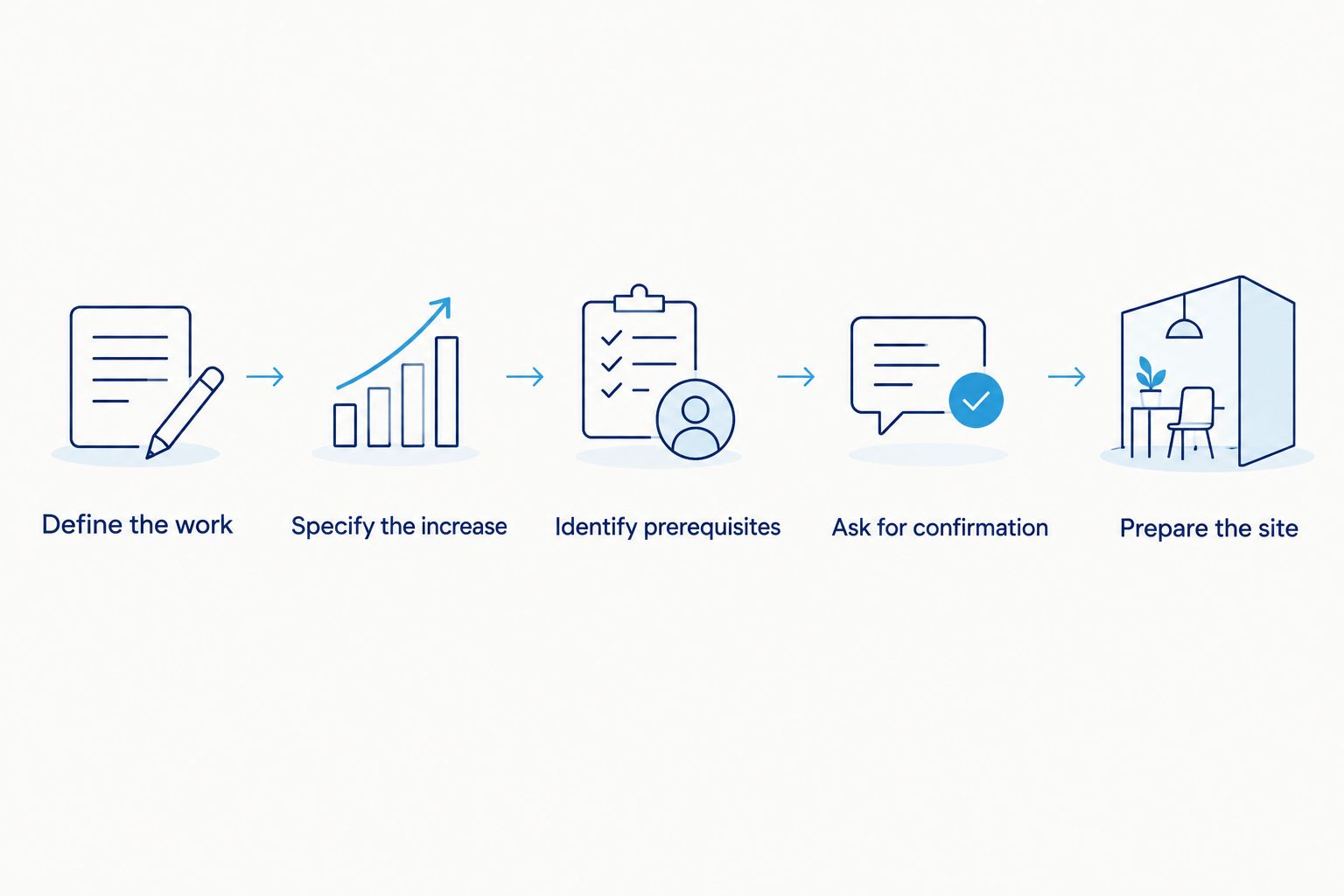
Confirm the assignment and its prerequisites before treating the start date as settled.
Match the request to the type of increase
Not every headcount increase is the same scheduling problem. Compare the reason for the request before deciding whether to ask for an immediate response, a staged start, or an advance recruiting plan.
Urgent shift coverage
Best for: Addressing a gap in an existing shift
What to establish first: Exact duties, reporting instructions, and required prerequisites
Advantage: Keeps the request focused on a defined assignment
Limitation: An urgent request is not a confirmed start
Planned headcount increase
Best for: Adding workers to a known operation
What to establish first: Added positions, start date, duration, and training capacity
Advantage: Allows staffing and site preparation to be coordinated
Limitation: Changes to the assignment require reconfirmation
Staged increase
Best for: Adding workers in groups your site can train
What to establish first: Priority roles and the order of starts
Advantage: Matches arrivals to supervisor capacity
Limitation: The full requested headcount does not start together
Seasonal ramp
Best for: Preparing for an expected peak
What to establish first: Forecast assumptions, shifts, roles, and approval points
Advantage: Makes the projected need explicit before the peak
Limitation: A forecast is not a final staffing commitment
Urgent shift coverage
If a shift is already at risk, send the staffing request immediately with the essential details. Explain what work needs coverage and whether a new worker must complete prerequisites before entering the assignment.
Avoid shortening the request to a worker count and a start time. Include the supervisor's contact details, arrival location, duties, and required experience so the assignment can be discussed accurately.
For a 2026 urgent coverage plan, distinguish an agency's response from an accepted assignment. The guide to how fast a staffing agency can fill an open shift addresses the related timing question; your specific request still needs direct confirmation.
Planned headcount increase
For a known increase, share the requirement before the intended start and keep the agency informed as the plan changes. Mark the request as approved or provisional so neither side mistakes a forecast for authorization to proceed.
Give the staffing partner enough information to understand the assignment itself, not just the business reason behind it. A warehouse receiving role, a production-line assignment, and an office support position require different descriptions even when they share a start date.
Recommendation: send the complete assignment before asking for a firm commitment. If approval is pending, identify the decision that will turn the forecast into an order.
Staged increase
A staged start is a planning option when your site cannot receive and train everyone together. Ask the staffing partner whether the requested increase can be organized around your training capacity and priority roles.
Specify which assignments support the most immediate work and which can begin later. Confirm each group separately rather than assuming approval of the overall request confirms every individual start.
The trade-off is clear: staged onboarding aligns arrivals with your receiving capacity, but it does not put the full requested team on site at once. Choose it because it fits the operation, not because it sounds easier to arrange.
Seasonal ramp
For a seasonal increase, share the expected peak and the assumptions behind it. Identify whether the forecast applies to a particular department, shift, or task rather than presenting a single site-wide number without context.
Your 2026 seasonal plan should also show what would trigger a change: an approved order, a revised production schedule, or a management decision. Use the trigger that actually governs your operation.
Keep provisional demand separate from confirmed assignments. Update both the staffing partner and the receiving supervisors when the forecast changes.
Why staffing lead time varies
The assignment determines the planning conversation. For the light-industrial, manufacturing, warehouse, office, and food-production sectors Sourced Staffing serves, describe these factors rather than asking the agency to infer them:
Role requirements: Explain the actual work and which experience is essential. Do not substitute a broad job title for the duties.
Shift and location: Give the worksite and the full schedule. A request without these details leaves the assignment incomplete.
Size of the increase: Separate additional positions by role and shift. A total alone does not show where people are needed.
Pre-start requirements: Identify screening, documentation, or orientation that your assignment requires. Confirm who handles each item.
Site readiness: State who receives new workers and how training will happen. A requested arrival date does not establish that the site is ready.
Assignment stability: Flag pending changes to duties, schedules, or duration. Ask for reconfirmation when material details change.
These factors are also your preparation checklist. Resolving them gives the staffing partner a defined assignment to evaluate; it does not guarantee a particular lead time.
What should I send with a headcount increase request?
Send a written assignment brief that someone outside your operation can understand. If the recipient must call back to learn where the worker reports or what the job involves, the brief is not ready for confirmation.
Include:
The worksite and reporting location.
The role, core tasks, and essential qualifications.
The additional workers requested for each shift.
The desired start date and expected assignment duration.
The shift schedule and any known schedule changes.
Required pre-start screening, documents, training, or equipment.
The receiving supervisor and approval contact.
Whether the request is approved, provisional, or replacing an earlier request.
Use plain descriptions. Instead of writing that you need general help, explain what the person will do and what they must know before arriving.
For 2026 requests, keep the latest approved version in the same conversation as the confirmation. When you change a detail, identify the change explicitly rather than expecting everyone to compare messages.
Discuss your staffing increase
Share your roles, shifts, worksite, and desired start date with a local staffing partner.
Can I increase temp headcount at short notice?
You can submit a short-notice request, but a requested start is not a confirmed start. Give the staffing partner the complete assignment and ask what can be committed to after the required checks and arrangements.
Keep urgency separate from prerequisites. Do not remove essential qualifications, safety training, or site requirements simply to make the request appear easier to fill.
Before you reorganize production around the increase, identify the point at which your team will receive confirmation. Also decide what work will remain on the existing schedule if the added workers are not confirmed.
Does advance notice guarantee the full headcount?
Advance notice is not a guarantee that the full requested headcount will start on the desired date. Treat the staffing request, candidate acceptance, and completion of pre-start requirements as separate planning states.
Ask your staffing partner which state each assignment has reached. That answer is more useful than an unqualified statement that the request is being handled.
In your 2026 staffing tracker, label requests clearly as requested, pending, or confirmed. Explain what confirmed means for your operation so supervisors do not interpret the same label differently.
Should I request all workers to start together?
Request a shared start only when your site can receive, orient, and train the group. If training capacity is limited, discuss a staged increase and agree on which assignments should begin first.
A common start date keeps the schedule simple, but concentrates the receiving work. Staged starts spread that work across the plan, but require separate confirmations and leave part of the increase for later.
Choose the start pattern your supervisors can support. Recruiting and onboarding need to meet at the same workable date.
FAQ
How much notice do I need to give before increasing temp headcount?
Give notice as soon as you expect the increase, then confirm the lead time for the specific assignment. The role, shift, pre-start requirements, and site readiness belong in that discussion.
Can a staffing agency confirm a start before screening is finished?
Ask whether the proposed start is conditional on screening or other prerequisites. Do not treat a conditional start as a completed assignment confirmation.
What should I tell my staffing agency when I need more workers?
Provide the duties, worksite, shift, added worker count, desired start date, and expected duration. Include required qualifications, pre-start arrangements, and the receiving supervisor.
Is requesting more workers the same as confirming them?
No, a request states what you want; confirmation establishes what has been agreed. Ask what remains pending before changing the operating schedule.
Should I give notice before management approves the increase?
Share the forecast as provisional if you want to begin a planning conversation before approval. State clearly that it is not yet an approved staffing request.
What if the shift or job duties change after I make the request?
Send the revised assignment and ask for reconfirmation. Do not assume the original agreement still applies to different duties or a different schedule.
Is Sourced Staffing relevant for a Northern Nevada staffing increase?
Sourced Staffing serves Reno and Carson City businesses in light-industrial, manufacturing, warehouse, office, and food-production sectors. Discuss your specific assignment directly to establish scope and timing.
One last thing
Before requesting more people, ask the receiving supervisor what happens when they arrive. If nobody owns the orientation, task assignment, and first-shift questions, resolve that gap alongside the recruiting request.
Notice starts the conversation; a confirmed assignment and a ready worksite make the start usable. Put both on your planning checklist, and do not let a worker count stand in for either.