
Seasonal Staffing Ramp-Up: Confirm Start Dates | 2026
Article
A staffing agency’s peak-season ramp-up timeline depends on the workers it can confirm for your specific roles, shifts, and start dates—not on a universal turnaround estimate. For your 2026 plan, separate the first workers starting from the full seasonal team becoming ready to work, because screening, orientation, and supervisor capacity affect that second milestone.
TL;DR
How quickly can a staffing agency ramp up seasonal headcount? Request confirmed start dates by role and shift.
Sourced Staffing fits Reno and Carson City employers seeking local recruiting, direct hire, and payroll services.
Measure peak-season hiring through confirmed starts, attendance, and readiness—not candidate names alone.
Choose phased starts when orientation capacity limits how many workers you can prepare together.
How quickly can a staffing agency ramp up for peak season?
Use a shift-by-shift start plan as your answer, not a blanket promise about speed. Ask the agency to distinguish workers it has contacted, workers who have accepted, and workers who have completed the requirements to start.
For local recruiting support, Sourced Staffing serves Reno and Carson City businesses in light-industrial, manufacturing, warehouse, office, and food-production sectors. Its stated services include recruiting, direct hire, and payroll; agree on the arrangement and start requirements before treating a hiring request as covered.
Build your seasonal hiring plan around these 5 steps. They form a planning sequence, not a promised delivery schedule.
1. Define the work
Give the agency the actual duties, worksite, schedule, assignment dates, and required experience. Separate essential qualifications from skills your team can teach during orientation.
A request for warehouse workers leaves important questions unanswered. A request that identifies the work area, shift, equipment requirements, and reporting instructions gives the agency a specific assignment to discuss with candidates. Do not leave those details until someone accepts.
2. Confirm candidates
Ask which candidates have accepted the assignment and which are still being contacted or considered. A name on a recruiting list is not a confirmed start.
Request status by role and shift, rather than a combined total for the whole site. Coverage on one shift does not answer whether another shift has enough workers. Keep tentative candidates separate from accepted assignments in your planning sheet.
3. Complete requirements
Identify the hiring documents, checks, credentials, and site requirements that apply to each role. Ask who owns each task and what must be finished before the worker reports.
Do not assume every position follows the same process. Where a requirement applies, make its status visible. An accepted assignment with an unfinished prerequisite belongs in a different planning category from a worker cleared to start.
4. Prepare the site
Confirm who will greet workers, explain the job, provide required training, and supervise their first assignment. Include timekeeping instructions and the process for reporting an absence or a work-related concern.
Match the arrival schedule to your ability to prepare people properly. If your supervisors cannot orient the planned group together, change the start sequence before confirming it. Recruiting activity and site readiness need to meet at the same point.
5. Verify readiness
Check who arrived and who is ready for the assigned work after orientation. Report missing workers, unresolved requirements, and role mismatches to the agreed contact.
Track 3 milestones separately: confirmed start, actual arrival, and readiness for assigned work. These are planning checkpoints, not industry averages. They prevent a scheduled headcount from being mistaken for a team that is already working.
The sequence gives your 2026 peak-season plan a clear handoff at each stage. Confirm the work first, then track people through acceptance, requirements, site preparation, and readiness.
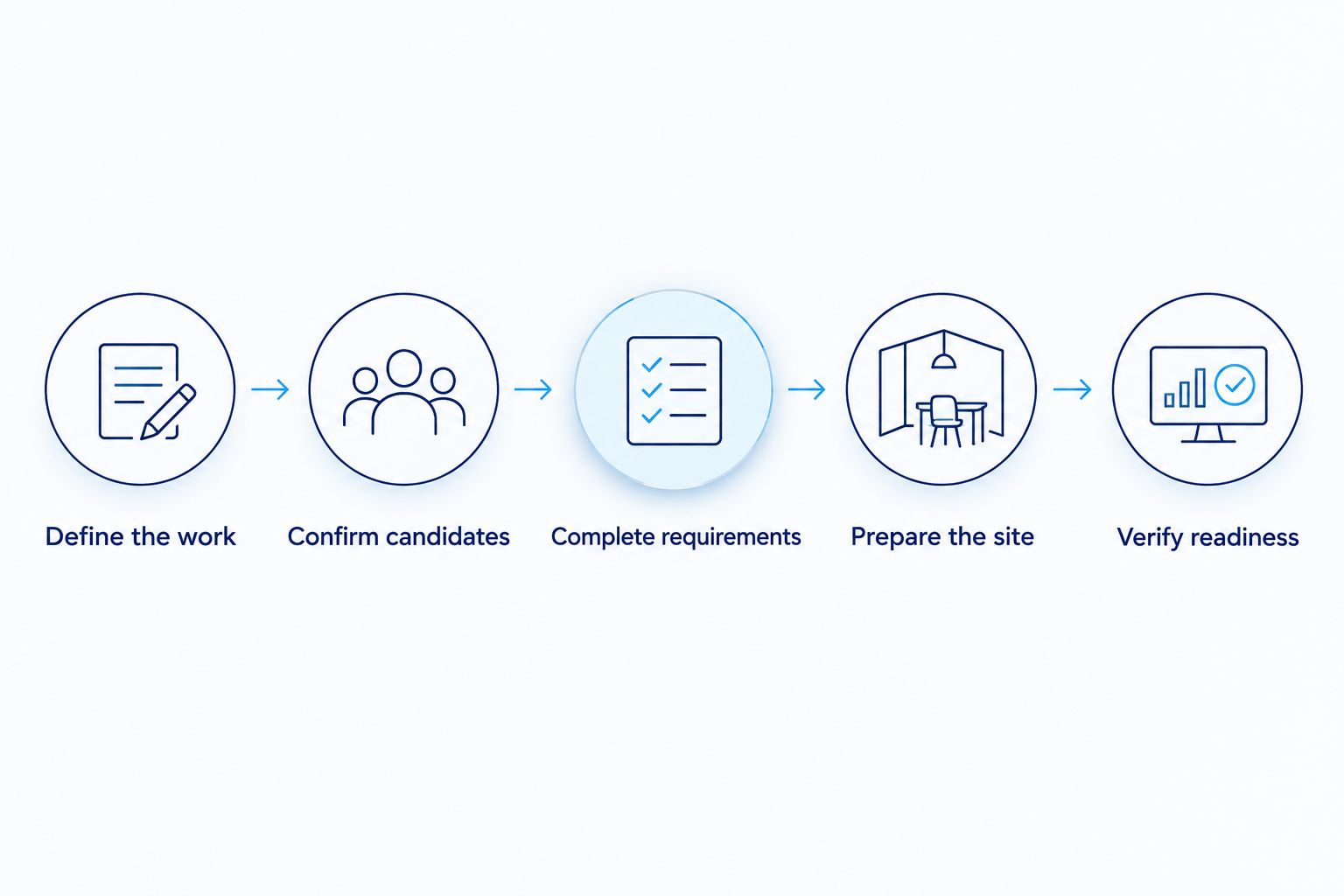
An accepted assignment and readiness for assigned work are separate checkpoints.
Why this matters
Your peak-season deadline concerns work getting done, not recruiting activity. If your plan counts every proposed candidate as a filled position, it hides the tasks still standing between that candidate and a productive shift.
Ask for the date each shift will be covered and the conditions attached to that date. A useful answer identifies what is confirmed, what remains open, and what your business must complete.
For 2026 planning, keep recruiting status and operating readiness in the same review. The agency can report candidate progress; your supervisors must report whether the site can receive and prepare those workers. Neither update replaces the other.
Phased starts versus a full-team start
Choose the start structure around the work and your orientation capacity. Neither approach supplies a universal answer to how fast an agency can recruit; each changes how you organize the people who are ready.
Phased starts
Best for: Teams that need separate orientation groups
Advantage: Lets you prepare each group before the next arrives
Limitation: Requires repeated orientation and careful shift tracking
What to confirm: Which roles start in each group and who trains them
Full-team start
Best for: Operations that need everyone to begin together
Advantage: Aligns arrivals with a shared launch
Limitation: Places orientation and supervision demands at the same time
What to confirm: Whether every worker and every site requirement is ready
Phased starts: organize around training capacity
With phased starts, you assign groups to agreed start dates rather than bring the entire seasonal team in together. Use this approach when the site needs a controlled introduction to tasks, equipment, or work areas.
The trade-off is coordination. Each group needs clear arrival instructions and a supervisor who knows what has already been covered. Choose phased starts when your team can prepare smaller groups properly but cannot prepare the whole team together.
Full-team start: verify the whole launch
A full-team start makes sense when the operation depends on everyone reporting for the same launch. It requires a plan for receiving, orienting, and supervising the entire group—not just confirmation that candidates have accepted.
The trade-off is concentration of work for your managers. Check every role and shift before calling the launch covered. Choose a full-team start only when worker readiness and site readiness both support the shared date.
Why the seasonal ramp-up timeline varies
These 5 factors belong in the planning discussion. Ask the agency to explain how each one applies to your request instead of accepting an estimate that ignores them.
Role requirements: Specify required experience, credentials, and tasks. The agency needs to distinguish workers who meet the requirements from people who would need additional preparation.
Shift and worksite fit: Confirm that candidates accept the actual schedule and location. Interest in a job does not confirm acceptance of its reporting time or worksite.
Headcount by role: Break the request into positions and shifts. A combined total conceals whether the essential work areas have coverage.
Pre-start requirements: Identify applicable checks, documents, and site prerequisites. Assign an owner to each requirement so unfinished tasks remain visible.
Orientation and supervision: State how many arrivals your team can prepare together. Your recruiting plan must match the site's ability to receive the workers.
For a 2026 hiring request, put these factors in writing before asking for a firm start plan. If a requirement changes, ask for an updated plan rather than assuming the previous date still applies.
Keep changes specific. A revised shift, different worksite, or newly required qualification changes the assignment candidates are being asked to accept. Tell the agency what changed and which roles it affects.
What should you send the agency before peak season?
Send a written request that your supervisors and the agency can both use. The goal is to make the assignment clear enough that nobody has to reconstruct it from separate conversations.
Use these 4 planning fields as the starting point:
Work: Duties, essential qualifications, physical requirements, and worksite.
Schedule: Shift times, assignment dates, and reporting instructions.
Coverage: Required headcount by role and shift, with the most important gaps identified.
Readiness: Applicable pre-start requirements, orientation arrangements, and the person responsible for receiving workers.
Then identify the deadline that matters: first arrivals, complete shift coverage, or readiness for assigned work. These are different requests. Ask the agency to respond against the milestone your operation actually needs.
If you are still defining the size of the request, use the guide to how many temp workers a staffing agency can provide alongside your shift-level planning. Keep the request tied to work you need covered, not an undifferentiated total.
Sourced Staffing is best for Reno and Carson City employers seeking recruiting, direct hire, and payroll services in its stated sectors. Confirm the proposed staffing arrangement and seasonal start plan directly; the service description alone does not establish a delivery deadline.
Discuss your seasonal staffing plan
Share your roles, shifts, worksite, and start requirements for Reno or Carson City.
What should a useful ramp-up commitment include?
A useful commitment names the roles, shifts, agreed start dates, and outstanding conditions. It also identifies who will report changes and who will make decisions when the plan needs adjustment.
Ask for a status summary that separates accepted assignments from unfinished requirements. Keep the same categories throughout the ramp-up so a change in wording does not obscure a change in readiness.
For your 2026 launch, agree on how you will handle a missed arrival or a worker who cannot perform the assigned duties. Ask about the response process without assuming a replacement deadline, automatic backfill, or guarantee. Those terms need direct confirmation.
Does filling the first shift mean the seasonal ramp-up is complete?
No. Filling the first shift establishes initial coverage, not completion of the entire seasonal hiring plan. Compare actual arrivals and readiness against every requested role and shift.
Keep the remaining gaps visible. A successful opening shift does not answer whether later starts, different schedules, or other work areas are covered.
Can a staffing agency guarantee the full team will start together?
Treat a shared start date as confirmed only when the agency explicitly agrees to it and identifies the conditions. Ask what happens if a candidate withdraws or a required step remains unfinished.
Do not turn a recruiting estimate into a guarantee in your operating plan. Record the commitment as stated and keep your own site responsibilities beside it.
Should you wait until demand rises to request seasonal workers?
Start the planning conversation when you can describe the expected work, schedule, and start requirements. You do not need to present an uncertain forecast as a final order; distinguish expected needs from approved hiring requests.
Give the agency updated information as the plan becomes definite. That keeps candidates from being asked to accept assignments whose basic terms are still changing.
FAQ
How quickly can a staffing agency ramp up seasonal headcount?
The timeline depends on confirmed candidates, role and shift requirements, pre-start tasks, and site readiness. Ask for agreed start dates by role and shift, separating first arrivals from full-team readiness.
What should I ask a staffing agency before peak season?
Ask which workers have accepted, which requirements remain unfinished, and when each requested shift will be covered. Also confirm who communicates changes and receives workers at your site.
Is a phased start better than starting everyone together?
A phased start fits operations that need separate orientation groups; a full-team start fits a shared launch. Choose the approach your supervisors can prepare and oversee properly.
Does a confirmed candidate count as a filled shift?
A confirmed candidate is not the same as a worker who has arrived and completed the requirements for assigned work. Track acceptance, arrival, and readiness separately.
Can Sourced Staffing help with seasonal hiring in Reno and Carson City?
Sourced Staffing provides recruiting, direct hire, and payroll services for Reno and Carson City businesses in light-industrial, manufacturing, warehouse, office, and food-production sectors. Confirm the seasonal arrangement and start plan directly.
What happens if a seasonal worker does not show up?
Follow the absence-reporting and coverage process agreed with the agency. Confirm the response process before launch rather than assuming an automatic replacement or a guaranteed deadline.
What information helps an agency plan my seasonal hiring?
Provide duties, qualifications, worksite, shifts, assignment dates, and headcount by role. Include applicable pre-start requirements and your site's orientation arrangements.
One last thing
Name the person who receives the first group before you approve its arrival. A staffing request can describe the jobs accurately and still leave workers without clear instructions at the worksite.
For your 2026 peak-season plan, check the arrival handoff as carefully as the candidate list. Confirm where workers report, who meets them, and what happens next. The most useful question is not simply whether people can start—it is whether both sides are ready for that start to become covered work.