
Is it legal to use temp workers long-term in Nevada?
Article
Yes, Nevada generally allows businesses to use temporary workers long-term; there is no general statewide assignment-length cap or automatic requirement to hire someone permanently after a set period. A long assignment does not remove wage, safety, workers’ compensation, or applicable benefit obligations, and your staffing agreement can impose its own limits. The legal question is how the employment arrangement works—not simply how long the worker stays.
TL;DR
Is it legal to use temp workers long term in Nevada? Generally yes; assignment duration alone does not decide compliance.
Nevada overtime, workplace safety, and applicable benefit rules still apply to long-term temporary assignments.
Contract limits and benefit-plan terms are separate from Nevada’s general employment rules.
Sourced Staffing serves Reno and Carson City businesses seeking staffing, recruiting, direct hire, and payroll services.
Is it legal to use temp workers long-term in Nevada?
Yes. Nevada does not generally set a maximum duration for an ordinary temporary staffing assignment. Nor does an assignment automatically become direct employment because it continues beyond an employer’s preferred conversion date. For the worker’s side of the question, see how long you can stay on a temp assignment.
Three different sets of rules determine what you can do: employment law, your agreement with the staffing agency, and any applicable benefit-plan or collective bargaining provisions. Keep them separate. A contract deadline is not necessarily a statutory deadline, and permission to extend an assignment is not permission to ignore employment protections.
For a 2026 compliance review, Nevada Revised Statutes Chapter 608 supplies the state wage-and-hour framework. Federal requirements, including the Fair Labor Standards Act, also apply where the employer and employment relationship fall within their coverage. Neither framework gives you a general exemption just because an agency calls the worker temporary.
Can the assignment continue?
What controls the answer: Applicable law and the staffing agreement
What it means for your business: Review extension terms rather than assuming a statewide deadline
Must you hire the worker directly?
What controls the answer: Contract commitments and any applicable special rules
What it means for your business: Assignment duration alone does not create a general conversion requirement
Who owes wages?
What controls the answer: The employment relationship under the relevant wage law
What it means for your business: The agency’s payroll role does not automatically eliminate your responsibility
Does the worker qualify for benefits?
What controls the answer: The governing law and written plan terms
What it means for your business: A temporary label does not settle eligibility
Who handles safety?
What controls the answer: Each employer’s duties and control over the work
What it means for your business: Allocate tasks, but do not treat the contract as a substitute for compliance
Why this matters
A short assignment can raise employment-law problems immediately. A long assignment can remain lawful when the parties handle their responsibilities correctly. Length is a review trigger, not a legal verdict.
For a Northern Nevada warehouse, manufacturing operation, office, or food-production business, an extended assignment means the worker continues operating inside your workplace. Your supervisors assign tasks, approve hours, and respond to problems. Those actions matter even when another company issues the paycheck.
The practical goal for 2026 is a documented arrangement that matches what happens on the floor. You need clear responsibility for pay, supervision, safety, and any promised hiring path—not a reassuring label on an outdated agreement.
Which employment rules still apply in 2026?
Overtime depends on hours and exemptions
Under the federal Fair Labor Standards Act, covered nonexempt employees generally earn overtime for work beyond 40 hours in a workweek. Nevada Revised Statutes 608.018 also addresses weekly overtime and, for qualifying employees, daily overtime after 8 hours in a workday.
Nevada’s daily overtime rule depends on the employee’s wage level and statutory exceptions. Employees paid below 1.5 times the applicable minimum wage generally fall within the daily-overtime rule, subject to those exceptions. Do not assume every temporary worker follows the same overtime calculation.
Before extending an assignment, confirm who captures actual hours and who checks the applicable overtime rules. Your agency needs accurate records of work performed, including time your supervisors authorize outside the scheduled shift. An approval policy does not erase the duty to pay for compensable work.
Break requirements do not disappear
Nevada Revised Statutes 608.019 generally requires a meal period of at least 30 minutes when an employee works a continuous 8-hour period, subject to statutory exceptions and exemptions. The same section generally provides paid rest periods of 10 minutes for each 4 hours worked, or a major fraction thereof.
Build legally required breaks into the actual workday. Telling the agency that breaks are available does not solve a schedule that prevents workers from taking them. Review any claimed exception against the statute rather than applying it to everyone on an agency roster.
Safety duties follow the workplace relationship
OSHA’s Temporary Worker Initiative explains that staffing agencies and host employers have responsibilities for protecting temporary workers. The division of tasks depends on the work and each employer’s role. A host employer’s control over site conditions and equipment remains important.
An experienced worker still needs information about hazards specific to your site and assigned duties. When the job changes, reassess training before the worker starts the new task. Confirm who handles injury reporting, protective equipment, and communication between the agency and your supervisors.
Benefit eligibility needs a separate review
Wage law, health coverage rules, protected leave, and retirement-plan eligibility do not necessarily use the same employer or employee tests. A finding under one law does not automatically answer every other question. Written benefit-plan terms also matter.
For a 2026 extension, have the responsible administrator review eligibility under the applicable rules and plan documents. Do not promise coverage based only on assignment length, and do not deny it based only on the word temporary. Where the arrangement is unclear, obtain employment-law advice before making a decision.
Why long-term temp staffing arrangements vary
The absence of a general Nevada assignment cap does not make every arrangement identical. These factors determine what needs attention:
Contract terms: Extension procedures, assignment limits, notice requirements, and conversion provisions can restrict what the parties agreed to do.
Supervision: Who directs the worker, changes duties, and controls working conditions matters under applicable employer-status tests.
Hours worked: Weekly hours, daily hours, and applicable exemptions determine wage-and-hour obligations.
Benefit provisions: Eligibility depends on the relevant law and written plan—not just the assignment title.
Job hazards: Equipment, tasks, and site conditions determine the training and safety measures required.
Hiring commitments: A stated pathway to direct employment needs to match the agreement and what you tell the worker.
Review the arrangement whenever these facts change. Extending an unchanged assignment and moving someone into a different job require different conversations, even when both actions keep the same person on your schedule.
Which staffing arrangement fits an ongoing role?
Temporary staffing, a planned transition to direct employment, and direct hire answer different business needs. Choose based on the role you actually need filled. None creates an exemption from employment law.
Extended temporary assignment
Best for: An ongoing assignment you intend to maintain through an agency
Practical advantage: Keeps the agency relationship in place
Limitation: Requires continuing coordination on hours, duties, and employment obligations
Planned temp-to-hire transition
Best for: A role with an agreed evaluation period before a hiring decision
Practical advantage: Establishes a defined decision point
Limitation: Requires clear terms; it is not an automatic promise of permanent employment
Direct hire
Best for: An established position you intend to employ directly
Practical advantage: Places the ongoing employment relationship with your business
Limitation: Your business takes responsibility for its direct-employment obligations
Do not use an extended temporary assignment to avoid responsibilities attached to the actual employment relationship. If your business wants the person as a direct employee, discuss that decision openly rather than relying on repeated extensions to postpone it indefinitely.
Sourced Staffing is best suited to Reno and Carson City businesses seeking local staffing, recruiting, direct-hire, or payroll services. The right arrangement depends on your role and employment needs; an agency relationship does not remove the host business’s legal duties.
What should you check before extending an assignment?
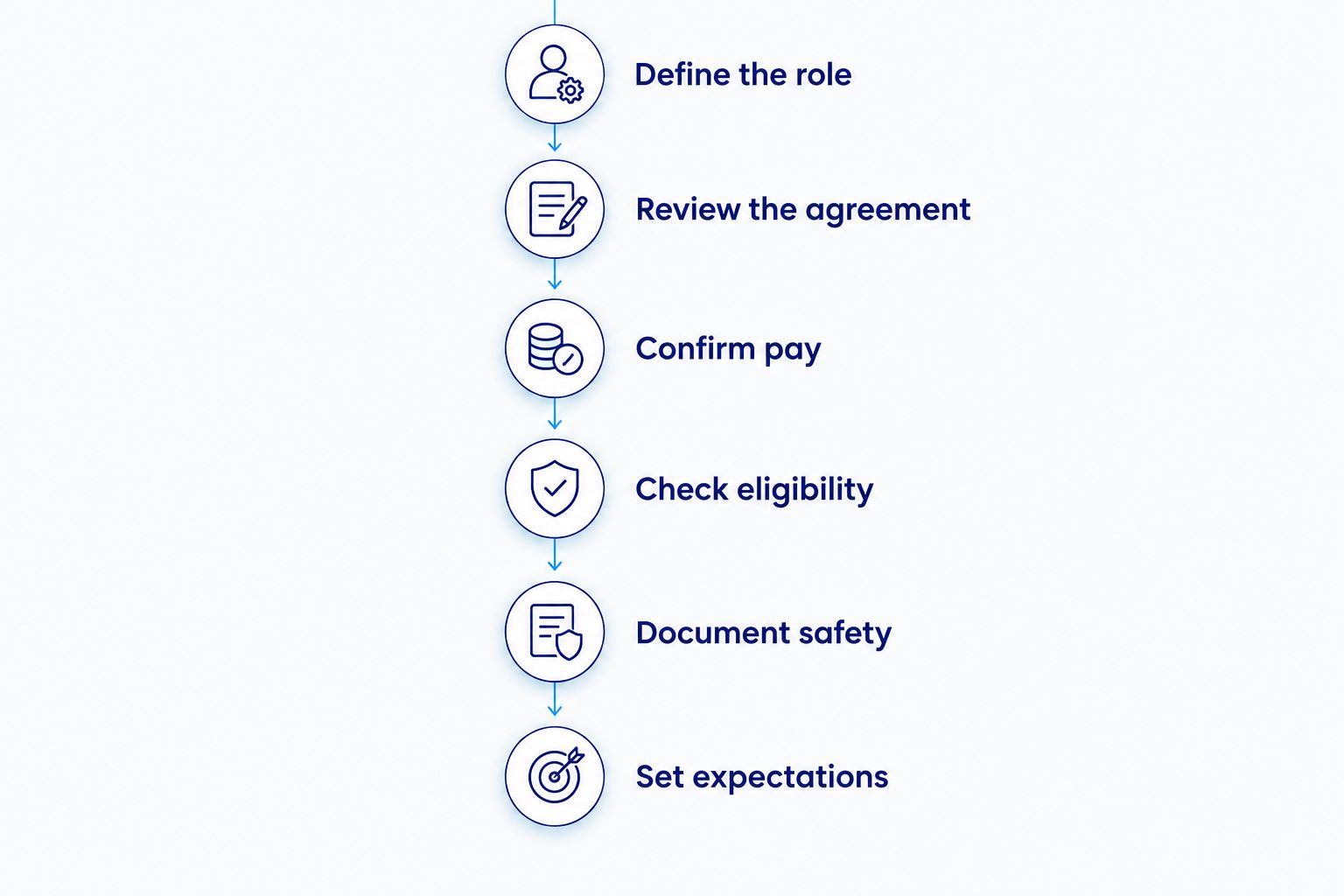
Use this sequence before approving another extension in 2026. It separates business decisions from legal obligations and gives your supervisors a clear record to follow.
Define the role. Record the duties, work location, schedule, and reason the assignment continues. Identify changes from the original request, especially new equipment, responsibilities, or hazards.
Review the agreement. Check extension language, notice requirements, and conversion terms. Confirm that any amendment reflects what both parties intend rather than relying on an informal conversation.
Confirm pay. Identify who records hours, approves corrections, calculates applicable overtime, and answers payroll questions. Explain how supervisors report work outside the original schedule.
Check eligibility. Send benefit and leave questions to the appropriate administrator. Review applicable law and plan terms instead of using an internal assignment-duration rule as the answer.
Document safety. Confirm site-specific training, reporting procedures, and responsibility for protective equipment. Revisit these items whenever duties or workplace hazards change.
Set expectations. Tell the worker whether the assignment is being extended or whether a direct-hire decision is planned. Document who communicates future changes and how concerns reach both employers.
A completed checklist is useful only when it matches daily practice. Ask the supervisor who actually directs the work to confirm the details. A payroll contact cannot resolve a training gap, and a staffing agreement cannot correct hours nobody reports.
Review the employment arrangement before approving the extension.
Does a staffing agency prevent joint-employer liability?
No. Using an agency does not automatically shield a host business from employment-law responsibility. The U.S. Department of Labor’s Fact Sheet 35 explains joint employment under the Fair Labor Standards Act. Employer status depends on the applicable legal test and the facts of the relationship.
Other laws apply their own standards, so there is no single contract sentence that resolves every employer-status question. Your agreement can allocate tasks between businesses, but it cannot cancel a worker’s statutory rights. Treat responsibility clauses as operational instructions, not immunity.
For a 2026 review, describe who actually controls schedules, supervises tasks, keeps records, and responds to complaints. Give those facts to counsel when employer status is disputed. Accurate facts are more useful than insisting that only one company is the employer.
Do you have to hire a temp worker permanently?
No general Nevada rule requires permanent hiring solely because an ordinary temporary assignment has lasted a particular period. A conversion requirement can instead come from your contract, a commitment you made, or another applicable provision. Read the relevant terms before rejecting or approving a transition.
If the role is becoming an established position, make a deliberate hiring decision. Explain whether you intend to extend the agency assignment, consider direct employment, or end the assignment under the agreement. Do not describe a job as temp-to-hire unless that accurately reflects the arrangement.
Can you reset obligations by ending and restarting an assignment?
An assignment break is not a universal reset for employment obligations. Benefit eligibility, service credit, and employer status follow their own rules. Ending an assignment on paper does not guarantee that prior service becomes irrelevant.
Avoid creating breaks merely to bypass rights or eligibility requirements. Before relying on a gap in service, ask the relevant administrator or employment attorney how that specific rule treats the interruption. The answer must come from the governing law or plan.
FAQ
Is it legal to use temp workers long term in Nevada?
Yes, Nevada generally allows long-term temporary assignments without a statewide duration cap for ordinary staffing arrangements. Employers must still comply with applicable wage, safety, benefit, and other employment requirements, along with their contract terms.
How many months can a temp worker stay at the same Nevada business?
There is no general Nevada maximum measured in months for an ordinary temporary assignment. Check the staffing agreement and any applicable special rules before extending it.
Do long-term temp workers get overtime in Nevada?
Covered nonexempt workers generally receive overtime after 40 hours in a workweek. Nevada also requires daily overtime after 8 hours for qualifying employees, subject to wage-level conditions and statutory exceptions.
Does working through an agency mean the host business has no responsibility?
No, an agency relationship does not automatically remove the host business’s employment-law or safety responsibilities. The applicable legal test and the actual working relationship determine the duties involved.
Do temp workers automatically become permanent employees?
No, assignment duration alone does not trigger a general Nevada requirement for permanent hiring. Contract terms, specific commitments, and other applicable provisions require separate review.
Can a Nevada employer use assignment breaks to avoid benefits?
An assignment break does not automatically reset benefit eligibility or service-credit rules. The governing law and benefit-plan terms determine how prior service and interruptions are treated.
Can Sourced Staffing help a Reno business with an ongoing hiring need?
Sourced Staffing provides staffing, recruiting, direct-hire, and payroll services for businesses in Reno and Carson City. Discuss the role and intended employment arrangement before choosing a service.
One last thing
An internal assignment limit is not the same as a Nevada legal deadline. Before ending a successful placement because someone says the worker has been there too long, ask which statute, contract provision, or plan term requires that decision. Then act on the actual rule.
This page provides general employment information for 2026, not legal advice for a particular workplace. Obtain advice from Nevada employment counsel when the assignment, benefit eligibility, or employer relationship is disputed.