
How long can you stay on a temp assignment? Terms decide, 2026
Article
You can stay on a temp assignment for the period set out in your assignment terms, including any confirmed extensions; there is no single duration that fits every temporary job. The expected end date is not a guarantee that the assignment will last that long or become permanent. In 2026, the clearest answer comes from checking the assignment’s end condition, the employer’s staffing policy, and the agency’s written instructions.
TL;DR
How long can you stay on a temp assignment? Your assignment terms and confirmed extensions determine the answer.
An expected end date does not guarantee work through that date or a permanent offer.
Temp-to-hire describes a possible hiring path, not an automatic conversion deadline.
Sourced Staffing connects Reno and Carson City job seekers with local businesses; ask about assignment duration before accepting.
How long can you stay on a temp assignment?
You can remain on the same temp assignment while it continues under the applicable terms and the employer and agency authorize the work. An assignment can have a calendar end date, a project-based endpoint, or an expected duration that requires further confirmation. Those are different arrangements, not interchangeable promises.
Start by identifying which arrangement you have. If a permanent role is your goal, understanding how temp-to-hire staffing works helps you separate a possible hiring path from a confirmed offer.
Fixed-end assignment
What determines its length: The stated end date and any approved extension
Best for: Workers planning around a known commitment
Advantage: Gives you a clear planning date
Limitation: The assignment can still end earlier under its terms
Project-based assignment
What determines its length: Completion of the defined work
Best for: Workers comfortable with a task-based endpoint
Advantage: Connects the assignment to a specific purpose
Limitation: The completion date can change
Ongoing temporary assignment
What determines its length: Continuing need, assignment terms, and staffing policies
Best for: Workers comfortable with an uncertain endpoint
Advantage: Allows work to continue when approved
Limitation: Provides less certainty about the final date
Temp-to-hire assignment
What determines its length: The temporary arrangement and a separate hiring decision
Best for: Workers seeking a possible permanent role
Advantage: Creates an opportunity to assess the job
Limitation: Does not guarantee a permanent offer
A long assignment is still temporary if no permanent hiring decision has been confirmed. Conversely, a short assignment can be useful if its purpose and endpoint fit your needs. Judge the assignment by its terms, not by the word “temporary” alone.
Why this matters
Your assignment length affects decisions outside work: transportation, childcare, other job applications, and whether you can commit to a particular schedule. An unclear endpoint makes those decisions harder. A clear endpoint gives you something concrete to plan around, even when it is subject to change.
For your 2026 job search, keep three issues separate: how long the current assignment is expected to run, whether another assignment is possible afterward, and whether permanent hiring is being considered. An answer to one does not answer the others. A supervisor’s continued need for help, for example, is not the same as an approved extension or a permanent offer.
Fixed-end assignments: plan around the stated date
A fixed-end assignment identifies an expected final date. Before accepting, ask whether that date is firm or an estimate, and ask what circumstances allow the assignment to end earlier. You also need to know who will notify you if the schedule changes.
The benefit is straightforward: you have a date for planning your next move. The drawback is equally important: a stated duration is not necessarily a guarantee of work through the entire period. Read the assignment terms rather than treating a calendar entry as a promise.
If an extension becomes available, confirm the revised endpoint and schedule with the agency. Do not assume that being scheduled beyond the original date settles every detail. Ask whether the duties, worksite, or other assignment conditions have changed as well.
Project-based assignments: confirm what “finished” means
A project-based assignment ends when a defined piece of work is complete, rather than solely because a date arrives. Ask what completion means for your role. Finishing your part of the work and finishing the employer’s entire project are not necessarily the same event.
This arrangement suits you when you prefer work with a specific purpose and can manage an uncertain finish date. Its limitation is that changes to the project can affect your schedule. A revised workload does not, by itself, tell you whether your assignment has been extended.
Get a usable explanation of the endpoint: the task you are supporting, who decides it is complete, and how you will receive notice. If the project changes, ask for an updated assignment expectation. A clear task description is more useful than an unsupported estimate of how long the work will last.
Ongoing assignments: ask about the next review
An ongoing temporary assignment has no clearly confirmed final date at the outset. That does not make it a permanent position. It means you need to understand how continuation is decided and what notice process applies.
The advantage is the possibility of continued work without a fixed project endpoint. The limitation is uncertainty: you cannot build a reliable long-term plan from an open-ended description alone. Ask whether the employer has an assignment-length policy and whether the agency has a review process.
When discussing an ongoing role in 2026, request a next review point rather than a guess about the distant future. Ask who will update you and what decision that review covers. A conversation about continued staffing need should not be confused with a conversation about permanent employment.
Temp-to-hire assignments: separate evaluation from an offer
Temp-to-hire means permanent employment is a possible outcome, not a promised result after a universal waiting period. Ask whether the employer has authorized a temp-to-hire position or is simply open to considering you later. Those descriptions create different expectations.
This arrangement is best for workers who want to assess a workplace while pursuing a potential permanent role. Its advantage is that you can learn about the duties, schedule, and working environment through the assignment. Its limitation is that the employer can decide not to make an offer.
Before you rely on conversion, ask who makes the hiring decision, what criteria apply, and when the employer expects to review your candidacy. If someone mentions a review date, clarify whether it is an evaluation meeting or an intended start date for permanent employment. A review is not an offer.
Why temp assignment length varies
Assignment length depends on the work and the rules governing that placement. These are the factors to verify rather than assume:
Business need: Ask whether you are covering an absence, supporting seasonal work, filling a vacancy, or completing a project. The reason for the assignment helps explain its endpoint.
Assignment terms: Check the stated duration, end conditions, and process for changes. The initial description and a later extension should agree.
Employer policy: Ask whether the worksite sets a maximum assignment length or requires approval to continue. A company policy is not the same as a universal legal limit.
Project or schedule changes: Confirm whether a change in workload also changes your assignment. Do not infer authorization from a busy workplace.
Hiring decisions: For temp-to-hire work, continued temporary work and permanent hiring are separate decisions. Ask about each directly.
You do not need to predict every change before taking the job. You do need to know which changes require an update and whom to contact. That makes an uncertain assignment easier to manage without pretending it is guaranteed.
How to confirm your assignment length before accepting
Use this sequence to get an answer you can act on. Keep your questions tied to the specific assignment, not to what happened to another worker at the same site.
Assignment terms: Request the written assignment details. Identify the expected duration, duties, worksite, and schedule.
End condition: Ask whether the assignment ends on a date, when work is complete, or after further notice. Clarify whether the endpoint is estimated.
Extension approval: Ask who authorizes additional work and how the agency will confirm an extension. Find out whether anything changes when it is extended.
Hiring decision: If permanent work matters to you, ask whether conversion is an actual option and who decides. Keep this separate from an extension discussion.
Next contact: Identify whom to contact before the endpoint and if the worksite gives you conflicting instructions. Save the agency’s assignment updates.
These steps turn a vague description into a working plan. You should leave the conversation knowing what is expected now, what remains undecided, and who can confirm a change.
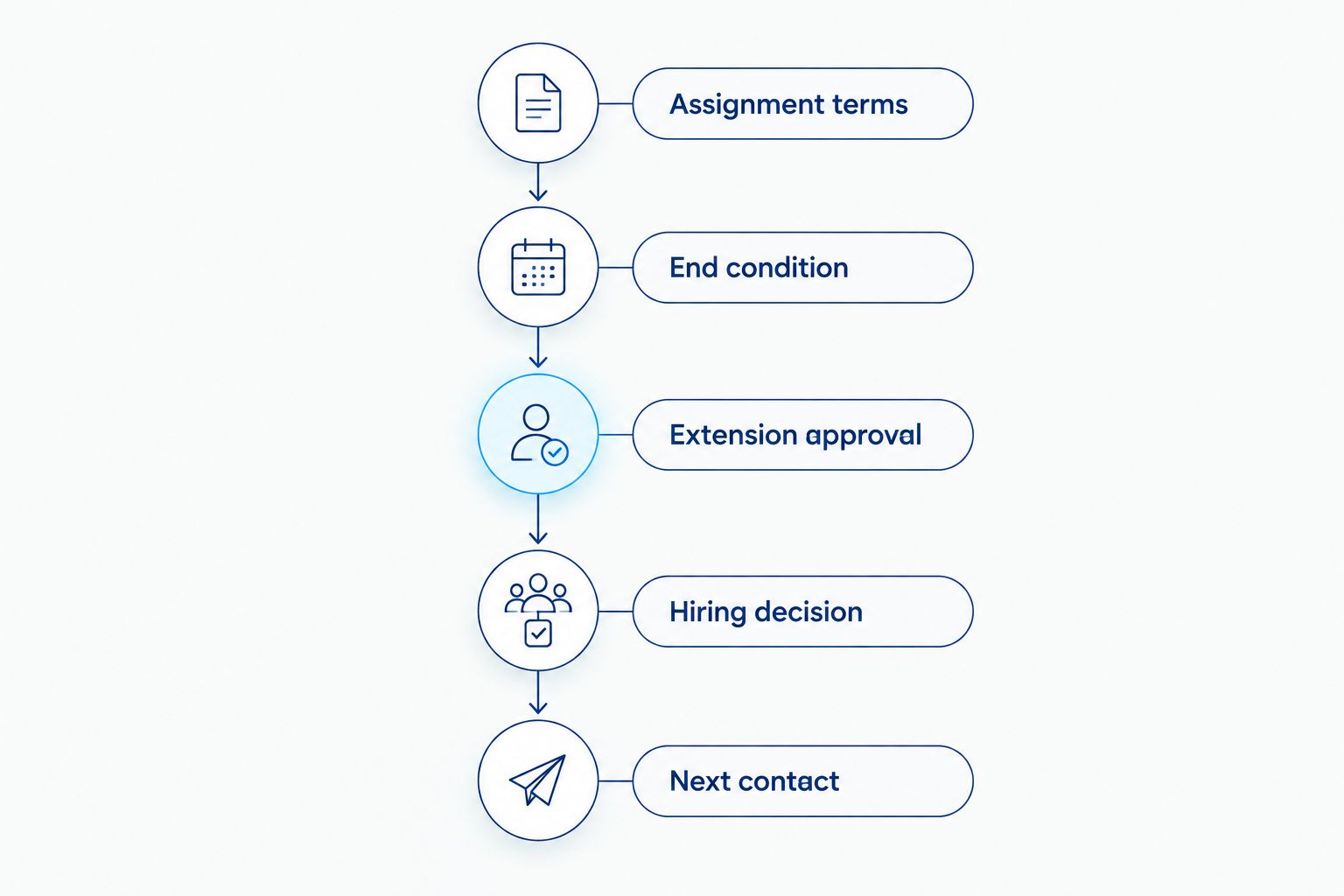
Confirm the endpoint and extension process separately from any permanent hiring decision.
Can a temp assignment be extended?
A temp assignment can be extended when the employer and agency approve continuation under the applicable terms. An extension does not automatically change the position into permanent employment. Confirm the revised duration and any changes to the schedule or duties.
If your supervisor asks you to return after the stated endpoint, contact the agency before treating that request as a confirmed extension. Explain what you were told and ask for updated instructions. For a 2026 assignment, retain the current written details rather than relying on an older description.
Does staying longer mean you will get hired permanently?
Staying longer on a temp assignment does not guarantee permanent hiring. Continued work shows that the assignment is continuing; it does not establish that an offer has been approved. Ask directly whether a permanent position exists and what decision remains outstanding.
You can express interest without treating conversion as inevitable. Ask what the employer needs to evaluate and when you should expect an update. If the answer remains unclear, continue making career decisions based on the temporary arrangement you actually have.
Can you leave before a temp assignment ends?
You can ask to end an assignment early, but you should check the applicable terms and coordinate the departure with the agency. Do not assume that leaving the worksite also completes the necessary communication. Ask about notice expectations and any steps you need to finish.
If the duties or schedule differ from what you accepted, explain the specific difference. If a safety concern is involved, report it promptly rather than waiting for the scheduled end date. Your next move should address the actual issue, not just the assignment’s length.
Where local staffing support fits
Sourced Staffing is best for job seekers seeking local staffing support in Reno and Carson City. Sourced Staffing connects local businesses and job seekers across light-industrial, manufacturing, warehouse, office, and food-production work, and provides recruiting, direct-hire, and payroll services.
The value of a local staffing conversation is matching your goals to a specific opportunity. The limitation is that agency support does not itself establish an assignment’s duration or guarantee a permanent outcome. When you contact Sourced Staffing, explain whether you want a defined temporary commitment or are primarily pursuing permanent work.
Discuss your next job
Explain your work goals and ask about the duration of the specific assignment being discussed.
FAQ
How long can you stay on a temp assignment in 2026?
You can stay for the period authorized under your assignment terms, including confirmed extensions. Check the endpoint, employer policy, and agency instructions for the specific placement.
Is there a universal maximum length for every temp job?
There is no single assignment duration that applies to every temp job. Requirements depend on the applicable rules and arrangement, so ask whether a stated limit comes from employer policy, assignment terms, or a specific legal requirement.
Does my temp assignment have to last until its expected end date?
An expected end date does not necessarily guarantee work through that date. Read the assignment terms and ask what circumstances allow an earlier end.
Can I keep working after my original assignment end date?
Confirm an approved extension with the agency before treating work beyond the original endpoint as authorized. Ask for updated duration, schedule, and duty information.
Will a long temp assignment automatically become permanent?
A long temp assignment does not automatically guarantee permanent employment. A permanent role requires a separate hiring decision and confirmation of the employment terms.
What should I ask Sourced Staffing about assignment length?
Ask Sourced Staffing for the specific assignment’s expected endpoint, extension process, and any permanent hiring opportunity. Explain your availability and whether you prefer temporary work or a permanent role.
What should I do when my temp assignment is about to end?
Contact the agency to confirm whether the assignment is ending, being extended, or awaiting a decision. Ask about your next steps without assuming another placement is guaranteed.
One last thing
The most useful question is not just “How long is the assignment?” It is “What event ends it?” A date, project completion, return of an absent employee, or a staffing decision gives you a clearer basis for planning than the label “temporary.”
Before accepting work in 2026, pair that question with another: who will confirm any change? Knowing the endpoint and the decision-maker helps you plan your next move without mistaking an estimate for a commitment.