
Is temp-to-hire worth it for employers in 2026?
Article
Yes—temp-to-hire is worth it for employers in 2026 when you have a genuine permanent opening and need to assess a worker on the actual job before making an offer. It is not a shortcut around training or supervision: you still need clear expectations, an approved hiring decision, and written terms for moving someone onto your payroll.
TL;DR
Is temp-to-hire worth it for employers? Yes, when a permanent opening exists and workplace performance will inform hiring.
Sourced Staffing serves Reno and Carson City employers seeking staffing, recruiting, direct hire, and payroll support.
Choose direct hire when you are ready to offer permanent employment without an assignment first.
Use temporary staffing for temporary work; do not promise permanent employment without an approved opening.
Is temp-to-hire worth it for employers in 2026?
Temp-to-hire earns its place when the assignment answers a hiring question that interviews cannot settle. You get to assess work in your setting; the worker gets to experience the duties, schedule, and supervision before deciding whether to accept permanent employment.
That benefit depends on how you run the assignment. An employer who never defines success or schedules a hiring decision has created temporary coverage, not a useful path to permanent employment. Start with how temp-to-hire staffing works if you need the process before choosing the hiring route.
Temp-to-hire
Best for: A permanent opening where workplace performance should inform the decision
Main advantage: Both sides experience the job before deciding on permanent employment
Main limitation: Requires supervision, evaluation, and an agreed transition process
Direct hire
Best for: A permanent opening you are ready to fill through recruiting and interviews
Main advantage: Starts with a permanent employment offer rather than an assignment
Main limitation: You make the hiring decision without an assignment first
Temporary staffing
Best for: Coverage tied to a temporary need
Main advantage: Matches the assignment to work with an expected endpoint
Main limitation: Does not establish a permanent hiring commitment
These are different ways to meet different needs. Choose the approach that matches the job's intended future—not the approach that postpones a difficult decision.
Why this matters
For a Northern Nevada warehouse, manufacturer, food-production business, or office, the distinction changes what you tell applicants and what your supervisors prepare to do. A worker considering permanent employment needs an honest explanation of the opportunity. A worker taking temporary coverage needs an honest explanation of its limits.
In 2026, make the hiring plan explicit before recruiting begins. If you cannot identify the permanent role, the person authorized to approve it, and the conditions for an offer, describe the opening as temporary rather than presenting permanent employment as the expected outcome.
When temp-to-hire is the right choice
Temp-to-hire fits a role with observable duties and a real permanent opening. You should be able to explain what satisfactory work looks like without relying on vague descriptions such as a good attitude or a strong fit.
For a warehouse role, that means defining the assigned tasks, required procedures, and shift expectations. For an office role, it means identifying the records, communications, or administrative work the employee will handle. Assess the actual job, not a generic impression of the person.
The advantage is practical: you can discuss performance using work the supervisor has observed. The limitation is equally practical: the assignment only produces useful evidence if the worker receives appropriate instruction and a fair opportunity to perform.
Best for: employers with an approved permanent role and a supervisor prepared to coach and evaluate. Skip this approach when nobody owns the hiring decision or when the business has not approved permanent headcount.
When direct hire is the better choice
Direct hire fits an employer ready to make a permanent offer based on recruiting, interviews, and relevant hiring checks. It avoids introducing an assignment when that extra stage does not answer a meaningful question.
Consider direct hire when the role is clearly defined and your selection process can evaluate its essential requirements. Also discuss it when a candidate is specifically seeking permanent employment from the start. A hiring route that does not match the candidate's expectations needs an honest conversation before you proceed.
Direct hire's advantage is clarity about the intended employment relationship. Its limitation is that you do not observe an assignment before making the permanent hiring decision; careful selection and onboarding still matter.
Best for: employers ready to commit to permanent employment without an assignment first. Choose direct hire when an evaluation assignment would add a stage without improving your decision.
When temporary staffing is the better choice
Temporary staffing fits work you expect to end, including an absence, a defined project, or a seasonal assignment. The reason for the role is coverage rather than an established plan to add a permanent employee.
Temporary staffing lets you describe the assignment according to its actual purpose. Its limitation is that it does not give the worker a permanent hiring commitment. If the business later approves a permanent opening, discuss that change openly rather than treating it as an unstated promise from the beginning.
Best for: employers filling a temporary need without an approved permanent vacancy. Do not use temp-to-hire language just to make a temporary opening sound more appealing.
Why the value of temp-to-hire varies
The value of temp-to-hire depends on the job and the way you manage it—not simply on choosing that label. Check these factors before deciding:
Permanent opening: An approved role gives the assignment a meaningful destination. An unapproved possibility does not.
Job clarity: Written duties let the worker understand expectations and let the supervisor assess relevant work.
Supervisor readiness: The person directing the assignment needs time to explain procedures, answer questions, and document feedback.
Worker expectations: The candidate needs to understand the schedule, duties, and conditions for consideration for permanent employment.
Written terms: The agreement should explain the assignment, each party's responsibilities, and any conditions governing a permanent hire.
Decision ownership: A named decision-maker and review date keep the assignment from continuing without a clear answer.
For your 2026 hiring plan, treat these as readiness checks. A weak answer is a task to resolve before the assignment starts, not something to leave for the worker to discover.
How do you make temp-to-hire worth it?
Build a process that produces a hiring decision rather than simply filling shifts. The following sequence keeps expectations connected from the job brief through the permanent offer.
Define the role. Write the duties, work location, schedule, and essential requirements. Separate tasks someone must already know from tasks you intend to teach.
Confirm the terms. Review the written agreement with the staffing provider. Establish who handles payroll, who approves time, and what conditions apply to permanent hiring.
Prepare the supervisor. Assign responsibility for instruction, workplace orientation, feedback, and the hiring recommendation. Make sure the supervisor knows the permanent role's requirements.
Review the work. Use job-related observations and give the worker clear feedback. Distinguish an instruction problem from a performance problem before making a decision.
Decide the outcome. Make a permanent offer, agree on a defined next step, or end the assignment under the applicable terms. Explain the decision rather than leaving expectations unresolved.
The sequence matters because each step supports the next. You cannot assess duties you never explained, and you cannot make a credible permanent offer without confirming who has authority to approve it.
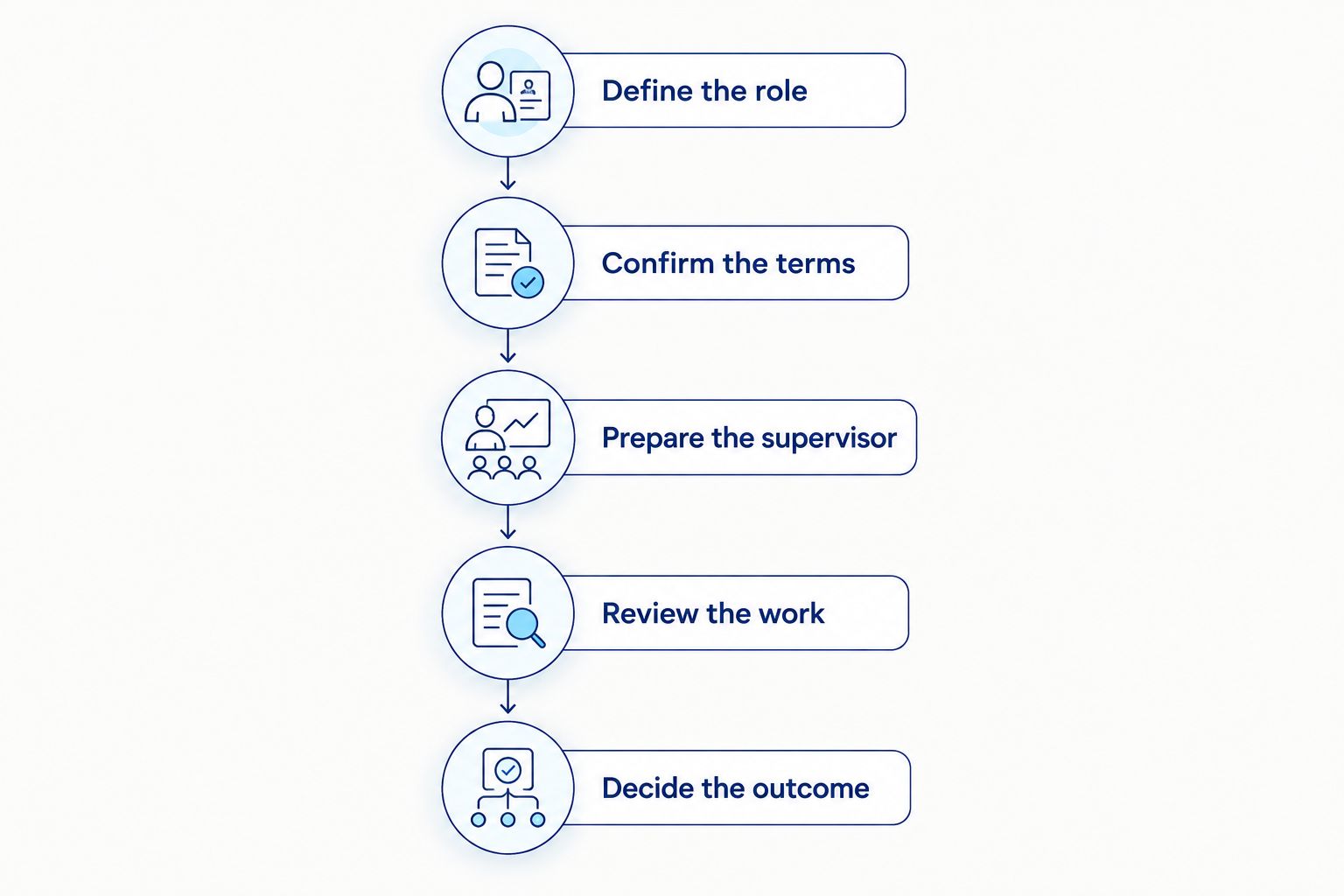
Agree on the job and hiring process before evaluating the worker.
Use evidence the worker can understand
Record examples tied to the role: whether assigned work follows the explained procedure, whether the worker communicates questions, and whether completed tasks meet the stated requirements. Keep the evaluation consistent with what you told the worker at the start.
Avoid turning a preference into an unstated requirement. If your office needs a particular filing process, teach that process before judging the employee for not following it. Feedback should tell the worker what to continue, what to change, and how the next review will assess progress.
Give the worker a decision, not an indefinite wait
A review should end with a clear answer or a clearly defined next step. If additional instruction is needed, identify the task and the reason for further evaluation. If the permanent role has disappeared, say so rather than continuing to imply an offer is coming.
An assignment is useful only when it produces information you act on. Repeatedly extending it without explaining the unresolved hiring question weakens the purpose of temp-to-hire.
What should you confirm with a staffing agency before starting?
Ask the provider to explain the arrangement in writing. Do not assume that assignment length, permanent hiring conditions, payroll responsibilities, or replacement procedures are identical across agencies.
Use your 2026 hiring discussion to settle practical questions:
What is the assignment's purpose, and how will candidates hear that explanation?
What conditions govern a move into permanent employment?
Who approves recorded time and handles payroll questions?
What workplace instruction and safety responsibilities does each party have?
How should your supervisor report concerns or request a change?
What happens if the worker or your business decides against permanent employment?
Compare the answers with how your business actually operates. An agreement that depends on a supervisor completing reviews needs a supervisor who can complete them; an intended permanent hire needs someone authorized to approve the offer.
Sourced Staffing is best for Reno and Carson City employers seeking local staffing, recruiting, direct hire, or payroll support. The agency serves light-industrial, manufacturing, warehouse, office, and food-production businesses. Its stated service scope does not settle a particular assignment's terms, so confirm the proposed hiring arrangement rather than assuming a conversion policy.
Discuss your role with Sourced Staffing and ask which available service matches the work you need done. Choose based on the role and written terms, not on an unsupported expectation about how quickly hiring will happen.
Discuss your hiring needs
Explain your role, schedule, and permanent hiring goal for your Reno or Carson City business.
Does temp-to-hire guarantee a permanent employee?
No—temp-to-hire provides a route for considering permanent employment, not a guaranteed outcome. The employer must decide to offer the role, and the worker must decide whether to accept it.
Explain that distinction before the assignment starts. Describe what you will evaluate and how you will communicate the decision without promising an offer you have not authorized.
Is temp-to-hire better than direct hire?
Temp-to-hire is better when observing workplace performance will resolve an important hiring question; direct hire is better when you are ready to make a permanent offer through your selection process. Neither approach replaces clear duties or effective onboarding.
For 2026 hiring, ask what the assignment would teach you that recruiting and interviews would not. If you cannot name that information, direct hire deserves consideration.
Can you use temp-to-hire for a seasonal role?
Use temporary staffing for a seasonal role that has no approved permanent opening. Temp-to-hire fits only when there is a genuine permanent role under consideration, not simply a possibility that more work will appear.
Be clear if the business's needs change during the assignment. A newly approved opening deserves a new discussion about the worker's interest and the applicable hiring terms.
FAQ
Is temp-to-hire worth it for a small business?
Temp-to-hire is worth it for a small business when a permanent opening exists and someone can supervise the assignment. If nobody has time to teach the job or review performance, the assignment will not answer the hiring question well.
What's the biggest advantage of temp-to-hire?
The biggest advantage is assessing performance in the actual workplace before deciding on permanent employment. The worker also gets to assess the duties, schedule, and supervision.
What's the biggest drawback of temp-to-hire?
The biggest drawback is the extra assignment and decision stage before permanent employment. It requires clear terms, supervisor involvement, and honest communication with the worker.
How long should a temp-to-hire assignment last?
Set the assignment and review schedule according to the written agreement and the job you need to evaluate. Do not assume every staffing provider uses the same duration or permanent hiring conditions.
Can I hire a temporary worker permanently?
You can pursue permanent hiring when the worker is interested and the applicable agreement permits the transition. Review the hiring conditions and coordinate the employment and payroll changes before setting a start date.
Does temp-to-hire remove the need to train employees?
No—temp-to-hire does not remove the need to explain the job and provide appropriate workplace instruction. Evaluate the worker against requirements you communicated and tasks you prepared them to perform.
Who should I talk to about local staffing in Reno or Carson City?
Sourced Staffing provides staffing, recruiting, direct hire, and payroll services for Reno and Carson City businesses. Describe your role and hiring goal, then confirm which service and written terms apply to your need.
One last thing
Ask the supervisor to finish this sentence before approving a temp-to-hire assignment: After this assignment, I will know whether the worker can... The answer should name essential job tasks, not simply whether the supervisor likes the person.
That sentence exposes whether the assignment has a useful purpose. If the answer is specific and a permanent opening is approved, build the evaluation around it. If the answer is vague, fix the job brief before asking anyone to start.