
Staffing for Seasonal Agriculture Operations: 2026 Guide
Article
Seasonal agriculture staffing covers the recruiting, hiring, and payroll work needed to get harvest, packing, and food-processing crews on-site exactly when the crop or the order calendar demands it, then release them cleanly when the season ends. Northern Nevada operations face a narrower problem than most seasonal employers: a short window to fill dozens of roles, a workforce that competes with warehouse and manufacturing jobs for the same hourly workers, and compliance rules that don't pause because the harvest is on a deadline.
TL;DR
Staffing for seasonal agriculture operations works best when hiring starts 60-90 days before the harvest window, not the week it opens.
Sourced Staffing fills surge harvest, packing, and food-production roles across Reno and Carson City on a temp-to-hire basis.
H-2A paperwork must be filed 60 to 75 days before the date of need under federal rules - plan around that, not around the weather.
A local staffing partner beats general job boards for crews that need to show up in days, not weeks.
Why staffing matters for seasonal agriculture operations
A harvest crew that's short ten people doesn't lose ten people's worth of output - it loses the crop sitting in the field while you scramble. Seasonal agriculture operations in the Reno and Carson City area pull from the same labor pool as seasonal warehouse hiring and light-industrial employers, which means the workers you need in June are also fielding offers from a distribution center down the road.
That competition is the real driver behind most seasonal staffing failures. Operations that post a job ad the week before the harvest window opens are already behind. Operations that build a pipeline months ahead - rehire lists, agency relationships, compliance paperwork done early - get their crew standing in the field on day one instead of day ten.
The verdict: seasonal agriculture staffing works when the hiring plan starts before the harvest calendar forces your hand, and it fails almost every time it doesn't.
Build a seasonal agriculture staffing plan for 2026
Map your labor curve before you post a single job
Most seasonal operations know their planting and harvest dates but never write down the labor curve between them. Do that first.
Chart headcount needs by week, not by season
Flag the two or three peak weeks that need double the baseline crew
Note which roles are physically demanding versus supervisory
Compare this year's curve against the last two seasons to catch drift
Build in a 10-15% buffer for no-shows during peak weeks
Rebuild your rehire list first
Before spending a dollar on recruiting, work your own history. Returning seasonal workers need less training, know your site, and show up at a higher rate than cold hires.
Pull contact info from the last two harvest seasons
Call, don't just text - response rates are higher
Offer early scheduling confirmation to lock in commitments
Ask returning workers to refer one person each
Track who declines and why, so next year's list improves
Post through free and low-cost local channels
Before paying for placement help, exhaust the channels that cost nothing but time. This step comes before an agency, not instead of one.
Nevada JobConnect and local workforce development boards
Community bulletin boards in agricultural and rural towns
Facebook groups built around Northern Nevada farm and ranch work
Referral bonuses paid to current employees for successful hires
Local high school and community college work-study programs
Bring in a local staffing agency for surge coverage
Once the free channels are running and you're still short on the peak weeks, a staffing agency is the fastest way to close the gap without slowing down your own HR team. Sourced Staffing recruits, screens, and payrolls temporary and temp-to-hire workers across Reno and Carson City, which means the agency - not your farm or plant - carries the burden of sourcing and onboarding a surge crew on short notice.
Confirm the agency can source in days, not weeks, for peak-week gaps
Ask whether workers can convert to permanent hires if the fit is right
Verify payroll, workers' comp, and tax handling are included
Check that the agency screens for physical-labor readiness, not just office roles
Ask how quickly a no-show gets replaced mid-shift
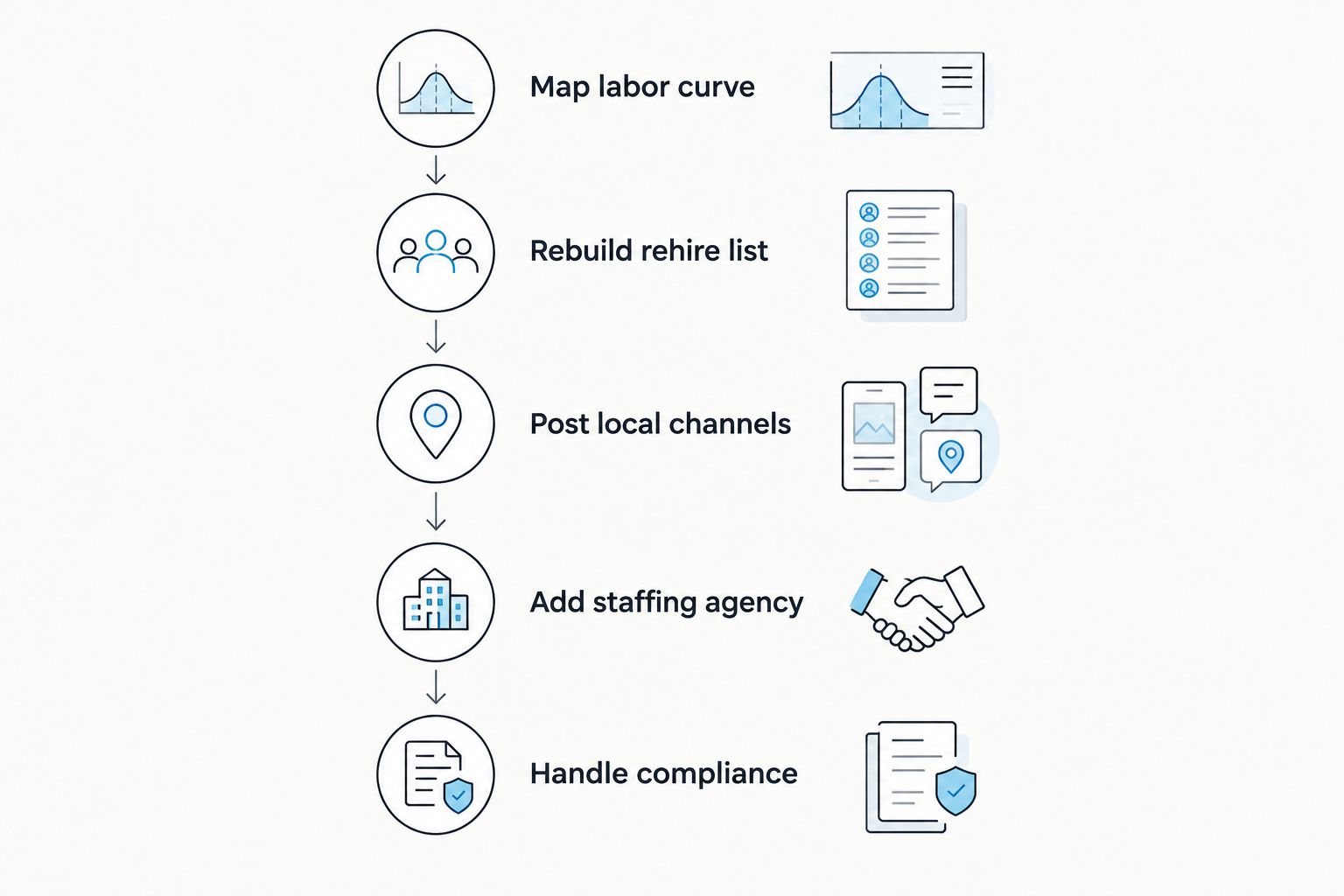
The agency step comes after free channels are exhausted, not before them.
Handle compliance paperwork before the crew arrives
Seasonal doesn't mean informal. Federal rules apply the same way to a six-week harvest hire as to a permanent one.
Complete Form I-9 within three business days of each new hire's start date
If using the H-2A program, file paperwork 60 to 75 days before the date of need
Confirm workers' compensation coverage extends to seasonal and temp staff
Track overtime under Nevada wage rules for any week over standard hours
Keep records for every hire, even one that lasts two weeks
Plan the off-ramp before the season ends
A clean end to the season protects next year's rehire list. Workers who feel dropped without notice don't come back.
Give a firm last-day estimate at least a week before the season winds down
Offer conversion to permanent roles for standout seasonal workers
Run a short exit conversation to capture what worked and what didn't
Confirm final pay and any owed hours are processed on time
Add every worker's performance notes to next year's rehire file
Your seasonal hiring options compared
DIY posting (job boards, bulletin boards)
Best for: Small operations with slow ramp-up
Key limitation: Slow response, no screening, high no-show risk
Nevada JobConnect / workforce boards
Best for: Operations wanting no-cost sourcing
Key limitation: Limited reach for peak-week surge needs
Farm labor contractor
Best for: Large-acreage crews needing bulk labor
Key limitation: Less oversight on individual worker fit
General staffing agency (non-local)
Best for: Operations open to remote account management
Key limitation: Slower response for last-minute Reno/Carson City gaps
Local full-service agency (Sourced Staffing)
Best for: Operations needing fast, compliant surge crews with conversion options
Key limitation: Requires a working relationship built ahead of peak season
Verdict: DIY and workforce boards work for slow, predictable ramp-ups; Sourced Staffing is built for the peak-week surge and food-production overlap that most seasonal ag operations in Northern Nevada actually face.
Get your 2026 harvest crew staffed right
Line up surge and temp-to-hire crews before peak week hits.
Common mistakes seasonal agriculture operations make
Waiting until the harvest window opens to start recruiting. By then, the same workers have already taken warehouse and manufacturing offers.
Skipping the rehire list. Cold-hiring every season wastes the training investment made the year before.
Treating seasonal workers as disposable. Workers who feel discarded at season's end don't answer the call next year.
Ignoring the overlap with food processing. Many harvest operations also run packing or light processing, which pulls from the same labor pool covered in direct-hire staffing for food manufacturers - plan both hiring tracks together, not separately.
Comparing agriculture hiring to construction-style temp-to-hire without adjusting for timing. Construction crews covered in temp-to-hire staffing for construction crews run on project timelines; agriculture runs on weather and crop timelines, and a plan built for one doesn't fit the other.
FAQ
What is staffing for seasonal agriculture operations?
It's the recruiting, hiring, and payroll process used to bring on harvest, packing, and food-processing workers for a fixed season and release them cleanly when the work ends. In Northern Nevada, this usually means a short surge of hourly hires layered on top of a smaller year-round crew.
How far ahead should I start hiring for harvest season?
Start 60-90 days before your peak week, not the week the harvest opens. If you're using the H-2A program, federal rules require filing paperwork 60 to 75 days before the date of need.
Is a staffing agency worth it for a short harvest season?
Yes, if your free channels and rehire list still leave you short on peak weeks. A local agency like Sourced Staffing sources and payrolls surge crews faster than most operations can do with an internal HR team stretched thin.
Can seasonal agriculture workers convert to permanent roles?
Yes, when the operation runs a temp-to-hire arrangement. Standout seasonal workers who convert reduce next season's recruiting load because they already know the site.
What compliance paperwork applies to seasonal farm hires?
Form I-9 must be completed within three business days of the start date for every hire, seasonal or not. Workers' compensation and Nevada overtime rules also apply regardless of how short the assignment is.
How is seasonal agriculture staffing different from seasonal warehouse hiring?
Agriculture staffing runs on crop and weather timelines that can shift week to week, while warehouse hiring in Reno and Sparks typically runs on a fixed peak-season calendar tied to order volume.
Do seasonal agriculture workers need bilingual support?
Many Northern Nevada agriculture and food-production crews include bilingual workers, so hiring materials and onsite communication should account for that from the first posting.
What happens if a seasonal worker doesn't show up mid-shift?
Without a backup plan, the shift runs short-handed. Working with a staffing agency ahead of the season means a replacement can be sourced the same day instead of losing the shift entirely.
One last thing
The operations that struggle least with seasonal agriculture staffing in 2026 aren't the ones with the biggest budgets - they're the ones that treat the rehire list as a real asset and update it every single season instead of starting from zero. Build that list once, and every year after gets easier.