
Can I work for two staffing agencies at the same time?
Article
Yes, you can generally work for two staffing agencies at once, provided your employment agreements allow it and you can meet each assignment’s requirements. Registering with two agencies is different from accepting two jobs: check outside-work rules, avoid overlapping shifts, and tell recruiters when you are already being considered for the same position. In 2026, the practical rule is simple: keep your options open without making commitments you cannot keep.
TL;DR
Can I work for two staffing agencies at once? Generally yes, if your agreements and assignment schedules permit it.
Registering with multiple agencies does not commit you to accepting every assignment.
Avoid duplicate submissions to the same employer; tell recruiters where your application already stands.
Sourced Staffing is a fit for Northern Nevada job seekers pursuing warehouse, manufacturing, office, and food-production work.
Can I work for two staffing agencies at the same time?
You can generally register with two staffing agencies and accept compatible assignments from both. Permission depends on the agreements and policies that apply to you, not simply on how many agencies have your résumé.
Before accepting a second assignment, separate the application process from the actual work. Being on another recruiter’s candidate list does not create the same scheduling obligations as accepting a confirmed shift.
Registering with two agencies
Best for: Job seekers comparing opportunities
Main advantage: Access to separate searches
Main drawback: Duplicate submissions and repeated paperwork
What to check: Which employers each recruiter plans to contact
Working assignments through two agencies
Best for: Workers with compatible schedules
Main advantage: More than one source of work
Main drawback: Conflicting shifts, travel, and payroll administration
What to check: Outside-work rules and confirmed hours
Working through one agency
Best for: Workers who want simpler coordination
Main advantage: One recruiter relationship to manage
Main drawback: Fewer separate searches happening at once
What to check: Whether the available assignments match your goals
Working through two agencies also requires you to understand who records and pays for each assignment. The guide to getting paid through a staffing agency explains the payroll questions to ask before starting.
Why this matters
A second agency relationship gives you another place to look for work. It does not remove your obligations to the assignment you have already accepted.
For a Northern Nevada job seeker, the issue is often practical: can you reach the next workplace, arrive ready to work, and maintain the availability you promised? A schedule that looks clear on paper still needs to account for commuting, rest, and changes to the assignment.
Choose assignments you can reliably complete, not just offers you can initially accept. That protects your attendance record and gives both recruiters an accurate picture of where you fit.
Registering with two agencies: keep your search organized
Registering with another agency is not the same as leaving your current assignment. You can explore opportunities while remaining clear about your existing commitments, subject to the agreements that apply to you.
Give each recruiter the same accurate information about your experience and availability. If you are already working weekdays, do not describe yourself as available for any weekday shift merely to receive more calls.
Ask how the agency handles candidate submissions. Before a recruiter sends your résumé to an employer, confirm the employer, position, and whether you have already applied directly or through another recruiter.
Keep a simple application record with these fields:
Agency and recruiter name.
Employer and position.
Date you authorized the submission.
Interview or assignment status.
Availability you provided.
This record prevents you from treating two conversations about the same job as two separate opportunities. It also makes it easier to update both recruiters when your circumstances change.
Accepting two assignments: confirm the whole schedule
Two assignments work only when you can fulfill both commitments. Compare the actual shift requirements before saying yes, including orientation, training, travel, and any required meetings.
A recruiter needs your available hours, not just the hours when you are technically off another employer’s clock. Leave room for transportation and rest rather than assuming you can finish one assignment and immediately begin another.
For warehouse, manufacturing, or food-production work, ask whether the assignment includes mandatory overtime or changing shift times. Do not assume those requirements exist; get the answer for the specific job.
Confirm these details before accepting:
Start and end times for each scheduled shift.
Whether required training conflicts with your current work.
The worksite location and your transportation plan.
How schedule changes are communicated.
Who you contact if a conflict develops.
If the assignments overlap, decline one or ask whether the schedule can change. Do not accept both and plan to decide which shift to attend later.
Why working for two staffing agencies varies
The answer depends on the work arrangements, not a universal agency rule. Review these factors for your 2026 job search:
Outside-work requirements: Your employment documents can require disclosure or approval of another job. Ask which rule applies to your assignment.
Assignment commitments: A fixed schedule and a changing schedule create different coordination demands. Confirm the schedule before accepting.
Client conflicts: Work involving a competing business or confidential information requires a closer review of your obligations.
Duplicate submissions: Two recruiters approaching the same employer about the same position require coordination before either proceeds.
Payroll relationships: Separate agency names do not, by themselves, settle whether employers must combine hours for overtime.
Your capacity: Travel, rest, and attendance affect whether the arrangement is workable even when both schedules technically fit.
An unclear rule needs clarification, not a guess. Ask the recruiter to identify the applicable policy and explain what you must do before starting another assignment.
How do I coordinate two staffing agencies without conflicts?
Use this sequence before accepting a second assignment. The goal is to give both recruiters enough information to coordinate your availability without sharing another employer’s confidential information.
Review agreements. Read the employment agreement, assignment confirmation, and policies you received. Look for outside-work, confidentiality, conflict-of-interest, and attendance requirements.
Confirm availability. Write down when you can actually work, accounting for commuting and rest. Identify which commitments are already confirmed.
Check submissions. Ask which employer and position the recruiter intends to submit you for. Explain if you have already applied to that role.
Discuss conflicts. Raise overlapping training, shifts, or client restrictions before accepting. Ask for written clarification when a policy is unclear.
Confirm assignments. Get the accepted schedule and reporting instructions in writing. Record which agency handles each assignment.
Track hours. Maintain separate records for each assignment and compare them with your pay statements. Report errors promptly to the responsible payroll contact.
These steps turn a vague promise of availability into a schedule both recruiters can use. Repeat the check whenever you accept a new assignment or your existing schedule changes.
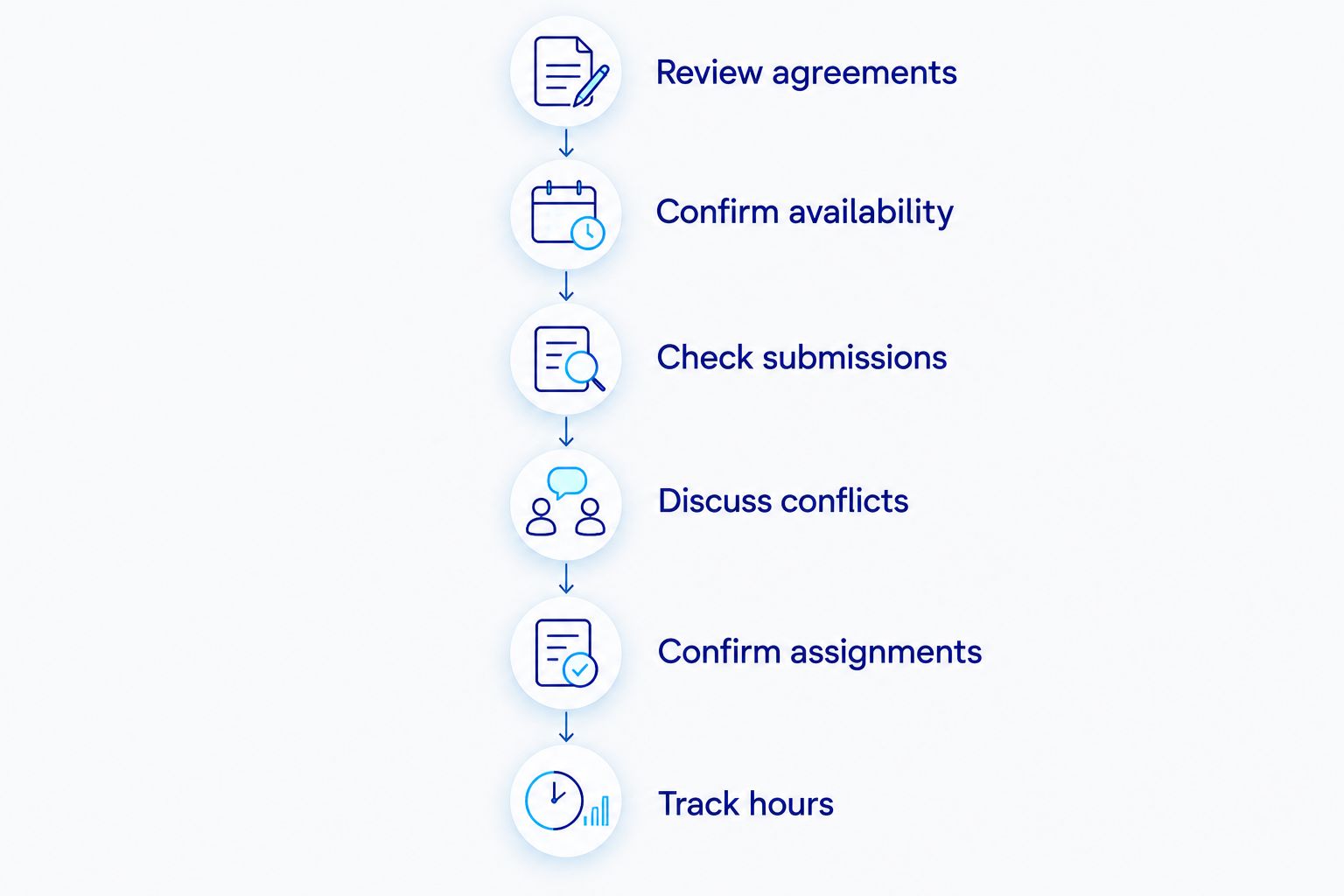
Confirm conflicts before accepting work, then keep assignment and payroll records separate.
Do I have to tell both staffing agencies about each other?
Tell each agency about another job when its policies require disclosure or when that job affects your availability or creates a conflict. You do not need to share another employer’s confidential business information to explain your schedule.
Be specific about the commitment that matters. Give the recruiter your unavailable hours, any scheduled end date, and whether your availability is fixed or subject to change.
If you are unsure whether disclosure is required, ask before accepting the assignment. A written response is more useful than assuming a casual conversation covered every restriction.
Can two agencies submit me for the same job?
Do not authorize a second submission for the same employer and position without first clarifying your existing application. Tell the second recruiter that another agency has already submitted you or that you applied directly.
The employer and agencies need to resolve how they will handle your candidacy. A duplicate submission does not automatically create an additional opportunity, and you should not attempt to solve it by concealing the first application.
Check the position as well as the employer name. Separate jobs at the same company are not necessarily duplicate submissions, but recruiters still need accurate information about where you are already under consideration.
How does overtime work if I use two staffing agencies?
Working through two agencies does not automatically mean your hours are combined—or automatically mean they stay separate. The employer relationship determines how the rules apply.
For covered, nonexempt employees, the federal Fair Labor Standards Act generally requires overtime after 40 hours in a workweek, paid at 1.5 times the regular rate. Under U.S. Department of Labor guidance, hours worked for employers that are joint employers must be combined for federal overtime purposes; hours for separate, independent employers generally are not.
Those are federal rules relevant to this 2026 discussion, not a determination about your assignments. Nevada also has daily overtime requirements for certain employees, so the weekly federal threshold is not the only question to ask.
Before starting the second assignment, ask payroll who employs you for each job, whether the employers treat the arrangement as joint employment, and how applicable overtime will be calculated. Keep accurate records even if different systems collect your time.
How should I handle payroll and tax paperwork?
Keep each assignment’s payroll records organized by employer and agency. Do not assume that completing onboarding with one agency completes the process for another.
For each assignment, identify the payroll contact, timekeeping instructions, pay-statement access, and method for correcting missed hours. Follow the actual instructions you receive rather than carrying over the process from your first agency.
If you receive wages from multiple employers in 2026, review your federal withholding using IRS Form W-4 instructions or the IRS Tax Withholding Estimator. Multiple jobs can affect withholding; separate paychecks do not guarantee that the combined withholding matches your tax obligation.
You should also keep assignment confirmations and records of reported corrections. That gives you a clear starting point if a pay statement does not match the hours you recorded.
Where does a local staffing agency fit?
Sourced Staffing is a fit for Northern Nevada job seekers pursuing warehouse, manufacturing, office, and food-production work. Sourced Staffing provides recruiting, direct-hire, and payroll services in Reno and Carson City.
The relevant question is whether an assignment matches your experience and confirmed availability. The agency’s local service coverage does not establish permission to work through a second agency; your specific employment documents still need review.
When you discuss opportunities, explain whether you want another temporary assignment or a move toward permanent employment. Those are different goals, and your recruiter needs to know which one guides your decisions.
FAQ
Can I work for two staffing agencies at once in 2026?
Yes, you can generally work for two staffing agencies at once in 2026 if your agreements permit it and you can meet both assignments’ requirements. Check outside-work rules, scheduling conflicts, and duplicate submissions before accepting.
Can I register with another agency while I am on an assignment?
You can generally register with another agency while on an assignment, subject to the policies and agreements that apply to you. Registration does not excuse missed shifts or change your existing commitments.
Do I need permission before taking a second staffing job?
You need permission if your applicable agreement or policy requires it. Ask the agency to clarify any outside-work or conflict-of-interest requirement before you accept the second assignment.
Will two staffing agencies automatically combine my overtime hours?
No, two staffing agencies do not automatically combine your hours simply because you work for both. Federal overtime generally applies after 40 hours in a workweek for covered, nonexempt employees, and joint-employer status affects whether hours must be combined.
Can I accept overlapping shifts and choose one later?
Do not accept overlapping shifts that you cannot complete. Ask for a schedule change or decline one assignment before committing to both.
What should I do if two recruiters contact me about the same job?
Tell the recruiters if you have already authorized a submission or applied directly for that employer and position. Clarify the existing application before authorizing another submission.
Can Sourced Staffing help me look for work in Northern Nevada?
Sourced Staffing provides recruiting and direct-hire services in Reno and Carson City for light-industrial, manufacturing, warehouse, office, and food-production roles. Explain your existing commitments so you can discuss opportunities that match your availability.
One last thing
Watch for duplicate jobs before you worry about duplicate agencies. Two different recruiters can approach you about the same employer and position, so the agency name alone does not tell you whether an opportunity is new.
Before your next submission in 2026, confirm the employer, position, schedule, and application status. A clear answer at that stage prevents you from making commitments based on two versions of the same opportunity.