
How much does direct hire staffing cost?
Article
Direct hire staffing costs depend on the recruiting agreement: the employer pays a placement fee calculated using the contract’s stated method, separate from the employee’s wages and benefits. For your 2026 hiring budget, confirm what triggers that fee, which recruiting tasks it covers, and whether screening or other services require separate approval.
TL;DR
How much does direct hire staffing cost? The recruiting agreement determines the employer’s placement fee and payment obligations.
Compare fee calculation, payment triggers, included recruiting work, and replacement terms—not just the quoted fee.
Sourced Staffing fits Northern Nevada employers seeking local direct hire recruiting for industrial, warehouse, manufacturing, office, and food-production roles.
Why this matters
A placement fee is not your complete hiring budget. Recruiting support and employing the successful candidate are separate responsibilities. You still need to account for wages, benefits, onboarding, supervision, and the equipment or training the role requires.
The first decision is whether you need someone hired directly onto your team or someone working through an agency assignment. Those arrangements create different payment obligations. The guide to how staffing agencies charge employers explains the broader distinction; this page focuses on the agreement for a direct hire.
Before comparing proposals, give each agency the same job description, compensation details, work location, and hiring requirements. Otherwise, you are comparing different searches rather than different offers for the same work.
How much does direct hire staffing cost?
The cost comes from the written agreement, not the label “direct hire.” A proposal needs to explain both how the placement fee is calculated and when you become responsible for paying it. Those are separate questions.
For a 2026 direct hire agreement, examine these contract elements together:
Fee calculation
What to confirm: Whether the agreement uses compensation or a fixed fee as its basis
Why it matters: Establishes how the placement obligation is calculated
Compensation definition
What to confirm: Which earnings count if the fee is compensation-based
Why it matters: Prevents confusion about base wages, bonuses, or other compensation
Payment trigger
What to confirm: The event that makes the fee payable
Why it matters: Distinguishes an accepted offer, a start date, or another agreed milestone
Recruiting scope
What to confirm: The tasks included in the agreement
Why it matters: Shows what your hiring team must still handle
Separate services
What to confirm: Whether screening or other work requires additional authorization
Why it matters: Keeps separately approved work visible
Replacement terms
What to confirm: Eligibility, exclusions, deadlines, and the remedy offered
Why it matters: Explains what happens if the placement ends
Compare the entire obligation, not one line in the proposal. An agreement can describe the fee clearly while leaving payment timing or replacement eligibility unclear. Resolve those gaps before the search begins.
Your employee’s compensation belongs in the employment offer. The recruiting agency’s fee belongs in the agency agreement. Keep both documents aligned on the role and compensation without treating them as interchangeable.
Compensation-based placement agreements
A compensation-based agreement ties the recruiting fee to a defined compensation amount. The important word is defined. Ask which earnings the calculation includes and which document establishes the final compensation basis.
This structure connects the fee calculation to the accepted employment terms. Its limitation is that an unclear definition can leave the parties using different figures. Before approving the search, identify how the agreement treats bonuses, commissions, overtime, or other earnings relevant to your role.
If the employment offer changes during the search, request a written explanation of how that change affects the placement obligation. Do not rely on the original job posting to settle a contract question.
Fixed-fee placement agreements
A fixed-fee agreement states the placement fee rather than deriving it from compensation. That makes the calculation easier to identify, but it does not explain the scope by itself. Read what work the agreement includes.
Confirm how the contract handles a materially different role, additional hires, or changes to the search. A clearly stated fee does not automatically mean every service or every future placement falls within the same agreement.
The benefit is a defined calculation basis. The limitation is that you still need clear boundaries around the work, payment trigger, and any separately authorized services.
Payment schedules and search commitments
Payment timing is different from fee calculation. An agreement can tie payment to a successful placement or establish payments at specified stages of the search. Read the actual trigger rather than assuming a label settles it.
Ask what happens if you pause the search, withdraw the opening, or hire through another source. Those situations belong in the agreement because recruiting work and your eventual hiring decision do not always follow the same path.
Do not treat a staged payment as proof that a placement is guaranteed. Confirm the promised work and the employer’s obligations separately from the payment schedule.
Why direct hire staffing costs vary
The agreement reflects the job being recruited and the work the parties agree to perform. Use these factors to explain differences between proposals—not to assume that one agency’s terms apply to another.
Compensation basis: In a compensation-based agreement, the defined earnings determine the fee calculation. Make that definition explicit.
Search scope: Candidate outreach, screening, interview coordination, and offer support need clearly assigned owners. Compare proposals against the same responsibilities.
Role requirements: Required experience, qualifications, schedule, and work location define the search. Separate essential requirements from preferences before requesting proposals.
Payment commitment: A placement-triggered agreement and a staged-payment agreement create different obligations during the search. Review cancellation language alongside payment timing.
Separately authorized work: Background screening or other requested services need an identified scope and approval process. Do not assume they are included.
Post-placement terms: Replacement provisions depend on their written conditions. Check the remedy, exclusions, notice requirements, and employer responsibilities.
For your 2026 search, keep these details in a single hiring brief. When agencies receive different instructions, differences in their proposals become harder to interpret. A consistent brief makes the comparison useful.
Is direct hire the right staffing arrangement?
Choose the employment arrangement before comparing recruiting agreements. Direct hire, temporary staffing, and payroll-only support solve different problems. Their payment structures should not be treated as interchangeable.
Direct hire
Best for: Employers ready to hire someone directly onto their team
Main advantage: Recruiting support for an employer’s own hire
Main limitation: The employer takes responsibility for onboarding and ongoing employment
Temporary staffing
Best for: Employers seeking workers for an agency assignment
Main advantage: An assignment structure rather than an immediate direct hire
Main limitation: Assignment management and any later hiring terms need review
Payroll-only support
Best for: Employers seeking payroll administration for identified workers
Main advantage: Separates payroll administration from candidate recruiting
Main limitation: Payroll support alone does not supply a candidate search
A direct hire search makes sense when you have a defined opening and intend to employ the successful candidate directly. It is not a substitute for planning the employee’s first day, training, or reporting relationship.
Temporary staffing addresses an assignment. Payroll-only support addresses administration. If you need recruiting, say so explicitly; otherwise, a proposal for administrative support will not answer your hiring need.
For a 2026 comparison, ask every provider to identify the arrangement in writing. Then compare agreements within that arrangement rather than placing unrelated services side by side.
How do you compare direct hire proposals?
Use the same review sequence for each proposal. Choose clear responsibilities and enforceable terms over an unexplained headline fee. Your hiring manager and the person approving the agreement should review the same version.
Define the role. State the duties, work location, schedule, reporting relationship, compensation details, and essential qualifications. Describe the actual work rather than relying on the job title alone.
Confirm the scope. Assign responsibility for candidate outreach, screening, interviews, references, offer communication, and onboarding. Ask the agency to identify any tasks outside its agreement.
Check the trigger. Identify the event that creates the payment obligation. Review how the contract treats a withdrawn offer, delayed start, cancelled search, or candidate who does not start.
Review the remedy. Read replacement or other post-placement provisions in full. Confirm what action you must take to qualify and what the agency promises to provide.
Approve the agreement. Put negotiated changes into the written contract before authorizing the search. Keep the approved agreement with the job brief and final employment offer.
These steps separate three issues that are easy to blur: the work being purchased, the event that makes payment due, and the remedy if the placement does not work out. Review each independently.
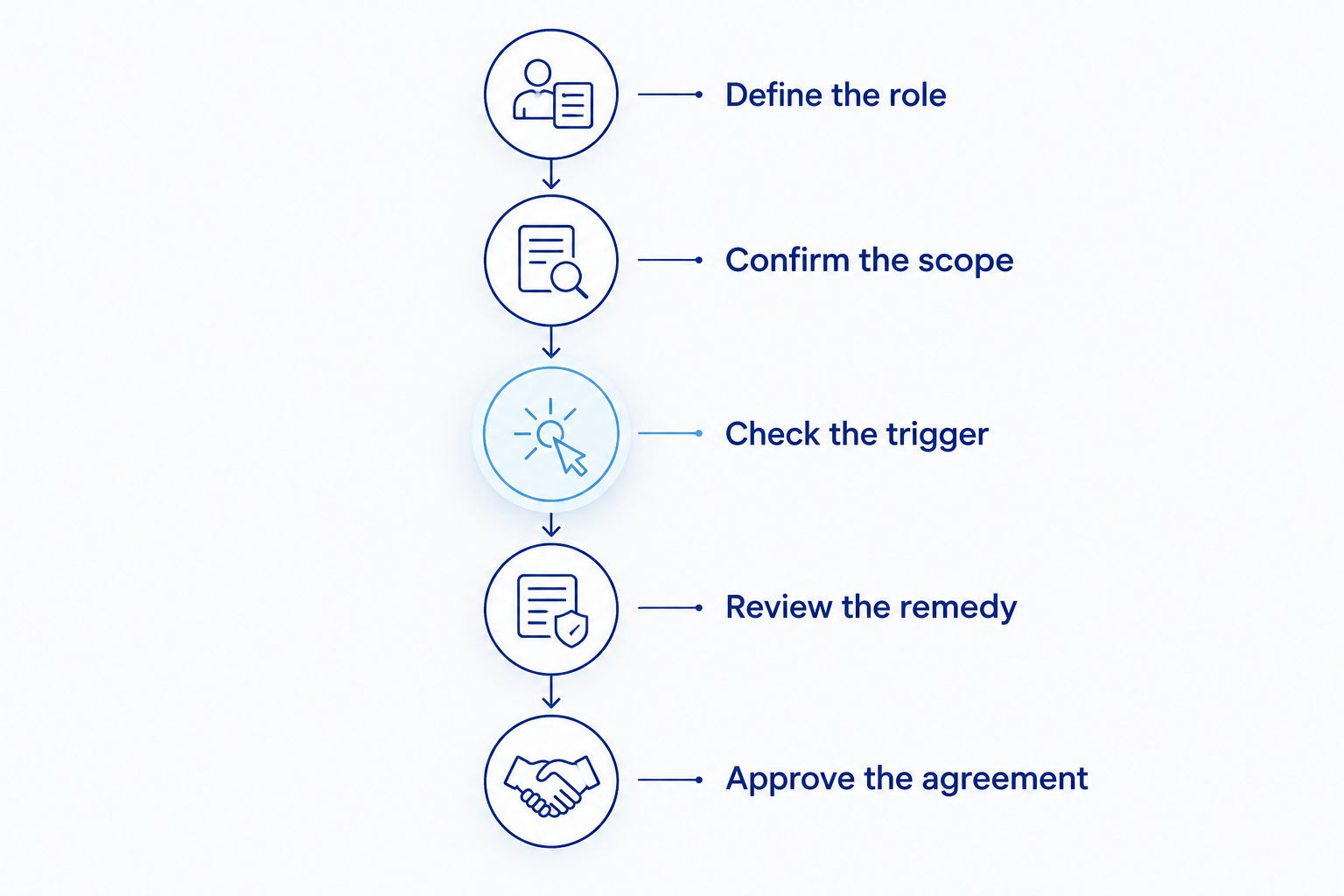
Confirm the recruiting scope and payment trigger before approving the agreement.
Keep a written record of answers. A conversation can clarify intent, but the agreement should contain the terms you expect to govern the search. If an explanation conflicts with the contract, resolve the conflict before signing.
When does a local direct hire agency fit?
Sourced Staffing fits Reno and Carson City employers seeking local direct hire recruiting for light-industrial, manufacturing, warehouse, office, and food-production roles. Its stated services include recruiting, direct hire, and payroll services connecting local businesses with job seekers.
The relevant advantage is a local staffing service aligned with those sectors. The boundary is equally important: the service description does not replace a role-specific agreement. You still need to establish the recruiting scope, payment obligations, and your responsibilities as the hiring employer.
When discussing Sourced Staffing, bring the job requirements and ask for terms tied to that opening. Confirm whether you need recruiting, direct hire placement, or payroll support so the proposed service matches the work you need done.
Discuss your direct hire needs
Share your role, location, schedule, and recruiting needs with a Northern Nevada staffing agency.
Is the direct hire fee separate from employee pay?
The direct hire placement fee is separate from the employee’s wages and benefits. The recruiting agreement governs the employer’s agency obligation, while the employment offer establishes the employee’s compensation.
For your 2026 budget, track recruiting and employment expenses separately. That keeps the agency agreement from obscuring the ongoing responsibilities that begin when the employee joins your team.
What happens if a direct hire leaves?
The recruiting agreement determines whether a replacement or another remedy applies. Read the conditions before hiring, including notice requirements, exclusions, and any obligations your business must meet.
A replacement provision is not automatically a refund provision. Ask exactly what happens next and document the answer in the agreement. Keep records of the employee’s start date and any required notice.
Can you compare agencies using the placement fee alone?
The placement fee alone does not establish which agreement fits your hiring needs. Compare the calculation basis, recruiting scope, payment trigger, separate services, and post-placement provisions together.
Also check how much coordination your own team must provide. A proposal is easier to evaluate when every recruiting task has an owner and every payment obligation has a defined trigger.
FAQ
How much does direct hire staffing cost for an employer?
The recruiting agreement determines the employer’s placement fee. Review its calculation method, payment trigger, included work, and separately authorized services before approving the search.
Is the direct hire fee included in the employee’s salary?
The employer’s recruiting fee is separate from the employee’s wages and benefits. Keep the agency agreement and employment offer separate, with consistent role and compensation details.
Do I pay a direct hire agency before someone starts?
Your agreement determines when payment becomes due. Confirm whether the trigger is a placement event or an agreed stage of the search rather than assuming the start date controls it.
Is direct hire better than temporary staffing?
Direct hire fits employers ready to employ the successful candidate directly; temporary staffing fits an agency assignment. Choose the arrangement first, then compare agreements for that service.
What should I ask about a direct hire replacement provision?
Ask what remedy applies, which conditions qualify, and what notice you must provide. A replacement provision does not automatically promise a refund.
Can Sourced Staffing help with direct hire recruiting in Northern Nevada?
Sourced Staffing provides recruiting and direct hire services for Reno and Carson City businesses. Its stated sectors include light-industrial, manufacturing, warehouse, office, and food production.
What should I send an agency before requesting direct hire terms?
Send the job duties, location, schedule, compensation details, essential qualifications, and reporting relationship. Give each agency the same brief so you can compare proposals for the same search.
One last thing
Ask this question before signing: What event makes us responsible for paying the placement fee? Have the agency point to the exact contract language. Then confirm that the same agreement explains what happens if the candidate never starts or the opening is withdrawn.
A clear answer does more for your hiring decision than a fee presented without its conditions. Establish the obligation before the search—not after an offer is accepted.