
Staffing agency Google Ads CPC benchmarks by service type 2026
Article
Staffing agency Google Ads CPC benchmarks by service type are not published as a clean public dataset, so the only benchmark that holds up in 2026 is your own account split by service line. This page gives you the framework to build that benchmark, the service-type breakdown to build it on, and the decision rules for what to do with the result.
TL;DR
No verified public staffing agency Google Ads CPC benchmarks by service type exist to quote, so this page publishes no invented figures.
Build your own benchmark: one campaign per service type, 28 days of data, cost per qualified lead as the deciding metric.
Direct hire, light-industrial temp and payroll searches carry different intent, so never blend them into one CPC average.
Judge every service line on cost per qualified lead, not CPC alone.
Short answer: what the average staffing CPC is
There is no honest single number. Google does not publish CPC by staffing service type, and the third-party averages that circulate blend job-seeker and employer searches, national and local auctions, and every service line into one figure. A local Reno or Carson City employer search for warehouse temps does not behave like a national "staffing agency" search.
The verdict: stop chasing an industry CPC average and benchmark each service line against its own cost per qualified lead. That is the number that tells you whether a campaign earns its budget.
Why this matters in 2026
Staffing agencies run two auctions at once. Employers search to buy workers. Job seekers search to find work. Both trigger similar keywords, and both bill per click.
A blended CPC hides that split. A campaign can show a low average CPC because job seekers clicked cheaply, while the employer clicks that pay your bills cost far more. The benchmark only means something when the two audiences and each service type are measured separately.
This matters most for agencies with a tight local footprint. A Northern Nevada agency serving Reno and Carson City competes in a small geographic auction, so a few competitors can move CPC more than any national trend.
The benchmark table: service type by what you can actually measure
This table lists the service types a Northern Nevada agency sells and the metrics that make each one comparable. It carries no CPC figures because none can be cited to a dated, scoped public source. Fill the last column from your own account.
Light-industrial temp staffing
Buyer intent: High, urgent, short sales cycle
Example keyword pattern: light industrial staffing reno
Metric to benchmark: Cost per qualified employer lead
Warehouse staffing
Buyer intent: High, tied to order volume
Example keyword pattern: warehouse staffing agency sparks
Metric to benchmark: Cost per qualified employer lead
Manufacturing and production line
Buyer intent: Medium to high, recurring need
Example keyword pattern: production staffing reno
Metric to benchmark: Cost per qualified employer lead
Food production staffing
Buyer intent: Medium, seasonal spikes
Example keyword pattern: food manufacturing staffing
Metric to benchmark: Cost per qualified employer lead
Office and admin staffing
Buyer intent: Medium, mixed with job seeker traffic
Example keyword pattern: office staffing agency sparks
Metric to benchmark: Cost per qualified employer lead, with job seeker clicks excluded
Direct hire placement
Buyer intent: Lower volume, longer decision
Example keyword pattern: direct hire recruiter reno
Metric to benchmark: Cost per qualified lead and cost per placement
Payroll services
Buyer intent: Specific, comparison-driven
Example keyword pattern: payroll only staffing
Metric to benchmark: Cost per qualified lead
What you can say about the spread
The data supports one structural statement, not a numeric one: CPC varies by intent, not by industry label. Urgent, bottom-of-funnel employer searches sit at one end. Broad job-seeker searches sit at the other.
Treat any source that gives you one staffing CPC figure as a blended average. It will not tell you whether your direct hire campaign or your warehouse campaign is overpaying.
Methodology and limits
The framework uses a 28-day window per campaign, the same window Google Search Console reports, so ad and organic data line up. One limitation is real: a single local account at low click volume produces noisy CPC. A campaign with few clicks in 28 days can swing sharply on one expensive click, so extend the window to 56 days before you act on a low-volume service line.
How to use these benchmarks
1. Split campaigns by service type
One campaign per row in the table. Do not mix direct hire with temp staffing in a shared budget. Direct hire has fewer clicks and a longer decision, and it gets starved by faster-converting temp keywords.
2. Exclude job seeker traffic from employer campaigns
Add negative keywords for job seeker intent: jobs, hiring near me, apply, employment, careers. Send those searches to a separate campaign aimed at candidate sign-ups, with its own budget and its own metric.
3. Measure cost per qualified lead, not CPC
CPC is an input. The output is what an employer lead costs after you remove spam, job seekers and out-of-area inquiries.
The arithmetic: CPC is spend divided by clicks. As an illustration only, $1,000 spent on 200 clicks is a $5 CPC. If 4 of those clicks become qualified employer leads, cost per qualified lead is $250. A second campaign with a higher CPC but a better lead rate wins. Those figures are an example of the math, not a benchmark.
4. Tie the ceiling to what a placement is worth
Your maximum sensible CPC comes from your own margin. Work back from the fee on a placement or the margin on a temp assignment to the lead cost you can afford. Cost context for what employers pay is covered in how much direct hire staffing costs and how much light-industrial staffing costs.
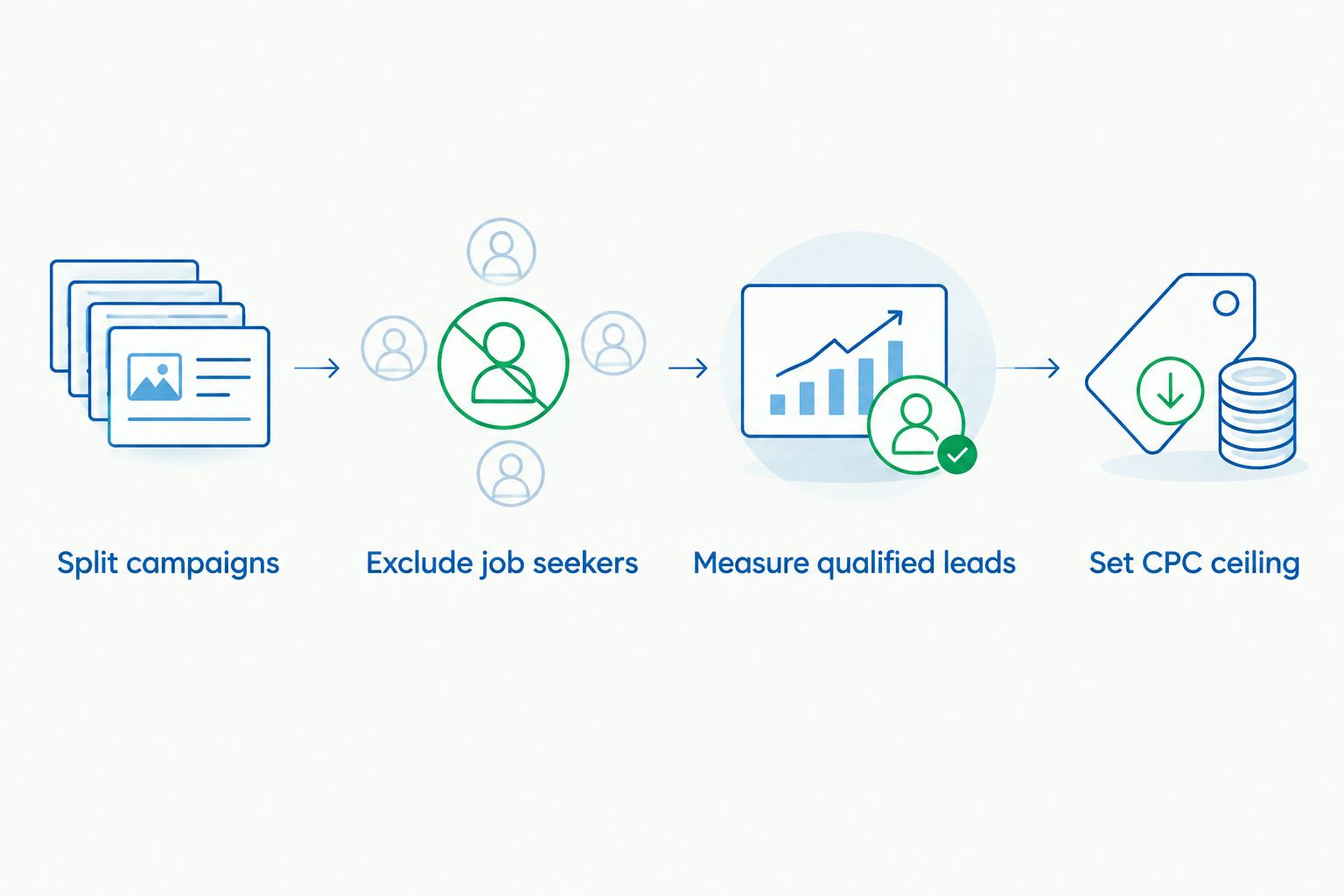
Set the CPC ceiling last, after lead quality is measured.
Service-by-service read
Light-industrial, warehouse and manufacturing
These lines carry the clearest employer intent. A business searching for warehouse or production workers usually has an open shift and a deadline. Expect the strongest lead rate here, which can justify a higher CPC than your other lines. Verify that against your own cost per qualified lead before you raise bids.
Verdict: bid for coverage here first, then tighten by location and hour.
Food production
Demand follows production cycles, so spend should too. Raise budgets ahead of known peaks and pull back after. A flat monthly budget wastes money in the slow weeks.
Verdict: run on a seasonal schedule, not a flat one.
Office and admin
This line draws the most job-seeker clicks, which inflates click volume and deflates quality. Strict negative keywords matter more here than anywhere else.
Verdict: only profitable with tight negatives.
Direct hire
Few searches, longer decision, higher value per client. Judge it on cost per placement, not cost per click. A direct hire campaign that looks expensive per click can still be your best return.
Verdict: keep it separate and judge it over a longer window.
Payroll services
Payroll-only searchers are comparing providers on a specific need. Match ad copy to that need; the mechanics are explained in how payroll-only staffing works.
Verdict: small, precise campaign; do not fold it into temp staffing.
Where paid search fits against local competitors
In a market as small as Northern Nevada, the auction is shaped by a handful of local agencies. Knowing who you bid against helps you set position goals. The field is mapped in the best staffing agencies in Northern Nevada, and it is worth reading before you raise bids on shared terms.
Need workers, not click reports?
Sourced Staffing serves Reno and Carson City employers.
FAQ
What is the average CPC for a staffing agency on Google Ads in 2026?
No verified public average exists by service type, and a single blended figure hides the gap between employer and job-seeker clicks. Benchmark your own campaigns by service line instead.
Is CPC the right metric for a staffing agency?
No. CPC is an input. Cost per qualified employer lead, and for direct hire cost per placement, decides whether a campaign pays for itself.
Should staffing agencies run one campaign or several?
Several. Separate campaigns for temp staffing, direct hire, payroll services and job-seeker sign-ups let you set budgets and bids that match each one.
How long should I wait before judging a staffing campaign?
Use 28 days as the minimum. For low-click service lines such as direct hire, extend to 56 days, since a few clicks can distort the average.
How do I keep job seekers from draining my employer budget?
Add negative keywords such as jobs, apply, hiring near me and careers to employer campaigns, then route those searches to a dedicated candidate campaign.
Which staffing service type deserves the highest bids?
Urgent employer searches for light-industrial and warehouse staffing usually show the clearest intent. Confirm with your own cost per qualified lead before raising bids.
One last thing
The cheapest CPC in your account is often your worst campaign. Low-cost clicks tend to come from job seekers and broad terms. Sort every campaign by cost per qualified lead in 2026 and cut from the bottom, not by CPC.