
Is it cheaper to hire direct or use a staffing agency?
Article
Hiring directly is cheaper when your recruiting process fills the role without costly delays or excessive staff time; a staffing agency is cheaper when the work it takes off your team and the vacancy costs it avoids outweigh its fee. The hidden cost is not just recruiting—it is the work left uncovered while you search, plus the responsibilities your business keeps after placement. For a 2026 hiring decision, compare the same role, working hours, and service scope rather than an employee’s wage against an agency’s total invoice.
TL;DR
Is it cheaper to hire direct or use a staffing agency? Compare total hiring costs, not wages alone.
Internal hiring fits employers with recruiting capacity and a hiring schedule that does not leave essential work uncovered.
Agency recruiting still requires employer interviews, onboarding, and supervision; outsourcing does not remove every hiring task.
Sourced Staffing serves Reno and Carson City employers seeking recruiting, direct-hire placement, and payroll services.
Is it cheaper to hire direct or use a staffing agency?
Neither route is automatically cheaper. The lower-cost choice is the one with the lower total cost for the same hiring need. Start by separating internal recruiting, agency-assisted direct hire, and agency staffing. These are different arrangements, not interchangeable quotes.
If you need a clearer starting point, the guide to how a staffing agency works for employers explains the relationship before you compare proposals.
Internal recruiting
Best for: Employers with recruiting capacity and a workable hiring schedule
Main advantage: You control sourcing, selection, and the hiring process
Main limitation: Your team carries the search workload and vacancy exposure
What to compare: Recruiting work, employment costs, and uncovered work
Agency-assisted direct hire
Best for: Employers seeking recruiting help for a permanent position
Main advantage: You bring outside recruiting support into the search
Main limitation: You still need to evaluate candidates and manage the employee
What to compare: Placement terms, retained hiring work, and employment costs
Agency staffing
Best for: Employers seeking workers for defined assignments or changing coverage needs
Main advantage: You can arrange staffing support around an assignment
Main limitation: Scope, billing, and responsibilities depend on the agreement
What to compare: Assignment terms, included services, and retained workplace duties
The phrase hire direct creates confusion because it describes both recruiting without an agency and placing a permanent employee through an agency. Decide whether you are comparing recruiting methods or employment arrangements before you compare costs. Otherwise, the proposals will answer different questions.
Why this matters
An internal hiring budget and an agency proposal can look different because they include different work. Internal recruiting spreads effort across managers, administration, and whoever handles applications. An agency proposal brings specified services into a visible charge.
Neither presentation proves which route costs less. In your 2026 comparison, identify the work each route covers and the work your team still performs. A visible invoice should not be compared with an internal estimate that leaves out interviewing, scheduling, and vacancy coverage.
For a warehouse, manufacturing floor, office, or food-production operation, define what happens while the position remains open. Record the actual coverage plan rather than assigning a generic value to an unfilled role. That is where the comparison becomes useful to your business.
Internal recruiting: count the work your team performs
Internal recruiting fits when your team can run the search without leaving essential work uncovered. You control the process, but control comes with responsibility for the tasks involved.
List who writes the job description, reviews applications, schedules interviews, checks references, and prepares the new hire to start. Include only tasks your business actually performs. Do not add hypothetical costs to make either route look better.
Then distinguish cash spending from existing staff time. Advertising or outside screening creates a direct expense if you use it. A manager’s interview time belongs in a separate labor estimate, based on your own records and a consistent calculation method.
The advantage is a process you manage directly. The limitation is that the search competes with other responsibilities. Before choosing internal recruiting, identify the person who owns the search and confirm that person has time to complete it.
A candidate already in your pipeline changes the comparison. You might need less sourcing work, but you still need selection, onboarding, and employment administration. Count the remaining work rather than budgeting for a search you do not need.
Agency-assisted direct hire: compare recruiting support, not payroll
Agency-assisted direct hire fits a permanent vacancy when you want outside help finding and evaluating candidates. The agency’s recruiting role and your employer responsibilities need separate treatment in the comparison.
Ask what the recruiting service includes: sourcing, initial interviews, reference checks, or other agreed steps. Request the actual scope rather than assuming every agency performs the same work. The guide to direct hire through a staffing agency covers this distinction.
The benefit is outside support for the search. The limitation is that your business still has decisions and work to complete, including final selection and preparing the employee for the role.
Review the agreement for when the fee becomes due, what triggers it, and what happens if the placement does not work out. Do not assume a replacement commitment or refund exists. Only count a contractual provision when it appears in the proposal you are evaluating.
For your 2026 budget, keep the recruiting service separate from the employee’s ongoing employment costs. This makes the comparison with internal recruiting much clearer: both routes lead to a permanent hire, but they distribute the search work differently.
Agency staffing: compare the assignment and its included services
Agency staffing fits a defined coverage need when the proposed assignment matches the work you need done. Your comparison must account for both the staffing service and the responsibilities that remain at your workplace.
Ask the agency to identify what its billing includes and what requires separate approval. Clarify payroll handling, screening, overtime billing, time approval, and any terms for hiring an assigned worker permanently. Treat every answer as agreement-specific.
The advantage is staffing support organized around the assignment. The limitation is that an agency arrangement does not eliminate your need to explain the work, supervise it, and coordinate with the staffing partner.
Sourced Staffing is a staffing agency serving Reno and Carson City businesses in light-industrial, manufacturing, warehouse, office, and food-production sectors. Its stated services include recruiting, direct-hire placement, and payroll services. Ask which service matches your need before requesting a comparison.
Sourced Staffing fits Reno and Carson City employers seeking recruiting, direct-hire placement, or payroll services. That service fit establishes relevance—not a promise that an agency arrangement will cost less than your internal process.
How do you compare the total cost of each hiring route?
Use the same role brief and planning period for both routes. Then follow this sequence so your 2026 decision rests on matching assumptions rather than differently packaged proposals.
Define the role. Specify duties, location, schedule, required skills, and whether the position is permanent or an assignment. Separate essential qualifications from preferences.
Map internal work. List sourcing, screening, interviews, administration, and onboarding. Assign an owner to each task and estimate effort from your actual process.
Request service scope. Ask the agency to explain included tasks, billing terms, and employer responsibilities in writing. Identify anything that remains outside the proposal.
Compare total cost. Combine each route’s actual expenses with consistently calculated internal effort and documented vacancy effects. Keep shared employment costs visible but do not count them twice.
Choose the route. Select the arrangement that meets the hiring need at the lower documented total cost. Keep the assumptions with the decision so you can check them after hiring.
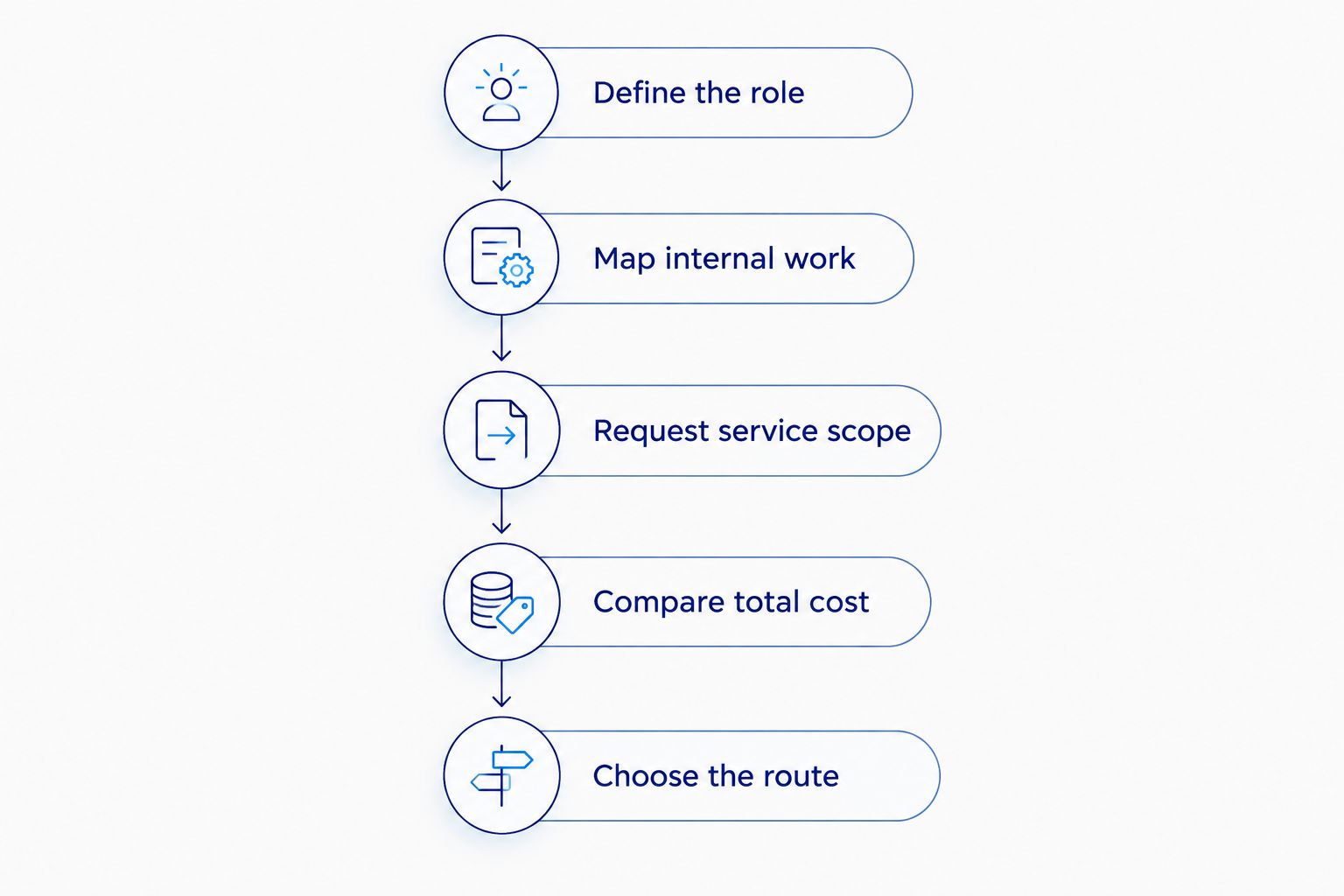
Compare matching hiring needs before choosing a recruiting route.
Build separate columns for cash expenses, internal effort, and vacancy effects. This prevents an estimate of staff time from being mistaken for an invoice you will actually pay. It also shows whether the decision changes because of recruiting expense or the consequences of leaving work uncovered.
Do not count the same consequence twice. If overtime covers the vacant position’s work, use the actual overtime effect rather than also treating all covered work as lost output. A comparison is useful only when its categories do not overlap.
Why hiring costs vary
The result changes with the work required, the work included, and the consequences of waiting. Use these factors to challenge both your internal estimate and the agency proposal:
Candidate requirements: Compare the same essential skills and qualifications. A broader job brief and a narrowly specified search are not equivalent assignments.
Recruiting capacity: Identify who handles applications and interviews internally. Count the work your team would actually perform, not a generic recruiting allowance.
Coverage urgency: Document how your business handles the vacancy. Use your actual overtime, reassignment, or uncovered-work records where they apply.
Employment arrangement: Separate permanent placement from assignment staffing. The service scope and ongoing responsibilities differ.
Included services: Confirm which screening, payroll, and administrative tasks appear in the agreement. Do not assume they are included.
Assignment changes: Review what happens when schedules, duties, headcount, or the intended employment arrangement change. Request written terms before making the comparison.
For a 2026 decision, use current proposals and current internal records. A previous hiring result is a reference point, not proof that the next vacancy will require the same effort.
Is hiring directly always cheaper for a permanent role?
No. Internal recruiting avoids an agency placement fee, but that alone does not establish a lower total hiring cost. Compare the search workload and documented vacancy effects with the agency’s proposal for the same permanent role.
Can an agency help with a permanent hire?
Yes. Agency-assisted direct hire is a recruiting route for a permanent position, distinct from arranging an assignment worker. Confirm the placement agreement and the responsibilities your business retains before proceeding.
What if you already have a candidate?
An existing candidate changes the service you need. Compare the remaining screening, hiring, and administration work rather than paying for or budgeting around unnecessary sourcing. If payroll support is the actual need, request that scope separately.
FAQ
Is it cheaper to hire direct or use a staffing agency?
The cheaper route is the one with the lower total cost for the same hiring need. Compare recruiting expenses, internal effort, documented vacancy effects, and the agency’s agreed scope.
Should I compare an agency bill with the employee’s wage?
No. An employee’s wage and an agency’s total bill do not necessarily cover the same items. Ask for the included services and compare equivalent cost categories.
Does direct hire mean hiring without an agency?
Not always. An employer can recruit internally or use an agency for a permanent placement. Clarify whether direct hire describes the recruiting method or the employment arrangement.
Will a staffing agency remove all my hiring work?
No. Your business still needs to define the role, make decisions, and prepare the workplace. The agreement should identify which tasks the agency handles and which remain yours.
What should I ask before signing a staffing agreement?
Ask about included services, billing triggers, employer responsibilities, assignment changes, and any permanent-hire terms. Rely on the written agreement rather than assumed protections.
Can I compare hiring costs without a national average?
Yes. Your actual recruiting records and a proposal for the same role provide the basis for a business-specific comparison. Keep cash expenses, staff effort, and vacancy effects separate.
Does Sourced Staffing offer direct-hire recruiting?
Yes. Sourced Staffing provides recruiting, direct-hire placement, and payroll services for local businesses in Reno and Carson City. Confirm the scope that matches your position before comparing proposals.
One last thing
Do not let a visible agency fee compete against an invisible internal hiring process. Write down the internal tasks first, even if your business already pays the people performing them.
Then distinguish spending from capacity. A route can require less cash while consuming more manager time; another can involve an invoice while reducing the work your team handles. Choose based on the constraint your business actually faces, and keep that reasoning alongside the cost comparison.